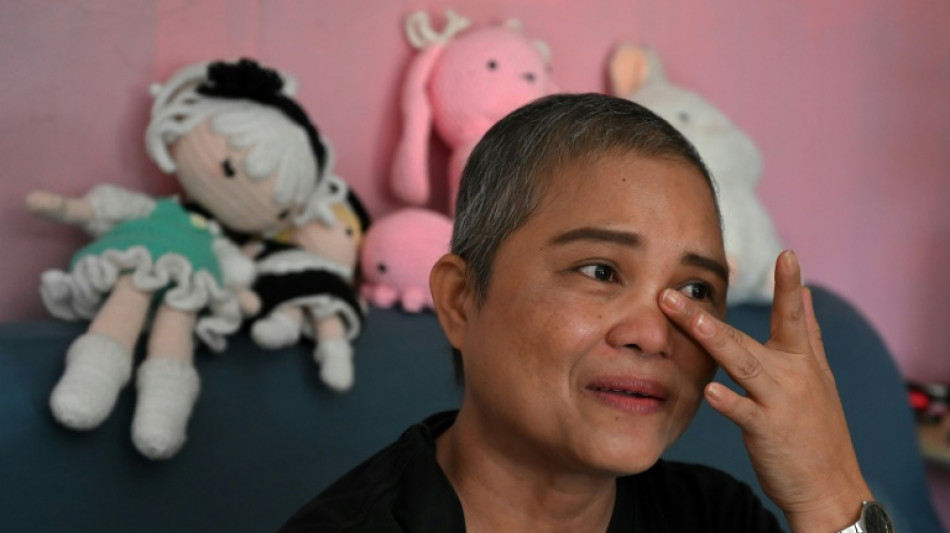
Cancer patients in the Philippines falling for alternative 'cures' / Photo: JAM STA ROSA - AFP

 South Korea score late to reach Asian Games football final

 Tom Kim defies jet-lag, Kho cards ace as Asian Games golf begins

 Thai teen rocker Nene aims to tour, write music... and return to school

 Ivory Coast clamps down on harmful illegal gold rush
 Nagoya mayor says sorry for Asian Games 'inconveniences'

 G20 trade officials meet under shadow of tariffs, overcapacity

 India's fat dog vote goes viral

 Asian Games crowds in spotlight as 998 see hosts in 50,000 stadium

 The eight stadiums for the 2027 Rugby World Cup

 Thieves swipe drugs under nose of Fiji police, swap with flour

 South Korea demands North apologise for DMZ mine blasts

 In Nepal's flood zone, teachers mourn students who never returned

 US Supreme Court lifts limits on third-country deportations

 Antonelli eager to 're-establish order' as F1 returns to Malaysia

 Paw-fect candidate: Australia finds new koala rescue dog

 One third of world population exposed to harmful air pollution: monitor

 North Korea denies South's claim it was apparently behind DMZ mine blasts

 West Bank's violent settlers part of a new generation fuelled by ideology

 US-led coalition ends mission in Iraq

 Pope-backed White Sox join Braves with MLB playoff wins

 Psychology Software Tools Builds on Early Bioz Success to Expand Access to Publication-Backed Product Evidence

 Alpha Growth Management Opens Rep Office in Japan

 NBA close to picking new $12-13bn Vegas team owners: report

 LA28 Olympics torch relay to visit all 50 states

 Spain brush aside Croatia in Nations League, England down Czechs

Filipino single mother Mary Ann Eduarte delayed chemotherapy for her breast cancer for several years and instead took food supplements falsely promoted on social media as cures for the deadly disease.
They didn't work and the cancer spread to herlungs and bones.
Eduarte is one of many Filipinos duped by medical misinformation flooding the social media platforms where they rank among the world's heaviest users.
A shortage of doctors, the difficulty of reaching a hospital in the archipelago, poor health literacy, and fear of incurring huge medical bills have led many people suffering from chronic conditions to seek alternative treatments online.
In recent years, AFP digital investigation journalists have seen an explosion in the volume of posts and paid advertisements promoting unproven treatments for diseases such as cancer.
The trend was fuelled by the Covid-19 pandemic, when healthcare systems were overwhelmed and many were too scared to visit a hospital.
Eduarte, 47, who makes a living selling beauty products online, found a lump in her right breast during a self-check in 2014.
She was advised to have a biopsy to find out if it was cancer, but she was scared and delayed having the procedure for two years.
Instead, she spent about 50,000 pesos ($900) a month on food supplements, including drinks made from tropical fruit and barley grass that she had seen advertised as cancer cures on Facebook and YouTube.
Eduarte finally agreed to have the biopsy in 2016, which confirmed the tumour was malignant.
But she refused chemotherapy, fearing it would make her sick and lose her hair, and continued taking the supplements for another three years.
"I really believed they would destroy my cancer cells because that's what I was being told by their marketing," Eduarte told AFP at her home near Manila.
"They were posting testimonials that said people were being cured."
After her cancer metastasised, Eduarte agreed to chemotherapy.
"I made the wrong decision," she admitted.
"Those food supplements actually cost me more than if I had immediately sought standard medical treatment."
- 'Our powers are limited' -
Madonna Realuyo, an oncologist at the Bicol Regional Hospital and Medical Center in the central Philippines, said online misinformation about cancer treatment was a "serious problem".
"Five out of 10 patients I see ask me about something they have seen or read on the internet -- 90 percent of the time the information is incorrect," Realuyo said.
"Telling them the correct information does not guarantee that they will listen to us or believe us."
The cost of cancer treatment, which can reach millions of pesos, made patients vulnerable to deceptive marketing of unproven products that are supposedly cheaper.
"Once you're diagnosed with cancer, the reality is that there's a lot of out-of-pocket expenses," said Aileen Antolin of the Philippine Foundation for Breast Cancer.
AFP has a global team of journalists who debunk misinformation as part of the third-party fact-checking programme of Meta, the parent company of Facebook. Fact-checkers from around 90 organisations, including media outlets, check posts on Facebook, WhatsApp and Instagram.
AFP has repeatedly debunked posts on Facebook that have falsely promoted products as natural cures for cancer, including "Doc Atoie's Finest Guyabano Wine", which was one of the products used by Eduarte.
The drink was featured in hundreds of posts that were shared on Facebook pages with tens, even hundreds, of thousands of followers.
The Philippines' Food and Drug Administration (FDA) told AFP it was not able to go after companies or individuals falsely promoting products online because it still doesn't have guidelines for implementing this section of the 2009 law that established the agency.
Instead, it issues warnings on its website and social media pages.
"Our powers are limited," FDA lawyer Pamela Sevilla told AFP.
Facebook owner Meta's ad policy prohibits any "promises or suggestions of unrealistic outcomes" for "health, weight loss or economic opportunity".
It says ads for over-the-counter medicines should comply with licences and approvals required by local laws.
These ads can be removed from the platform once flagged, while posts that do not directly violate Meta's community standards but are rated as false by third-party fact-checkers like AFP are labelled as misinformation and demoted so they are less likely to appear in newsfeeds.
But when AFP checked Meta's ad library it found ads for "Doc Atoie's Finest Guyabano Wine" and some other products debunked by AFP still there.
- Silenced by lawsuits -
The barrage of medical misinformation during the pandemic prompted Melbourne-based doctor Adam Smith, who speaks Tagalog, to make YouTube videos identifying misleading ads or posts.
"I realised a huge number of people in the population believed they could treat their medical illness with supplements and vitamins, which was crazy to me," Smith told AFP via Zoom.
But he quit after being hit with several lawsuits by the companies whose products he was exposing.
"These companies and individuals are very happy to use the Philippine justice system to silence free speech and to silence any criticism," Smith said.
After surviving cancer, Eduarte said she was now on a mission to educate others about the dangers of online misinformation.
"I'm telling you, having taken those food supplements... they really did nothing to cure my illness," she said.
J.Gomez--AT


