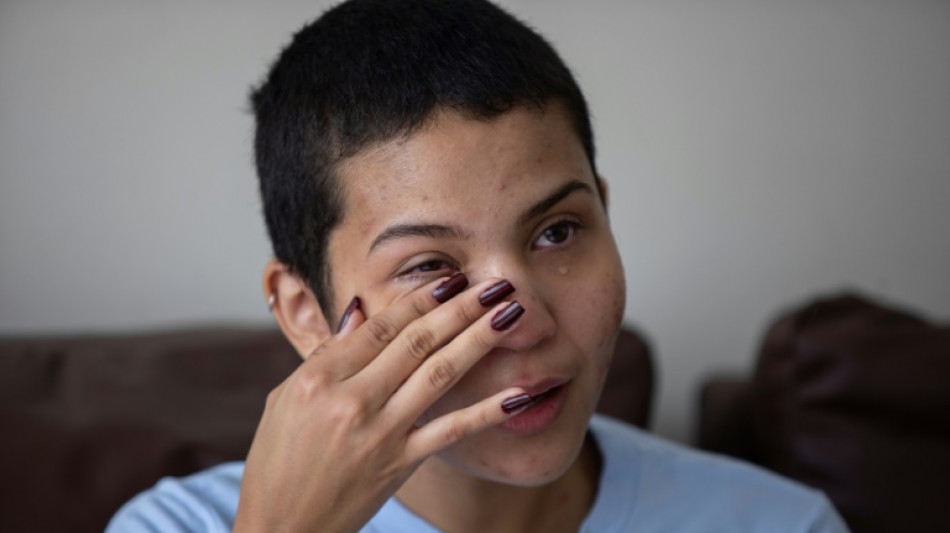
Emigrate or waste away: dilemma for Venezuela multiple sclerosis patients / Photo: Pedro Rances Mattey - AFP

 Energy costs spark inflation surges in France, Italy

 South Korea break China hearts to reach Asian Games football final
 Eala storms into Asian Games semi-finals to thrill adoring fans

 Turkey freezes ex-minister's assets as fund crisis grows

 What we know about the North Korean POW dispute

 Most equities rise after oil price plunge, US data in focus

 Polar oceans transformed as warming melts ice habitats: research

 Lost shark becomes viral star in South Korea
 Dangote to launch $16bn refinery in Kenya
 North Korean leader 'extremely obese': Seoul spy agency
 Yankees and pope-backed White Sox start MLB playoffs with wins

 Malaysia's ex-PM Mahathir in hospital for observation

 'No limits': Marathon world record holder Sawe chasing history

 Countdown begins to biggest-ever Rugby World Cup
 Bangladesh women lose ground after quota reform

 Vietnam admits 'differing opinions' on Hanoi development

 Stocks temper gains as oil pares heavy losses, US data in focus
 New Zealand denies breaching climate commitments to EU

 Albert becomes youngest US scorer in 4-2 win over Chile

 Pirate island's plunging population shows Greece's demographic decline
 With elections ahead, Latvia's Russian-speakers reject Moscow's help

 Brazil football clubs face massive sponsorship blow from betting ban
 ChatGPT maker wants to be the App Store for AI as safety concerns grow

 Women fight fires and sexism in Indonesian Borneo

 Forsling's OT blast lifts Florida over Carolina in NHL opener

For Venezuelan Jaimar Tuarez, 22, being diagnosed with multiple sclerosis felt like a death sentence in a country unable to provide the drugs she needs to keep her ever-worsening symptoms at bay.
With no means of paying for private treatment or tests, including a spinal tap that costs $800, the psychology student has launched a crowd-funding campaign on GoFundMe that she hopes will allow her to travel abroad in search of medical help.
"For many people the only option is to emigrate," Tuarez, who was diagnosed in 2022, told AFP at her apartment in Charallave, a city some 50 kilometers (31 miles) from Caracas.
"I have to get out of here..." she said through tears. "What will happen with my next relapse? Will I lose the ability to speak? I am 22 years old... what will happen to all my dreams, my plans?"
The plight of Tuarez and an estimated 2,000 other Venezuelans with MS -- a potentially disabling disease of the central nervous system -- underlines the difficulties facing people in need of chronic medication in cash-strapped Venezuela.
There is no cure, but drugs can alleviate MS symptoms.
According to the Inter-American Commission on Human Rights (IAHCR), Venezuela's IVSS social welfare institute stopped providing prescription MS medication years ago.
Venezuela is in the grips of an unprecedented economic crisis, with its once-thriving oil industry all but collapsed and GDP shrinking by 80 percent in eight years of recession until 2022.
Millions have fled in search of a better life elsewhere, many seeking a path to the United States.
- 'We are adrift -
Tuarez has weakened to the point where she can barely stand, forcing her to abandon her psychology studies and quit her job as an online editor that had helped augment the family income.
Now Tuarez and her mother, a stroke survivor, both depend on the meager income of her 72-year-old grandmother, who works at a beauty salon in the capital.
Andres Marcano, a 53-year-old translator diagnosed with MS two decades ago, told AFP his mobility has drastically deteriorated in the last five years after he stopped receiving state-funded medication.
"I find it difficult to speak. I don't walk. I am unable to stand and therefore I move around in a wheelchair," he told AFP via WhatsApp.
The situation "is serious, we are adrift," said another MS sufferer, Maria Eugenia Monagas, 57, who pays privately for treatment thanks to the income of her husband and two children, one of them abroad.
"Many are disabled, or dead, due to a lack of medicines," she said.
The government of President Nicolas Maduro blames the state's failure on US sanctions. But others point to graft allegations against officials from the health ministry and the IVSS in a country with a long history of corruption and mismanagement, according to international observers.
- No options -
Tuarez said her last relapse left her temporarily unable to speak, walk or eat independently.
She was prescribed steroids to ease the symptoms, but could not get any through the IVSS.
In the private sector, the medicines she needs cost as much as $30,000 per year.
Tuarez said she spent Christmas Eve sending out emails to aid organizations in different countries, seeking help to leave the country with her mother, who needs care and cannot be left behind.
So far, she has collected $600 out of her objective of $10,000.
Tuarez is overwhelmed at the thought of leaving behind her family, a beloved dog and two cats, but fears her life is in danger if she does not.
"I wish there were other options, to make a career and live my life (in Venezuela), but there are none," Tuarez said.
Ch.Campbell--AT