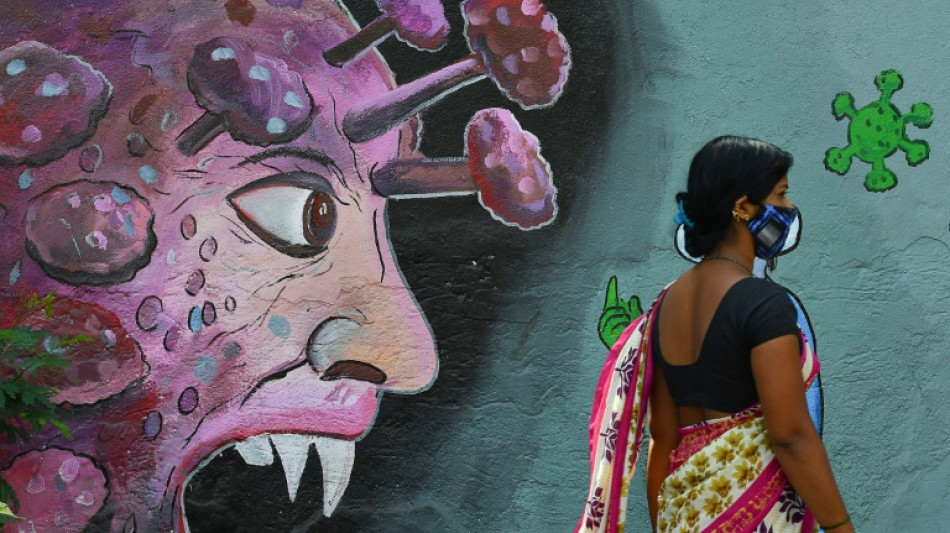
Researchers start to find clues on the trail of long Covid / Photo: INDRANIL MUKHERJEE - AFP/File

 Energy costs spark inflation surges in France, Italy

 South Korea break China hearts to reach Asian Games football final

 Eala storms into Asian Games semi-finals to thrill adoring fans

 Turkey freezes ex-minister's assets as fund crisis grows

 What we know about the North Korean POW dispute

 Most equities rise after oil price plunge, US data in focus

 Polar oceans transformed as warming melts ice habitats: research

 Lost shark becomes viral star in South Korea
 Dangote to launch $16bn refinery in Kenya

 North Korean leader 'extremely obese': Seoul spy agency
 Yankees and pope-backed White Sox start MLB playoffs with wins

 Malaysia's ex-PM Mahathir in hospital for observation

 'No limits': Marathon world record holder Sawe chasing history

 Countdown begins to biggest-ever Rugby World Cup

 Bangladesh women lose ground after quota reform

 Vietnam admits 'differing opinions' on Hanoi development

 Stocks temper gains as oil pares heavy losses, US data in focus

 New Zealand denies breaching climate commitments to EU

 Albert becomes youngest US scorer in 4-2 win over Chile

 Pirate island's plunging population shows Greece's demographic decline
 With elections ahead, Latvia's Russian-speakers reject Moscow's help

 Brazil football clubs face massive sponsorship blow from betting ban
 ChatGPT maker wants to be the App Store for AI as safety concerns grow

 Women fight fires and sexism in Indonesian Borneo

 Forsling's OT blast lifts Florida over Carolina in NHL opener

Tens of millions of people across the world are thought to suffer from long Covid, but four years after the pandemic was declared this elusive condition still cannot be tested for -- let alone treated.
However research could be finally starting to find early clues on the trail of long Covid, raising hopes of future breakthroughs that may also illuminate other stubbornly ambiguous chronic syndromes.
Long Covid is the name given to a wide variety of symptoms still being suffered by people weeks and months after they first contracted the SARS-CoV-2 virus.
The most common are fatigue, shortness of breath, muscle pain and brain fog.
One notable study released last month showed there were significant differences in the proteins of the blood of more than 110 long Covid patients.
Onur Boyman, a Swiss researcher and senior author of the Science study, told AFP he believes this is a "central puzzle piece" in what keeps Covid raging for so long in the bodies of some people.
Part of the body's immune system called the complement system, which normally fights off infection by killing infected cells, remains active in people with long Covid, continuing to attack healthy targets and causing tissue damage, the researchers said.
Boyman said that when people recovered from long Covid, their complement system also improved, suggesting a strong link between the two.
"It shows that long Covid is a disease and you can actually measure it," Boyman said, adding the team hopes this could lead to a future test.
Researchers not involved in the study cautioned that this complement system "dysregulation" could not explain all the different ways that long Covid seems to attack patients.
Still, it is "great to see papers coming out now showing signals which might start to explain long Covid", said Claire Steves, professor of ageing and health at King's College London.
- 'Every aspect of my life' -
Lucia, a US-based long Covid sufferer who preferred not to give her last name, told AFP that "studies like these bring us a lot closer to understanding" the condition.
She pointed to another recent paper which found damage and fewer mitochondria in the muscles of long Covid patients, which could indicate why many patients become exhausted after even a small amount of exercise.
For Lucia, long Covid turned climbing up the stairs to her apartment into a daily battle.
When she first caught Covid in March 2020, Lucia said she could not have imagined how the condition would "affect every aspect of my life -- including socially and financially".
Lucia, a member of the Patient-Led Research Collaborative, emphasised that people with long Covid do not only have to deal with their many health issues.
They also have "to contend with disbelief or dismissal from the medical community or from within their social circles", she said.
The importance of supporting patients was highlighted by a BMJ study this week, which found that group rehab improved the quality of life of long Covid patients.
- Why has it been so hard? -
Ziyad Al-Aly, a clinical epidemiologist at Washington University in St Louis, said long Covid has been so elusive because it is a "multi-system disease".
"Our minds are trained to think about diseases based on organ systems" such as heart or lung disease, he told AFP.
But understanding the mechanisms behind long Covid could more broadly answer "why and how acute infections cause chronic disease", he said.
This means solving the mystery of long Covid may bolster the fight against other conditions such as chronic fatigue syndrome or lingering symptoms after influenza, increasingly referred to as "long flu".
While the true number of long Covid sufferers is difficult to determine, the World Health Organization says it could be between 10-20 percent of all people who have contracted the disease.
Research from the US Centers for Disease Control and Prevention has suggested that the percentage of people who get long Covid has decreased as new coronavirus variants have become less severe.
Vaccination against Covid has been shown to significantly reduce the chance that people will get long Covid, emphasising the importance of booster shots, researchers say.
H.Thompson--AT