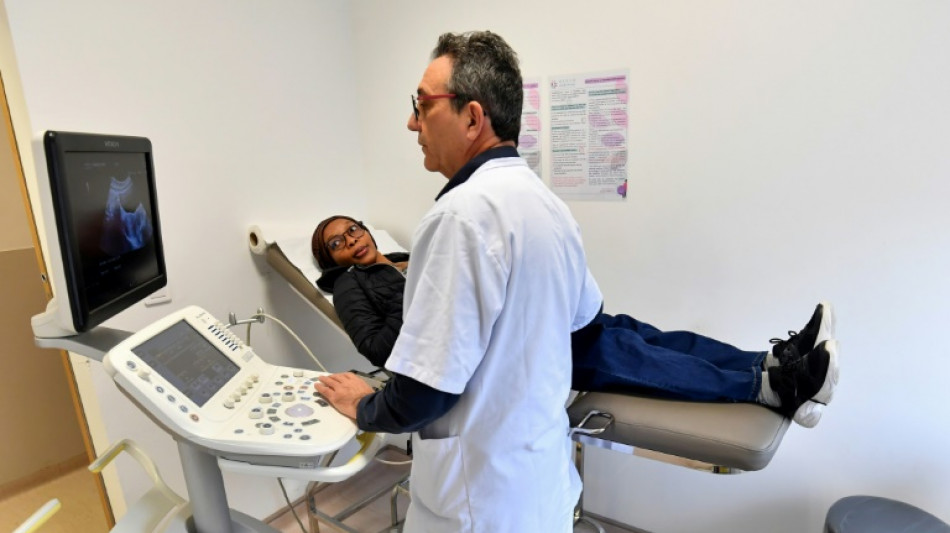
As Tunisia's economy falters, medical tourism flourishes / Photo: FETHI BELAID - AFP

 Energy costs spark inflation surges in France, Italy

 South Korea break China hearts to reach Asian Games football final
 Eala storms into Asian Games semi-finals to thrill adoring fans

 Turkey freezes ex-minister's assets as fund crisis grows

 What we know about the North Korean POW dispute

 Most equities rise after oil price plunge, US data in focus

 Polar oceans transformed as warming melts ice habitats: research

 Lost shark becomes viral star in South Korea
 Dangote to launch $16bn refinery in Kenya
 North Korean leader 'extremely obese': Seoul spy agency

 Yankees and pope-backed White Sox start MLB playoffs with wins

 Malaysia's ex-PM Mahathir in hospital for observation

 'No limits': Marathon world record holder Sawe chasing history

 Countdown begins to biggest-ever Rugby World Cup
 Bangladesh women lose ground after quota reform
 Vietnam admits 'differing opinions' on Hanoi development
 Stocks temper gains as oil pares heavy losses, US data in focus
 New Zealand denies breaching climate commitments to EU

 Albert becomes youngest US scorer in 4-2 win over Chile
 Pirate island's plunging population shows Greece's demographic decline
 With elections ahead, Latvia's Russian-speakers reject Moscow's help
 Brazil football clubs face massive sponsorship blow from betting ban
 ChatGPT maker wants to be the App Store for AI as safety concerns grow
 Women fight fires and sexism in Indonesian Borneo

 Forsling's OT blast lifts Florida over Carolina in NHL opener

At a fertility clinic in Tunis, Bintou Yunoussa hopes doctors can finally help her conceive -- one of more than two million foreigners who travel to Tunisia annually for medical procedures.
While Tunisians face economic hardships and their government is mired in debt, medical tourism has thrived and authorities are looking to expand the profitable sector even further.
Yunoussa, from Niger, said a relative had recommended the private clinic in the Tunisian capital after three years of unsuccessful treatments.
"My sister-in-law had twins after an insemination carried out in Tunisia," the 25-year-old told AFP. "That's why I chose to come here."
She was accompanied by her sister Khadija, 32, who had her eggs frozen five months ago in the same clinic, which specialises in medically assisted reproduction.
Nadia Fenina, a health ministry official, said Tunisia's highly specialised private clinics and skilled staff make it a leading medical tourism destination.
"Tunisia is number one in Africa in terms of healthcare demand and supply," Fenina told AFP.
Medical tourism has bounced back from a coronavirus-era halt, and the sector generates around 3.5 billion dinars ($1.1 billion) in annual revenues -- about half of Tunisia's overall tourism income last year.
"Medical tourism is linked to the general tourism sector, because a foreign patient is also a tourist who generally does not come alone," said Fenina.
"The promotion of medical tourism depends on the development of the tourism sector" as a whole, she added.
Accounting for nine percent of Tunisia's gross domestic product, tourism is crucial for the debt-stricken country where the economy has slowed down, with a World Bank estimate putting growth for 2023 at a modest 1.2 percent.
Last year, the small Mediterranean country of 12 million people drew nearly nine million tourists, according to official figures.
They included more than 500,000 foreign patients hospitalised in Tunisia and about two million others who had received same-day care, officials say.
- Chance to relax -
The Tunis clinic where Yunoussa was treated received 450 patients for in vitro fertilisation last year, many of whom from sub-Saharan African countries where some treatments may be unavailable or hard to access, said Dr Fethi Zhiwa.
Others came from elsewhere in North Africa as well as Western countries like Britain, Switzerland and Canada, said the doctor, citing affordable rates and Tunisia's "world-renowned fertility specialists" as the main drawing points.
Many European medical tourists come for cosmetic surgery, representing 15 percent of all treatments for foreigners in Tunisia, Fenina said.
Mohamed, a 59-year-old Libyan who gave his first name only, visits Tunisia twice a year to see his cardiologist for regular check-ups following an operation.
"This doctor saved my life, I will never change him," he said.
Travelling with his wife, the couple planned to use the latest trip to also "spend a few days relaxing in Tabarka", a town on Tunisia's northwestern coast, Mohamed said.
Tourism has "strong potential" in Tunisia and can grow "if we overcome some obstacles and limitations", said Fenina.
Direct flights to more African destinations and simpler visa procedures could help, she said, "which is why we are working to implement a medical visa".
The health ministry is also working on better coordination between medical tourism agencies, healthcare providers and other stakeholders, and collaborating with the private sector to set up facilities geared towards an elderly European clientele.
While the country has seen an alarming rise in anti-migrant sentiment, marked by violence and fiery remarks last year by the president painting "hordes" of Africans as a threat, Yunoussa said she felt welcome in Tunisia.
"I feel at home here," she said.
N.Walker--AT