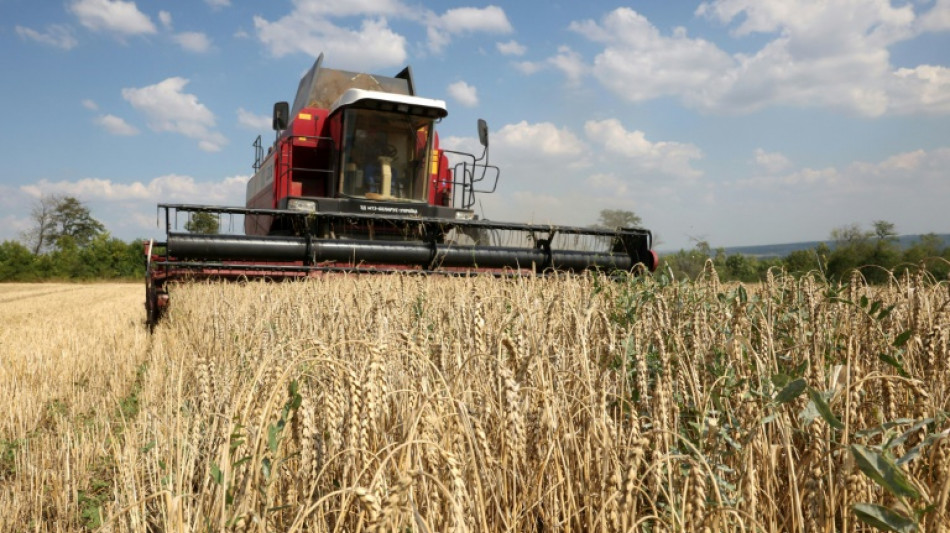
Fixing food could produce trillions in annual benefits: report / Photo: Anatolii Stepanov - AFP/File

 Energy costs spark inflation surges in France, Italy

 South Korea break China hearts to reach Asian Games football final

 Eala storms into Asian Games semi-finals to thrill adoring fans

 Turkey freezes ex-minister's assets as fund crisis grows

 What we know about the North Korean POW dispute

 Most equities rise after oil price plunge, US data in focus

 Polar oceans transformed as warming melts ice habitats: research

 Lost shark becomes viral star in South Korea
 Dangote to launch $16bn refinery in Kenya

 North Korean leader 'extremely obese': Seoul spy agency

 Yankees and pope-backed White Sox start MLB playoffs with wins

 Malaysia's ex-PM Mahathir in hospital for observation

 'No limits': Marathon world record holder Sawe chasing history

 Countdown begins to biggest-ever Rugby World Cup

 Bangladesh women lose ground after quota reform

 Vietnam admits 'differing opinions' on Hanoi development

 Stocks temper gains as oil pares heavy losses, US data in focus

 New Zealand denies breaching climate commitments to EU

 Albert becomes youngest US scorer in 4-2 win over Chile

 Pirate island's plunging population shows Greece's demographic decline
 With elections ahead, Latvia's Russian-speakers reject Moscow's help

 Brazil football clubs face massive sponsorship blow from betting ban

 ChatGPT maker wants to be the App Store for AI as safety concerns grow

 Women fight fires and sexism in Indonesian Borneo

 Forsling's OT blast lifts Florida over Carolina in NHL opener

The ways food is produced and consumed across the world is racking up hidden costs in health impacts and environmental damage amounting to some 12 percent of world GDP a year, according to a new report Monday.
In the research, a consortium of scientists and economists found that transforming food systems across the world could prevent 174 million premature deaths, help the world meet its climate goals, and provide economic benefits of $5 trillion to $10 trillion.
While intensive food production has helped to feed a global population that has doubled since the 1970s, the report found that this has come with a growing burden on people and the planet.
Poor diets lead to obesity or undernutrition and associated chronic illness, while polluting farming practices drive global warming and biodiversity loss, threatening potentially catastrophic climate impacts that would whiplash back on the world's ability to produce food.
"We have an amazing food system," said Vera Songwe, an economist with the Africa Growth Initiative at the Brookings Institution, and part of the Food System Economics Commission (FSEC), which produced the report.
"But it has done that with a lot of cost to the environment, to people's health, and to the future and to our economics," she said.
Researchers estimated total underappreciated costs from food systems of up to $15 trillion a year. That includes around $11 trillion each year from the loss in productivity caused by food-linked illnesses like diabetes, hypertension and cancer.
Environmental costs are estimated at $3 trillion from current agricultural land use and food production methods, which scientists say account for a third of planet-heating greenhouse gas emissions.
- 'Dramatic' costs -
The authors also compared computer modelling of the consequences by 2050 of continuing current trends and of a hypothetical food system transformation.
They said that on the current pathway, food systems alone will push global warming above the Paris Deal's more ambitious threshold of 1.5 degrees Celsius since preindustrial times.
Heating could reach a catastrophic 2.7C by 2100, they said, while food production would be increasingly battered by climate change.
Obesity would also increase globally by 70 percent, they said, while around 640 million people would still be underweight.
Imagining a better system, the report's authors said more effective policies could improve diets, drastically reducing diet-related deaths due to chronic diseases, while transforming food systems into a source of carbon storage by 2040, helping the world stay within its climate goals.
But the report, which comes as farmers across parts of Europe stage protests over a variety of grievances including incomes and environmental regulations, acknowledged that change would be challenging.
The authors urged policymakers to compensate those left behind by a shift to a more sustainable system, noting that promoting healthier diets would have different priorities and focus in different parts of the world.
The authors policymakers to work to compensate those left behind by changes.
The report comes after the UN's Food and Agriculture Organization released research in November estimating that the hidden costs of food systems across the world were around $10 trillion a year, or nearly 10 percent of GDP.
Johan Rockstrom, of the Potsdam Institute for Climate Impact Research and the FSEC, said the fact that both groups had come up with a "very dramatic number", exceeding $10 trillion, was reason to have confidence in the findings.
But he warned that the future projections were "conservative" because even if the world manages to transition away from fossil fuels, the food system can push the world above 1.5C on its own.
"(That) likely means irreversible changes to major life support systems on Earth, which means that the price tag correlated to the food system would accelerate very rapidly for hidden costs that are not included in these analyses," he said.
M.Robinson--AT