Scientists discover genetic underpinnings of bisexuality / Photo: Pau BARRENA - AFP/File

 In Manchester, people say City scandal is 'shame for football'

 Stocks lacklustre as inflation data weighs on sentiment

 Israel-bound plane rerouted, pilots wounded in reported fight

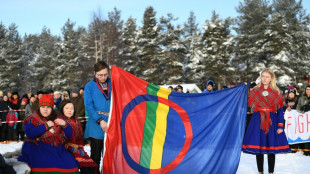 Truth commission on Sweden's Sami people seeks redress

 Energy costs spark inflation surges in France, Italy

 South Korea break China hearts to reach Asian Games football final

 Eala storms into Asian Games semi-finals to thrill adoring fans

 Turkey freezes ex-minister's assets as fund crisis grows

 What we know about the North Korean POW dispute
 Most equities rise after oil price plunge, US data in focus
 Polar oceans transformed as warming melts ice habitats: research

 Lost shark becomes viral star in South Korea
 Dangote to launch $16bn refinery in Kenya

 North Korean leader 'extremely obese': Seoul spy agency

 Yankees and pope-backed White Sox start MLB playoffs with wins

 Malaysia's ex-PM Mahathir in hospital for observation

 'No limits': Marathon world record holder Sawe chasing history

 Countdown begins to biggest-ever Rugby World Cup

 Bangladesh women lose ground after quota reform

 Vietnam admits 'differing opinions' on Hanoi development
 Stocks temper gains as oil pares heavy losses, US data in focus

 New Zealand denies breaching climate commitments to EU

 Albert becomes youngest US scorer in 4-2 win over Chile
 Pirate island's plunging population shows Greece's demographic decline
 With elections ahead, Latvia's Russian-speakers reject Moscow's help

For the first time, scientists have identified genetic variations associated with human bisexual behavior -- and found these markers are linked to risk-taking and having more offspring when they are carried by heterosexual men.
Jianzhi "George" Zhang, a professor at the University of Michigan and senior author of the new research, told AFP it helped answer the long-standing evolutionary puzzle of why natural selection has not eliminated the genetics underpinning attraction within the same sex.
The study, published Wednesday in Science Advances, was based on data from more than 450,000 people of European descent who signed up for the UK Biobank, a long-term genomics project that has proven a major boon for health research.
It builds on growing research including a seminal 2019 paper in Science that found genetic variants influenced to some extent whether a person engaged in same-sex behavior, though environmental factors were more important.
"We realized that in the past, people lumped together all homosexual behavior...but actually there's a spectrum," Zhang said, explaining part of the motivation for the new work.
By studying participants' complete sets of DNA, or genomes, and combining that information with survey responses, Zhang and his co-author Siliang Song were able to confirm the signatures associated with same-sex behavior and bisexual behavior were in fact distinct.
- 'Nature is complicated' -
This meant they could be analyzed separately -- which in turn revealed that male heterosexuals carrying the markers, which they called bisexual behavior (BSB)-associated alleles, father more children than average and thus carry those genes forward.
What's more, men who describe themselves as risk-takers tended to have more children and were more likely to carry BSB-associated alleles.
"Our results suggest that male BSB–associated alleles are likely reproductively advantageous, which may explain their past persistence and predict their future maintenance," the authors wrote.
Although the UK Biobank's survey simply asked respondents whether they considered themselves risk-takers or not, it is likely risk-taking behavior involves more unprotected sex and more partners.
"Nature is complicated," said Zhang, reflecting on the fact that a single gene can influence multiple traits -- a phenomenon known as "pleiotropy."
"Here we're talking about three traits: number of children, risk taking, and bisexual behavior: they all share some genetic underpinnings."
On the other hand, exclusive same-sex behavior (eSSB) associated alleles were correlated with having fewer children when carried by heterosexual men -- suggesting that over time these traits will fade away.
However, the UK Biobank data also revealed the proportion of people reporting both bisexual and homosexual behavior has been rising for decades, which is probably due to growing societal openness.
The authors estimated, for instance, that whether a person is bisexual or not in their behavior is 40 percent influenced by genetics, and 60 percent by the environment.
"We want to make it clear that our results predominantly contribute to the diversity, richness, and better understanding of human sexuality," they stressed. "They are not, in any way, intended to suggest or endorse discrimination on the basis of sexual behavior."
O.Gutierrez--AT