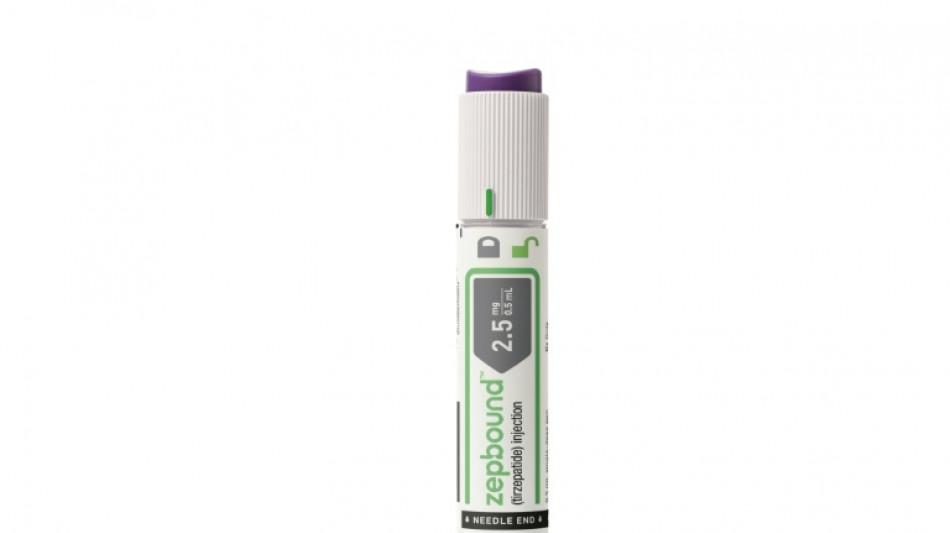
Patients regain much weight after stopping new obesity drug: study / Photo: Handout - Eli Lilly/AFP/File

 In Manchester, people say City scandal is 'shame for football'

 Stocks lacklustre as inflation data weighs on sentiment

 Israel-bound plane rerouted, pilots wounded in reported fight

 Truth commission on Sweden's Sami people seeks redress

 Energy costs spark inflation surges in France, Italy

 South Korea break China hearts to reach Asian Games football final

 Eala storms into Asian Games semi-finals to thrill adoring fans

 Turkey freezes ex-minister's assets as fund crisis grows

 What we know about the North Korean POW dispute

 Most equities rise after oil price plunge, US data in focus

 Polar oceans transformed as warming melts ice habitats: research

 Lost shark becomes viral star in South Korea

 Dangote to launch $16bn refinery in Kenya

 North Korean leader 'extremely obese': Seoul spy agency

 Yankees and pope-backed White Sox start MLB playoffs with wins

 Malaysia's ex-PM Mahathir in hospital for observation

 'No limits': Marathon world record holder Sawe chasing history

 Countdown begins to biggest-ever Rugby World Cup

 Bangladesh women lose ground after quota reform

 Vietnam admits 'differing opinions' on Hanoi development

 Stocks temper gains as oil pares heavy losses, US data in focus

 New Zealand denies breaching climate commitments to EU

 Albert becomes youngest US scorer in 4-2 win over Chile

 Pirate island's plunging population shows Greece's demographic decline

 With elections ahead, Latvia's Russian-speakers reject Moscow's help

A new generation of obesity drugs often delivers dramatic weight loss, but many patients wonder what happens when they stop treatment.
One study published Monday in the Journal of the American Medical Association provides an answer: much of the weight comes back, signaling patients may be locked into long term dependence on the drugs.
The research was based on weekly injections of tirzepatide, the compound in Eli Lilly's new weight loss drug Zepbound that was approved by the United States last month.
After 36 weeks, 670 adults achieved a notable mean weight loss of 20.9 percent.
The group was then split into two, with half continuing on Zepbound, and the other half given a placebo.
At 88 weeks, those on the placebo regained almost half of the weight they had lost, ending up 9.9 percent lower than their baseline.
Those on Zepbound continued to lose weight, ending 25.3 percent lower than where they had started.
The trial patients were mostly women and had a mean age of 48, with a mean weight at the outset was 107.3 kilograms (236.6 pounds).
All participants were encouraged to consume 500 calories less each day than they burnt and take at least 150 minutes of exercise per week.
Common side effects were gastrointestinal issues including nausea, diarrhea, constipation and vomiting, said the study.
- Growing evidence -
Study authors, led by Louis Aronne at Weill Cornell Medicine, New York, said the results "emphasize the need to continue pharmacotherapy to prevent weight regain and ensure the maintenance of weight reduction."
They added the latest research adds to four previous trials that showed "medications, including potent antiobesity medications such as semaglutide, have demonstrated that weight is substantially regained" after stopping treatment.
Semaglutide is the active ingredient in Novo Nordisk's Ozempic and Wegovy, which, like Zepbound, are examples of so-called "GLP-1 agonists" that work by mimicking the function of a hormone that secretes insulin, slows down the emptying of the stomach, and suppresses appetite.
Zepbound also contains another molecule that acts like the gut hormone GIP.
In response to the study, Lilly's Jeff Emmick said in a statement that "patients, providers and the public do not always understand obesity is a chronic disease that often requires ongoing treatment, which can mean that treatment is stopped once weight goals are met."
GLP-1 agonists have been found to cut the risk of cardiovascular disease associated with obesity -- but they also heighten the risk of gastrointestinal problems, studies show.
Though the rates of serious issues such as stomach paralysis are low, some experts fear that using the drugs for years or decades could change the benefit-to-risk calculus.
Cost can also be a disincentive. Zepbound costs $1,059.87 per month, and insurance companies often do not cover weight loss medications. Medicare, state subsidized insurance for the elderly, is barred from covering it.
L.Adams--AT