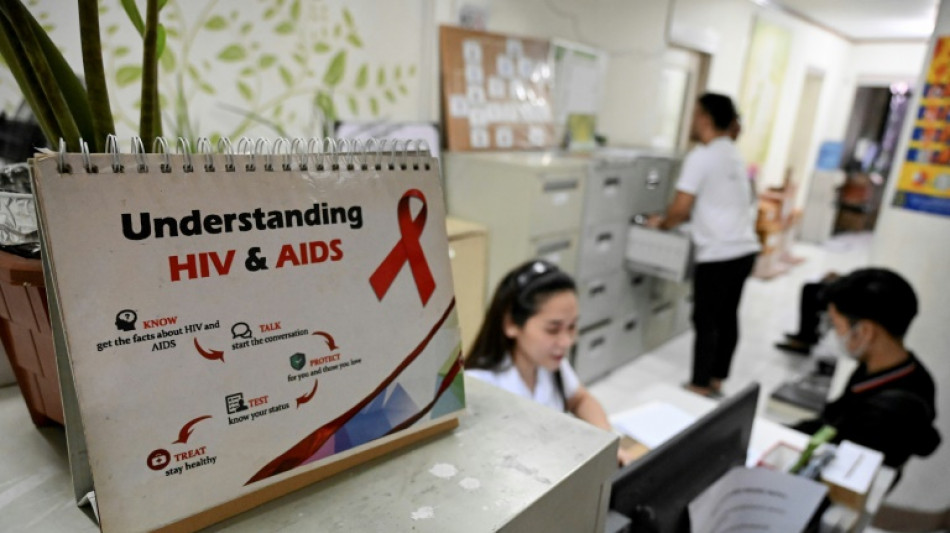
Poor education, stigma fuel Philippines' soaring HIV infections / Photo: JAM STA ROSA - AFP

 In Manchester, people say City scandal is 'shame for football'
 Stocks lacklustre as inflation data weighs on sentiment
 Israel-bound plane rerouted, pilots wounded in reported fight

 Truth commission on Sweden's Sami people seeks redress

 Energy costs spark inflation surges in France, Italy

 South Korea break China hearts to reach Asian Games football final

 Eala storms into Asian Games semi-finals to thrill adoring fans

 Turkey freezes ex-minister's assets as fund crisis grows

 What we know about the North Korean POW dispute

 Most equities rise after oil price plunge, US data in focus

 Polar oceans transformed as warming melts ice habitats: research

 Lost shark becomes viral star in South Korea
 Dangote to launch $16bn refinery in Kenya
 North Korean leader 'extremely obese': Seoul spy agency

 Yankees and pope-backed White Sox start MLB playoffs with wins

 Malaysia's ex-PM Mahathir in hospital for observation
 'No limits': Marathon world record holder Sawe chasing history

 Countdown begins to biggest-ever Rugby World Cup

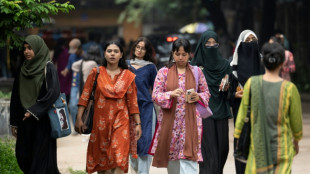 Bangladesh women lose ground after quota reform
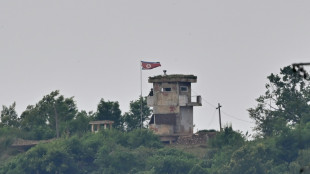
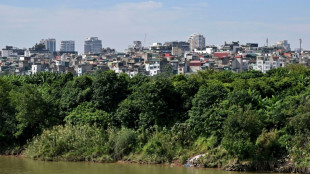 Vietnam admits 'differing opinions' on Hanoi development
 Stocks temper gains as oil pares heavy losses, US data in focus
 New Zealand denies breaching climate commitments to EU

 Albert becomes youngest US scorer in 4-2 win over Chile

 Pirate island's plunging population shows Greece's demographic decline
 With elections ahead, Latvia's Russian-speakers reject Moscow's help
HIV infections are soaring in the Philippines, with experts blaming online dating, poor sex education and conservative attitudes in the deeply religious country for fuelling the spread of the virus.
While less than one percent of the country's more than 110 million people have been diagnosed with HIV, UN data show it has one of the world's fastest-growing epidemics.
Philippine health officials warn the number of people testing positive for HIV every year is accelerating and the caseload could more than double to over 400,000 by 2030.
The vast majority of new infections are among men having sex with men and transgender women.
A growing number are teenagers.
"It's alarming because it shows that we're not yet controlling the epidemic," said Van Phillip Baton, an adviser for the Joint United Nations Programme on HIV/AIDS (UNAIDS) in the Philippines.
Baton warned the virus could spread to the general population if action wasn't taken.
Experts said social media and online dating sites had fanned infections over the past decade by making it easier for people to find sexual partners.
But increased sexual activity, particularly since Covid-19 restrictions were lifted, has not been matched by a greater use of condoms or pre-exposure prophylaxis drugs to prevent infection, said Baton.
Ignorance was a major factor.
A sexual health study by the University of the Philippines' Population Institute in 2021 showed more than a third of young Filipinos aged 15 to 24 did not believe using condoms could reduce the risk of acquiring HIV.
And the proportion of young Filipinos who had heard of HIV and AIDS had fallen to 76 percent -- the lowest level since 1994.
"This means more information needs to be disseminated to correct the perspectives of young people on HIV/AIDS," said Vicente Jurlano, a professor at the Population Institute.
A family planning law that took effect in 2013 after years of opposition from the Catholic Church required government health centres to hand out free condoms and mandated that sex education be taught in schools.
But people aged under 18 need parental permission to receive condoms.
And the education department only began rolling out "comprehensive sexuality education" in 2018 after legal delays, with the main focus on preventing teenage pregnancy.
Rosalie Masilang of the department's curriculum bureau told AFP that HIV was part of sex education and students were informed about condoms, but they were not shown how to use them.
Many schools, however, do not allow the discussion of condoms or sex, said HIV & AIDS Support House co-founder Desi Andrew Ching, whose non-profit organisation teaches sex education in schools.
"Our culture demonises sex," Ching said.
- 'Stigma and discrimination' -
HIV-positive youth often faced discrimination from family and friends, driving some to depression and even suicide, said Krang, who volunteers at an HIV testing and treatment facility in the central city of Iloilo.
Krang, who asked AFP to use his nickname, said he knew very little about HIV before testing positive for the virus in 2018.
The 23-year-old initially kept his result secret for fear of being ostracised.
"The majority of the youth living with HIV are discriminated against by their peers if they tell them," Krang said, with their status posted on Facebook or shared with their teacher.
Even people trying to practise safe sex faced barriers.
In online discussion forums, young Filipinos complain that they had been put off buying condoms at some pharmacies and small stores after being asked for identification cards or ridiculed.
- More testing centres needed -
UNAIDS has set a goal of ending AIDS as a global health threat by 2030, which includes reducing the number of new HIV cases by 90 percent compared to 2010.
While new infections globally fell 38 percent from 2010 to 2022, the Philippines saw a 418 percent increase -- the fastest-growing HIV epidemic in the Asia-Pacific region and the fourth fastest in the world, UNAIDS data show.
With only 63 percent of HIV-positive Filipinos aware of their status and 41 percent on medication -- far below the UNAIDS target of 95 percent -- more testing and treatment centres were needed, particularly outside cities.
HIV can lead to AIDS if untreated. AIDS-related deaths increased 538 percent in the Philippines between 2010 and 2022, compared with a 51 percent drop in the world, UNAIDS data show.
"The only people who die of AIDS these days are those who were diagnosed late," said John Ruiz, medical director of Klinika Bernardo, which offers free HIV services in Manila.
"I really think the entire population should be open to HIV -- for people not to stigmatise the disease, and for those who are infected not to be ashamed."
F.Ramirez--AT