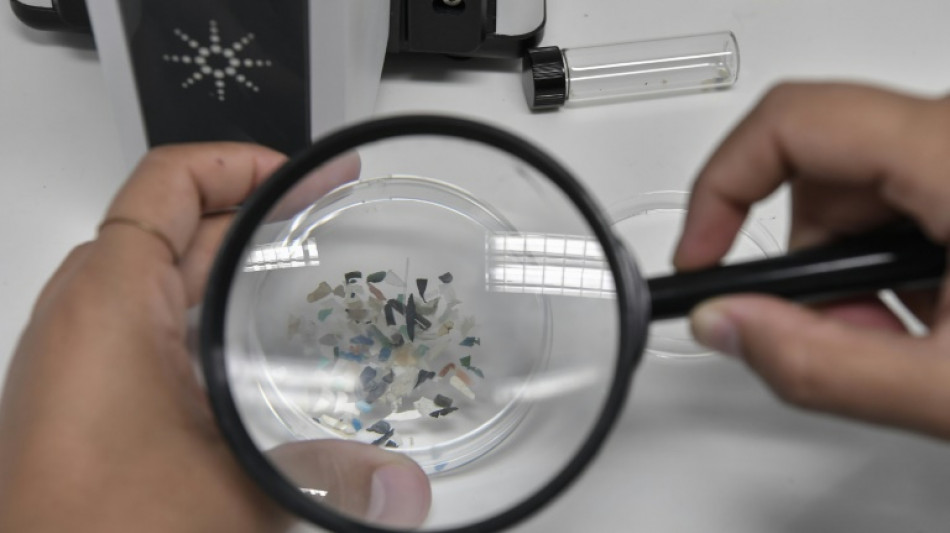
Scientists find microplastics in blood for first time

 Stocks move lower despite oil prices dropping

 AI driving up innovation investment: UN

 UN Security Council extends Haiti mission by 6 months

 Man Utd do not deserve medals if Man City stripped of titles: Rooney

 Vana Completes Expanded Staking as Part of the Vega Upgrade, Publishes Expanded VANA Token Economics

 Spain to cap gas price hikes, extend fuel discounts

 'We just need rain': Germany's Rhine river hits new low

 Yemen health system at 'breaking point': WHO

 Ireland undecided on second Israel match: coach

 France's Le Pen defiant after top ally hit by antisemitism claims

 Tom Cruise trades stunts for satire as toxic tycoon 'Digger'

 MEXC Unveils "WE SEE YOU" Brand Visual Refresh, Putting People Behind Every Trade in Focus

 Thai capital cleans up after deadly floods

 NATO, EU allies rally to Estonia after 'sabotage' blamed on Russia

 Families demand justice for Cameroon's 'nightmare' wave of murdered women

 Tebas says Man City should face 'most severe' sanctions if guilty of rule breaches

 Pochettino calls Man City success 'a period of deception'

 Settler attack on West Bank village injures Israeli forces, drawing rare rebuke

 Mystery over UK airbase scare after reports no explosives found

 Spanish govt races to adopt housing law under protest pressure

 Estonia slams Russian 'sabotage' after arson attack on defence company

 Slovenia sees surge in '.si' sites after Trump hypes 'super intelligence'

 'Like a dream' for An as Games organisers 'sorry' for latest mix-up

 Tokyo suffers longest streak of rainy days on record

 Indonesia charges train driver over crash that killed 16 women

Scientists have discovered microplastics in human blood for the first time, warning that the ubiquitous particles could also be making their way into organs.
The tiny pieces of mostly invisible plastic have already been found almost everywhere else on Earth, from the deepest oceans to the highest mountains as well as in the air, soil and food chain.
A Dutch study published in the Environment International journal on Thursday examined blood samples from 22 anonymous, healthy volunteers and found microplastics in nearly 80 percent of them.
Half of the blood samples showed traces of PET plastic, widely used to make drink bottles, while more than a third had polystyrene, used for disposable food containers and many other products.
"This is the first time we have actually been able to detect and quantify" such microplastics in human blood, said Dick Vethaak, an ecotoxicologist at Vrije Universiteit Amsterdam.
"This is proof that we have plastics in our body -- and we shouldn't," he told AFP, calling for further research to investigate how it could be impacting health.
"Where is it going in your body? Can it be eliminated? Excreted? Or is it retained in certain organs, accumulating maybe, or is it even able to pass the blood-brain barrier?"
The study said the microplastics could have entered the body by many routes: via air, water or food, but also in products such as particular toothpastes, lip glosses and tattoo ink.
"It is scientifically plausible that plastic particles may be transported to organs via the bloodstream," the study added.
Vethaak also said there could be other kinds of microplastics in blood his study did not pick up -- for example, it could not detect particles larger than the diameter of the needle used to take the sample.
The study was funded by the Netherlands Organisation for Health Research and Development as well as Common Seas, a UK-based group aimed at reducing plastic pollution.
Alice Horton, anthropogenic contaminants scientist at Britain's National Oceanography Centre, said the study "unequivocally" proved there was microplastics in blood.
"This study contributes to the evidence that plastic particles have not just pervaded throughout the environment, but are pervading our bodies too," she told the Science Media Centre.
Fay Couceiro, reader in biogeochemistry and environmental pollution at the University of Portsmouth, said that despite the small sample size and lack of data on the exposure level of participants, she felt the study was "robust and will stand up to scrutiny".
She also called for further research.
"After all blood links all the organs of our body and if plastic is there, it could be anywhere in us."
L.Adams--AT