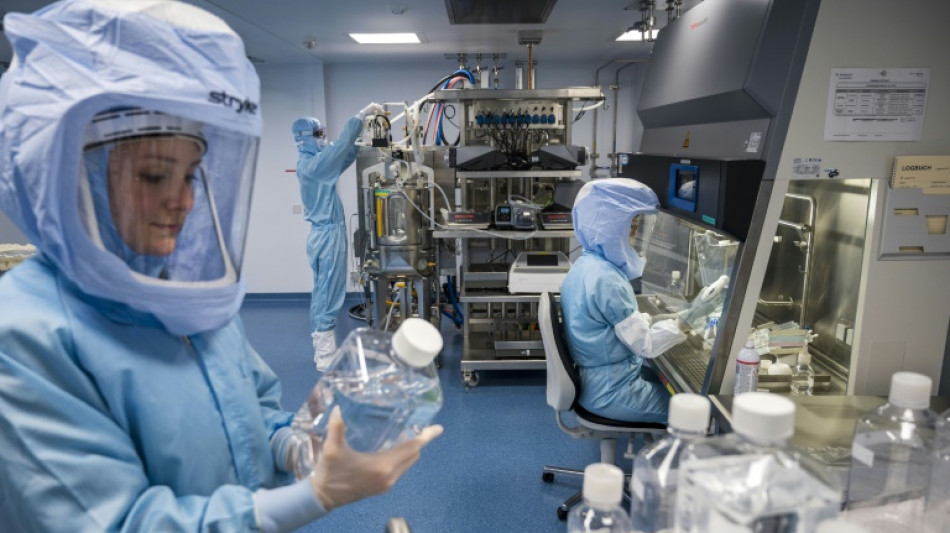
From Covid to cancer: High hopes for Nobel mRNA vaccines / Photo: Thomas Lohnes - AFP/File

 Turkey says news site closed for 'LGBTQ propaganda'

 Oil companies close in on Venezuela despite hurdles
 Turkey freezes ex-minister's assets as fund scandal grows

 Guardiola backs Man City after bombshell guilty verdicts

 G20 trade ministers open talks under strain of Trump tariffs

 France in talks with UK to end 2025 migrant accord: ministry

 Europe's surging inflation spreads gloom in stock markets

 Truth commission demands compensation for Sweden's Sami people

 Japan win marathon penalty shootout to set up South Korea gold-medal clash

 Djokovic grinds out opening-round win at China Open

 Northern Ireland police probe blockade of disputed parade

 UK PM Burnham reopens divisive debate on rejoining EU

 Man City future in doubt after guilty verdict
 'Do something,' begs Iranian woman after death sentence over protests

 China extends 52-year unbeaten record as Games organisers say sorry
 In Manchester, people say City scandal is 'shame for football'

 Stocks lacklustre as inflation data weighs on sentiment

 Israel-bound plane rerouted, pilots wounded in reported fight

 Truth commission on Sweden's Sami people seeks redress

 Energy costs spark inflation surges in France, Italy

 South Korea break China hearts to reach Asian Games football final

 Eala storms into Asian Games semi-finals to thrill adoring fans

 Turkey freezes ex-minister's assets as fund crisis grows

 What we know about the North Korean POW dispute

 Most equities rise after oil price plunge, US data in focus

The coronavirus pandemic brought global renown to the mRNA technology that underpins vaccines from Pfizer/BioNTech and Moderna, and on Monday earned a Nobel Prize for two scientists who have been key to its development.
Katalin Kariko of Hungary and Drew Weissman of the United States won the Nobel Medicine Prize for their work on "nucleoside base modifications that enabled the development of effective mRNA vaccines against COVID-19".
These types of jabs are new but researchers have been working for decades to try to figure out how to use messenger RNA (ribonucleic acid) for other vaccinations and to treat illnesses from AIDS to cancer.
- How does it work? -
Messenger RNA's job in the body is to help deliver specific instructions from DNA to cells.
In the case of the Pfizer/BioNTech and Moderna jabs, lab-generated mRNA tells human cells to create antigens -- proteins that are similar to ones found in the Covid-19 virus.
Thanks to those antigens, a person's immune system learns how to fight the virus and neutralise Covid if it enters the body.
After the cells create these proteins, the body breaks down the mRNA instructions and gets rid of them.
Such direct communication with cells is revolutionary -- classic vaccines aimed to provoke an immune response by injecting a neutralised form of a virus or antigens into the system.
- Where did this come from? -
The first big breakthrough, in the late 1970s, was in using mRNA to make test-tube cells produce proteins.
A decade later, scientists were able to get the same results in mice, but mRNA still had two major drawbacks as a medical tool.
For one thing, cells in live animals resisted synthetic mRNA, provoking a dangerous immune response.
On top of that, mRNA molecules are fragile, making them difficult to deliver to the system without altering them.
In 2005, Kariko and Weissman of Penn State University published a groundbreaking study showing that a lipid -- or fat molecule -- envelope could safely deliver mRNA without negative effects.
The research caused a buzz in the pharmaceutical community and start-ups dedicated to mRNA therapies began to pop up around the world.
- What else can mRNA do? -
Scientists have worked on developing mRNA jabs for illnesses like seasonal flu, rabies and Zika, as well as those that have remained vaccine-resistant until now, including malaria and AIDS.
Researchers have also started testing personalised treatments on cancer patients, using samples of the proteins in their tumours to create specialised mRNA.
This then triggers the immune system to target specific cancer cells.
"The mRNA platform is versatile," University of Pennsylvania biochemist Norbert Pardi told AFP. "Any protein can be encoded as mRNA so there are many potential applications."
P.A.Mendoza--AT