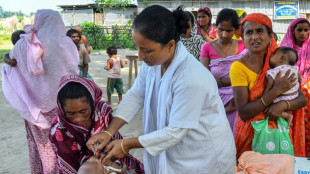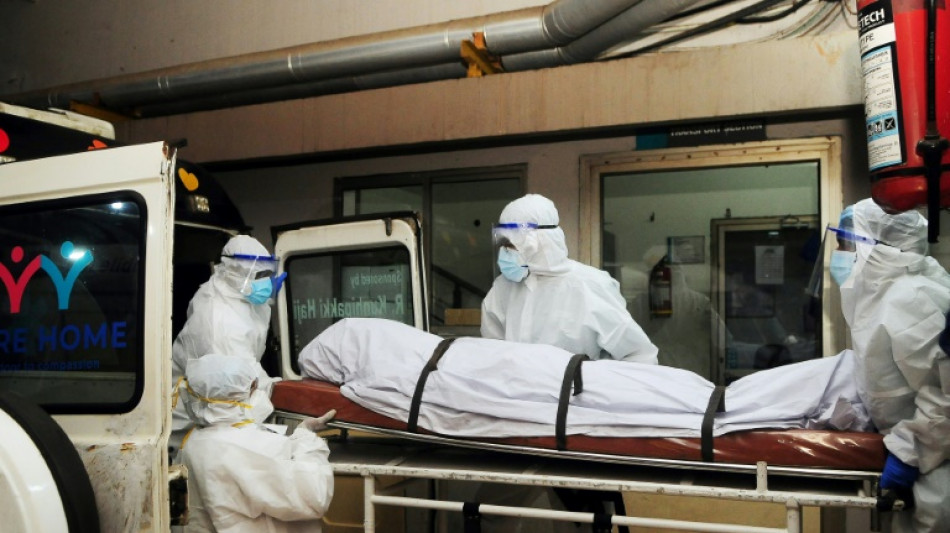
India's Nipah virus outbreak: what do we know so far? / Photo: - - AFP

 Europe's surging inflation spreads gloom in stock markets

 Truth commission demands compensation for Sweden's Sami people

 Japan win marathon penalty shootout to set up South Korea gold-medal clash

 Djokovic grinds out opening-round win at China Open

 Northern Ireland police probe blockade of disputed parade

 UK PM Burnham reopens divisive debate on rejoining EU

 Man City future in doubt after guilty verdict

 'Do something,' begs Iranian woman after death sentence over protests

 China extends 52-year unbeaten record as Games organisers say sorry

 In Manchester, people say City scandal is 'shame for football'

 Stocks lacklustre as inflation data weighs on sentiment

 Israel-bound plane rerouted, pilots wounded in reported fight

 Truth commission on Sweden's Sami people seeks redress

 Energy costs spark inflation surges in France, Italy

 South Korea break China hearts to reach Asian Games football final

 Eala storms into Asian Games semi-finals to thrill adoring fans

 Turkey freezes ex-minister's assets as fund crisis grows

 What we know about the North Korean POW dispute

 Most equities rise after oil price plunge, US data in focus

 Polar oceans transformed as warming melts ice habitats: research

 Lost shark becomes viral star in South Korea

 Dangote to launch $16bn refinery in Kenya

 North Korean leader 'extremely obese': Seoul spy agency

 Yankees and pope-backed White Sox start MLB playoffs with wins

 Malaysia's ex-PM Mahathir in hospital for observation

Authorities in India are scrambling to contain a rare outbreak of Nipah, a virus spread from animals to humans that causes deadly fever with a high mortality rate.
Here is a look at what we know so far:
- What is the Nipah virus? -
The first Nipah outbreak was recorded in 1998 after the virus spread among pig farmers in Malaysia.
The virus is named after the village where it was discovered.
Outbreaks are rare but Nipah has been listed by the World Health Organization (WHO) -- alongside Ebola, Zika and Covid-19 -- as one of several diseases deserving of priority research for their potential to cause a global epidemic.
Nipah usually spreads to humans from animals or through contaminated food, but it can also be transmitted directly between people.
Fruit bats are the natural carriers of the virus and have been identified as the most likely cause of subsequent outbreaks.
Symptoms include intense fever, vomiting and a respiratory infection, but severe cases can involve seizures and brain inflammation that results in a coma.
There is no vaccine for Nipah.
Patients have a mortality rate of between 40 and 75 percent depending on the public health response to the virus, the WHO says.
- What has happened during previous outbreaks? -
The first Nipah outbreak killed more than 100 people in Malaysia and prompted the culling of one million pigs in an effort to contain the virus.
It also spread to Singapore, with 11 cases and one death among slaughterhouse workers who came into contact with pigs imported from Malaysia.
Since then, the disease has mainly been recorded in Bangladesh and India, with both countries reporting their first outbreaks in 2001.
Bangladesh has borne the brunt in recent years, with more than 100 people dying of Nipah since 2001.
Two early outbreaks in India killed more than 50 people before they were brought under control.
The southern state of Kerala has recorded two deaths from Nipah and four other confirmed cases since last month.
Authorities there have closed some schools and instituted mass testing.
This marks Kerala's fourth recorded spate of Nipah cases in five years. The virus killed 17 people during the first instance in 2018.
The state has managed to stamp out previous outbreaks within a matter of weeks through widespread testing and strict isolation of those in contact with patients.
- Are animal-to-human viruses becoming more frequent? -
Having first appeared thousands of years ago, zoonoses -- diseases that can be transmitted from animals to humans -- have multiplied over the past 20 to 30 years.
The growth of international travel has allowed them to spread more quickly.
By occupying increasingly large areas of the planet, experts say, humans also contribute to disruption of the ecosystem and increase the likelihood of random virus mutations that are transmissible to humans.
Industrial farming increases the risk of pathogens spreading between animals while deforestation heightens contact between wildlife, domestic animals and humans.
By mixing more, species will transmit their viruses more, which will promote the emergence of new diseases potentially transmissible to humans.
Climate change will push many animals to flee their ecosystems for more livable lands, a study published by the scientific journal Nature warned in 2022.
According to estimates published in the journal Science in 2018, there are 1.7 million unknown viruses in mammals and birds, 540,000-850,000 of them with the capacity to infect humans.
P.A.Mendoza--AT