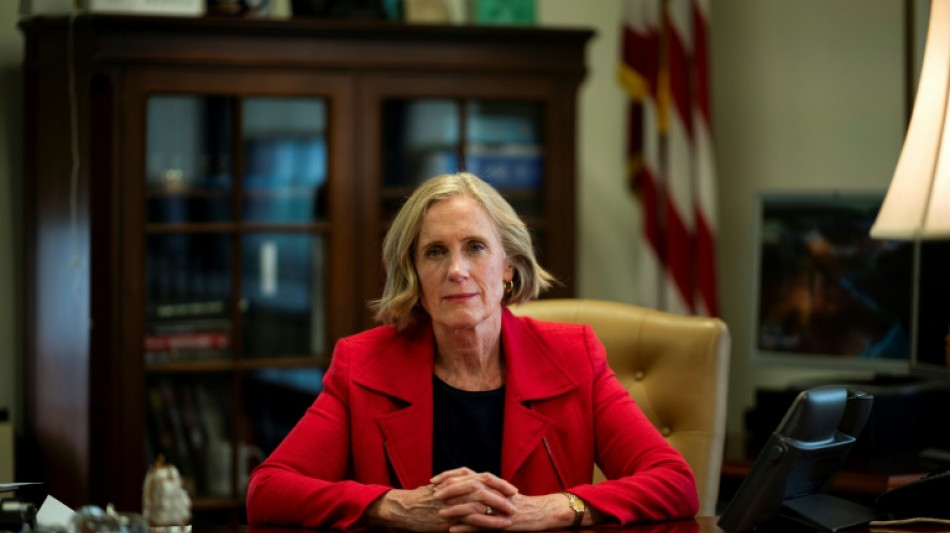
Fentanyl pill surge worries New York drug prosecutor / Photo: Johannes EISELE - AFP

 Europe's surging inflation spreads gloom in stock markets

 Truth commission demands compensation for Sweden's Sami people

 Japan win marathon penalty shootout to set up South Korea gold-medal clash

 Djokovic grinds out opening-round win at China Open

 Northern Ireland police probe blockade of disputed parade

 UK PM Burnham reopens divisive debate on rejoining EU

 Man City future in doubt after guilty verdict

 'Do something,' begs Iranian woman after death sentence over protests

 China extends 52-year unbeaten record as Games organisers say sorry
 In Manchester, people say City scandal is 'shame for football'

 Stocks lacklustre as inflation data weighs on sentiment

 Israel-bound plane rerouted, pilots wounded in reported fight

 Truth commission on Sweden's Sami people seeks redress

 Energy costs spark inflation surges in France, Italy

 South Korea break China hearts to reach Asian Games football final

 Eala storms into Asian Games semi-finals to thrill adoring fans

 Turkey freezes ex-minister's assets as fund crisis grows

 What we know about the North Korean POW dispute

 Most equities rise after oil price plunge, US data in focus

 Polar oceans transformed as warming melts ice habitats: research

 Lost shark becomes viral star in South Korea

 Dangote to launch $16bn refinery in Kenya

 North Korean leader 'extremely obese': Seoul spy agency

 Yankees and pope-backed White Sox start MLB playoffs with wins

 Malaysia's ex-PM Mahathir in hospital for observation

As America's illegal drug market continues to expand, from heroin and fentanyl to the "zombie drug" known as tranq, AFP spoke with New York's special narcotics prosecutor Bridget Brennan.
Here are her responses:
- Q: What developments are you seeing in fentanyl trafficking? -
"Fentanyl itself has had different variations called analogs. What we've seen most recently is some deadly combinations. Xylazine is now being mixed with fentanyl. And xylazine is not an opioid, it's a sedative. It's an animal tranquilizer. And it works on the body differently. And that combination of xylazine and fentanyl is proving to be not only deadly, but it is very destructive.
"Now what we're seeing is fentanyl pressed into pills, often in Mexico, and sometimes in the US. What we have seen is a real explosion in the number of pills that we've seized. Last year, here in New York City, my office alone seized almost a million fentanyl pills (up 425 percent from 2021). And it continues to expand."
- Q: How are the pills dispersed? -
"The pills are distributed through social media, through websites. They may have the markings of a Xanax prescription, oxycodone prescription, (Attention Deficit Disorder drug) Adderall -- another prescription which incidentally has been in short supply in the US.
"That's one way the criminal organizations look to expand their market. That concerns me quite a bit, because those people who might be buying through social media, through the websites may be far more naive than the people who are buying on the street. And they also may have no tolerance for fentanyl."
"They actually may think that they're buying Adderall but they're really getting fentanyl. And if they have no tolerance whatsoever, it certainly could be fatal."
- Q: What is being done to combat the threat?
"The best thing we can do is take as much supply off the market as possible. The other very important thing is to try to shut down the supply of money that's going back to Mexico, and now going back to China.
"There are many ways to attack the problem, but the most important thing is the one thing we can control somewhat in the US. And that is to decrease the demand for the drugs, decrease the number of people who want to use the drugs, and treat those people who are suffering from addictions to the drugs.
"The other thing that I would like to see is an effective prevention program. Messaging, honest messaging that explains what these drugs are, explains the consequences of using them in simple words, and not trying to terrify people but trying to educate people and especially children.
"Often, abuse of drugs starts when people are quite young. And if you can educate them as we've done with cigarettes, if we can use those same kinds of tools and educate them, then ultimately we'll see the demand diminish."
- Q: Is there anything hampering the fight? -
"The trend that worries me the most is that we seem to be unable to work effectively with Mexico to control the production and distribution of the drugs. We need a more effective strategy to work with the Mexican government.
"The other problem is the more we buy drugs the more we empower the cartels, which corrupt the government there, and really harm the lives of the Mexican people. And so it's just a circular problem.
"The other thing is how to break our cycle here. We'd like to lay all the blame on Mexico but we're the ones using the drugs. And we need to break that cycle.
"The US has decreased the number of treatment programs. You don't see many very straightforward, clear, well done prevention campaigns in the US either anymore. So we're not focusing on all the aspects of this problem."
G.P.Martin--AT