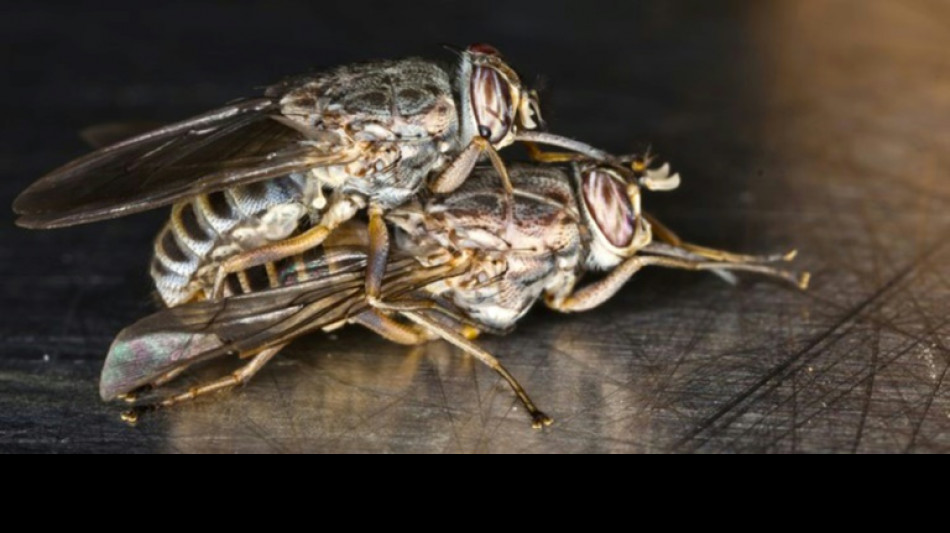
Discovery of tsetse fly mating behavior may help curb sleeping sickness / Photo: Geoffrey Attardo - EUREKALERT!/AFP

 Italy bans burqas in schools, caps numbers of foreign students per class

 Israel policies threaten 'life and existence' of Palestinians, Abbas says

 Paolini steers Italy past China in BJK

 Zidane admits emotion on eve of first game as France coach

 Breetzke and Maharaj sink Australia in first one-day international

 Zelensky broke confidentiality with North Korea POWs disclosure: South's president

 Former Liverpool star Carroll reveals he was sexually assaulted

 Dominican Republic calls for Haiti force to be strengthened

 Dolly Parton's nephew ordered to stay away from estate staff, properties

 Early exit for Philippine darling Eala at Singapore Open

 Hurricane Polo triggers huge waves in coastal Mexican city

 What happens if the US bans diesel exports

 Macklemore hits back with 'Free Palestine Tour' after Sheeran split

 Met Opera to give New Yorkers free tickets in affordability push

 Top ECB official to resign to take up IMF role

 Xi and Trump call for peace in lavish White House state visit

 Five up-and-coming players looking to make mark in Nations League

 CNN, MS NOW, Politico request court hearing after White House access denied

 Eviction of pensioner puts Spain housing crisis in spotlight

 CNN, MS NOW, Politico say reporters still barred from White House

 Udinese sign ex-Real Madrid defender Alaba on free transfer

 Trump welcomes Xi to Washington with lavish praise

 Kane relishing chance to become England's most-capped player

 Average EU diesel price hits record 2.23 euros a litre: AFP analysis

 Whitetip Investments Marks 10 Years of Regulation, Transparency & Responsible Trading

Researchers have identified chemicals in tsetse flies that control their mating behavior, a discovery that may well aid the fight against the disease-causing insects in sub-Saharan Africa.
"It could be used in traps to make them more effective in trapping tsetse flies," said John Carlson, a biology professor at Yale University and one of the authors of a study published Thursday in the journal Science.
Trypanosomiasis, also known as sleeping sickness, is caused by parasites transmitted by the tsetse fly. It affects humans and domestic animals.
The disease threatens millions of people in dozens of countries in sub-Saharan Africa.
Animal trypanosomiasis, known as Nagana, kills some three million cattle each year, an annual cost of $1.2 billion, according to a companion article in Science.
It is considered a major cause of rural poverty and the authors warned that the geographic range of the tsetse fly is expected to grow as a result of climate change.
For the study, the researchers focused on pheromones, chemical compounds an animal releases that affect the behavior of others of the same species.
Pheromones allow insects to identify each other in an environment where there are potentially thousands of other species.
The Yale researchers identified volatile sex pheromones that had not previously been isolated in tsetse flies despite more than a century of study.
Pheromones are currently used to control a wide variety of other insect pests such as moths.
Pantry moths, for example, can be caught using sticky traps baited with a plastic disc soaked with an attractive pheromone.
- 'The flies stop moving' -
For the study, the researchers soaked tsetse flies in liquid and then used a gas chromatograph-mass spectrometer to identify specific chemicals.
One of them, methyl palmitoleate (MPO), acted as an aphrodisiac, attracting male tsetse flies.
In tests, male tsetse flies were attracted to decoys -- knots in yarn doused with MPO -- and, unusually, to females of another tsetse fly species.
Olfactory neurons on the antennae of the flies were found to increase their firing rates in response to MPO.
"Not only is MPO an attractant, but it causes tsetse flies to freeze -- the flies stop moving," Carlson said.
Current traps for tsetse flies use animal odors but MPO tends to last longer and could "enhance the effectiveness of traps," he said.
Carlson said field tests using MPO were getting underway in Kenya.
The type of pheromone identified in the study may not be effective against all types of tsetse flies, however.
The study focused on the species Glossina morsitans, a major vector of the disease in cattle, not on Glossina fuscipes, which causes the most human cases of the disease.
But Carlson said he was optimistic that the research methods used could lead to identifying pheromones from other tsetse species.
T.Sanchez--AT