French aristocrat's golden dental secret revealed 400 years on / Photo: Handout - INRAP/Rozenn Colleter/AFP/File

 Chile's Atacama Desert blossoms with life after El Nino rains

 Sri Lanka hands 220-year jail terms to 15 convicted of Easter bombings

 Typhoon Dujuan leaves 7 dead in Japan from landslides, flooding: media

 Ganna and Borghini lead Italy to mixed relay gold at cycling worlds

 Drug cocktail killed former child star Hayden Panettiere: coroner

 Moldova declares energy, water emergency

 French Holocaust denier jailed for eight months

 Oil prices slide, AI stock buzz fades

 Trump threatens to 'annihilate' Iran in bombastic UN speech

 Prada's skirts take centre stage as Milan Fashion Week begins

 Quoin Pharmaceuticals Announces FDA Fast Track Designation for QRX003 for the Treatment of Peeling Skin Syndrome

 Brazil's Flavio Bolsonaro turns scandal into poll gains

 Republican senator seeks probe of Trump Jr Russian-funded wedding

 Memoir by Diana's brother goes on sale after rocking UK monarchy

 Newcomers South Korea face holders Italy in Davis Cup finals

 Japan's Kojima sounds Marchand warning with Asian Games gold

 England rugby star Pollock signs new Northampton deal

 STARTRADER Expands Its Chinese Equity CFD Range with CXMT and Unitree Robotics

 MEXC Expands Opportunity Compass with Stock Trading Handbook to Help Crypto Users Build Investment Knowledge

 England paceman Wood retires from international cricket

 Magnificent Mandhana's 79 helps India to Asian Games cricket gold

 Marchand 'stressed' about racing Japanese rivals at LA Olympics

 Mobile boat clinics bring healthcare to India's remote islands

 Former India paceman Zaheer Khan named Chennai coach in IPL

 Six-year-old Chinese girl sets world record with Rubik's Cube

Scientists have discovered the long-buried secret of a 17th-century French aristocrat 400 years after her death: she was using gold wire to keep her teeth from falling out.
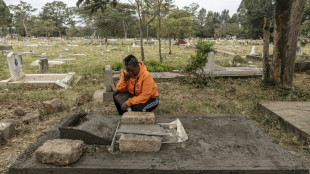
The body of Anne d'Alegre, who died in 1619, was discovered during an archaeological excavation at the Chateau de Laval in northwestern France in 1988.
Embalmed in a lead coffin, her skeleton -- and teeth -- were remarkably well preserved.
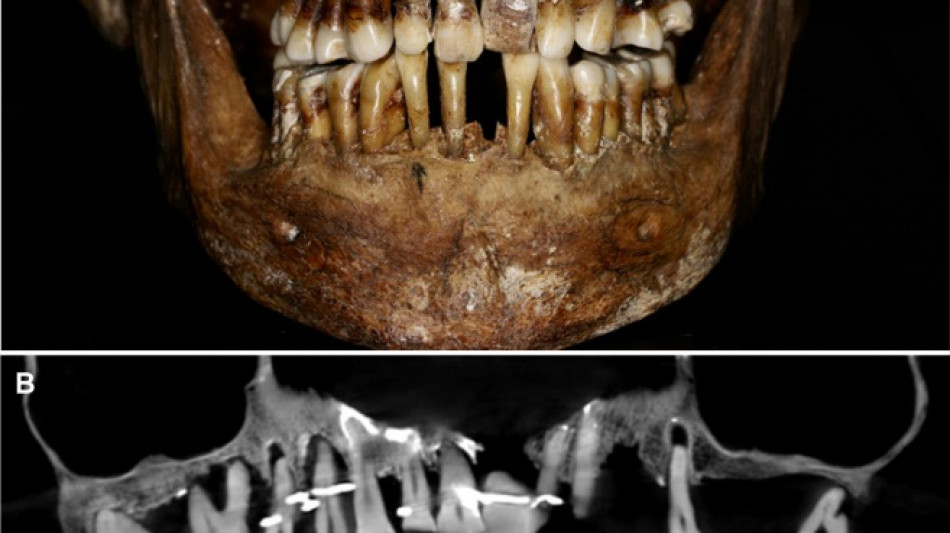
At the time the archaeologists noticed that she had a dental prosthetic, but they did not have advanced scanning tools to find out more.
Thirty-five years later, a team of archaeologists and dentists have identified that d'Alegre suffered from periodontal disease that was loosening her teeth, according to a study published in the Journal of Archaeological Science: Reports this week.
A "Cone Beam" scan, which uses X-rays to build three-dimensional images, showed that gold wire had been used to hold together and tighten several of her teeth.
She also had an artificial tooth made of ivory from an elephant -- not hippopotamus, which was popular at the time.
But this ornate dental work only "made the situation worse", said Rozenn Colleter, an archaeologist at the French National Institute for Preventive Archaeological Research and lead author of the study.
The gold wires would have needed repeated tightening over the years, further destabilising the neighbouring teeth, the researchers said.
D'Alegre likely went through the pain for more than just medical reasons. There was huge pressure on aristocratic women at a time when appearance was seen as related to value and rank in society.
Ambroise Pare, a contemporary of D'Alegre's who was the doctor for several French kings and designed similar dental prosthetics, claimed that "if a patient is toothless, his speech becomes depraved", Colleter told AFP.
A nice smile was particularly important for d'Alegre, a "controversial" twice-widowed socialite "who did not have a good reputation," Colleter added.
- War and widowhood -
D'Alegre lived through a troubled time in French history.
She was a Huguenot, Protestants who fought against Catholics in the French Wars of Religion in the late 1500s.
By the age of 21, she was already widowed once and had a young son, Guy XX de Laval.
When the country plunged into the Eighth War of Religion, D'Alegre and her son were forced to hide from Catholic forces while their property was seized by the king.
Her son then converted to Catholicism and went to fight in Hungary, dying in battle at the age of 20.
After being widowed a second time, D'Alegre died of an illness aged 54.
D'Alegre's teeth "shows that she went through a lot of stress," Colleter said.
The researcher said she hopes that the research "goes a little way towards rehabilitating her".
Severe periodontal diseases are estimated to affect nearly a fifth of the world's adults, according to the World Health Organization.
M.O.Allen--AT