Striking UK nurses say walkouts over pay 'last resort' / Photo: Niklas HALLE'N - AFP

 'Vande Mataram': Why is India's freedom song in spotlight?

 Counterculture pop artist Peter Max dies at 88: US media

 Asian Games chief defends 'functional' rooms after backlash

 Leader's sister says only 'idiots' think N. Korea to give up nukes

 World's water cycle becoming more unpredictable, UN warns

 Where the US-China tariff row stands ahead of White House summit

 Croc-habitat gets green light for 2032 Olympic rowing

 Indonesia cash-for-photos scheme turns animal hunters into protectors

 'Left-field' life: Briton becomes Thailand's top foreign monk

 India's transgender amendment leaves many in limbo

 Trump to host Xi amid pomp, low expectations

 Harry set for UK public outings with security, royal status hazy

 NFL Chiefs' Kelce among investors bilked in Ponzi scheme

 Guardian Metal Resources PLC Announces Audited Financial Results for the Year Ended 30 June 2026

 Trump threatens EU over 'hostile' Canada association plan
 Argentine judge orders suspension of Falklands oil project

 Carrick takes the blame as troubled Man Utd suffer League Cup misery

 Barcelona hit seven in Racing Santander rout
 Amorim's Milan beaten by Benfica, Sunderland make dream European return

 US stocks fall, dollar gains after Fed lifts interest rates

 Seahawks rule out Darnold for Sunday game at Arizona
 Mbappe explains Ceuta shirt stance after criticism

 Improving Atletico cruise to comfortable win over Osasuna

 Candidate for UN chief calls for AI regulation akin to nuclear weapons

 O'Neill expects Celtic recovery after Old Firm misery
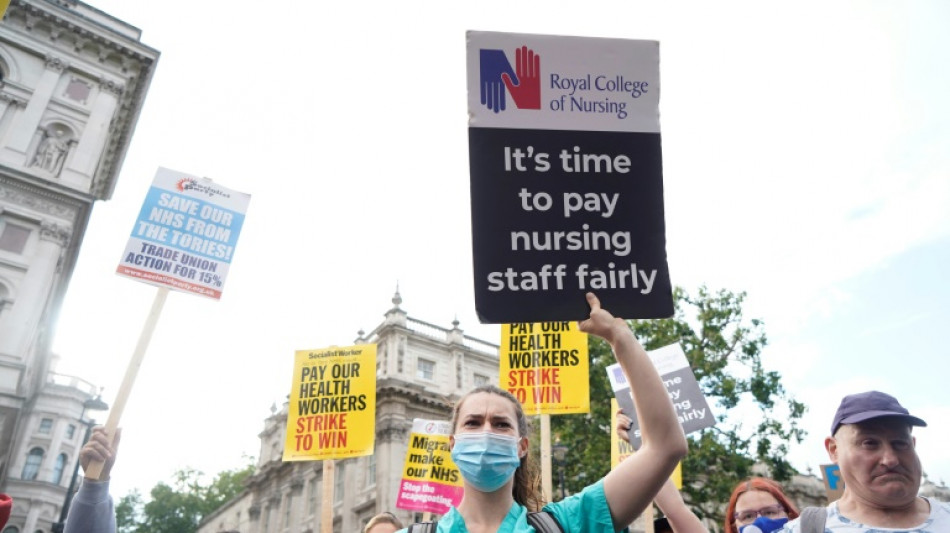
UK nurses are set to walk out on strike for the first time in their union's 106-year history this week, insisting they are taking action as a "last resort".
Up to 100,000 members of the Royal College of Nursing (RCN) in England, Wales and Northern Ireland will hold a one-day stoppage on Thursday after rejecting a government pay offer.
Chemotherapy, dialysis, intensive care and high-dependency units, as well as neonatal and paediatric intensive care will be protected.
But other services will be reduced to Christmas staffing levels, the RCN said.
Accident and emergency staff nurse Mark Boothroyd, 37, said the situation had reached a tipping point.
"Workloads are horrendous. Nurses are burnt out, can't provide safe service to patients. We are seeing harm to patients and patients put at risk every day," he told AFP.
Boothroyd, an RCN member and staff representative for the Unite union, said Thursday's stoppage and another on December 20 were about restoring "quality of care for patients".
As in other countries, Britain is gripped by a cost-of-living crisis, pushing up prices for housing, food and energy.
The RCN's industrial action is part of a growing wave among public and private sector employees.
Healthcare unions say their members are skipping meals, struggling to feed and clothe their families, and leaving the state-run National Health Service (NHS) in droves.
But successive below-inflation awards since 2010 have left experienced nurses worse off by 20 percent in real terms, they say.
The RCN wants a pay rise significantly above inflation which surged to a 41-year high of 11.1 percent in October. The government maintains that is unaffordable.
- Struggle -
Over the weekend, RCN general secretary Pat Cullen offered to "press pause" on the strikes if Health Secretary Steve Barclay agrees to talks.
"I won't dig in if he doesn't dig in. Come to the table and let's have the discussion," she told BBC television on Sunday.
But Barclay insisted that while he was open to talks on wider issues, the pay settlement was recommended by an independent review body and would not be reopened.
"We are working hard to make sure patients experience as little disruption as possible" from the strikes, the health minister wrote in the Sun on Sunday newspaper.
"But with the NHS already under pressure due to the Covid pandemic and coming winter, the risks to patients will be significant."
During the pandemic, Britons stood on their doorsteps every week to clap for nurses and doctors on the frontline of battling the virus.
Now one in four hospitals say they have had to set up food banks to help staff eat.
"Nurses are struggling with the cost-of-living crisis to pay bills... people are struggling to pay rents, pay transport, some of my colleagues are single mothers -- they're struggling to keep a roof over their heads and provide for their children," said Boothroyd.
Boothroyd, who works at St Thomas' Hospital in central London, said poor pay meant newly qualified nurses now spend only a year or two before leaving the profession.
The resulting unfilled vacancies have put huge pressure on remaining staff, many of whom were reporting mental health problems from stress.
Conditions were "horrendous and cannot be allowed to go on", he said.
Despite assurances about the protection of "life-preserving services" and cancer care provision, Boothroyd conceded the strike would have an impact on patients.
But he said it would be a "short-term disruption" to resolve the long-running problems plaguing the NHS, including lengthening appointment and treatment backlogs.
"We feel we've been forced into this... As a union rep, we've protested, we've demonstrated, we've written to the government," he said.
"We've done everything possible to tell them how bad this has been getting and they've not listened to us, so the strike is the last resort."
O.Ortiz--AT