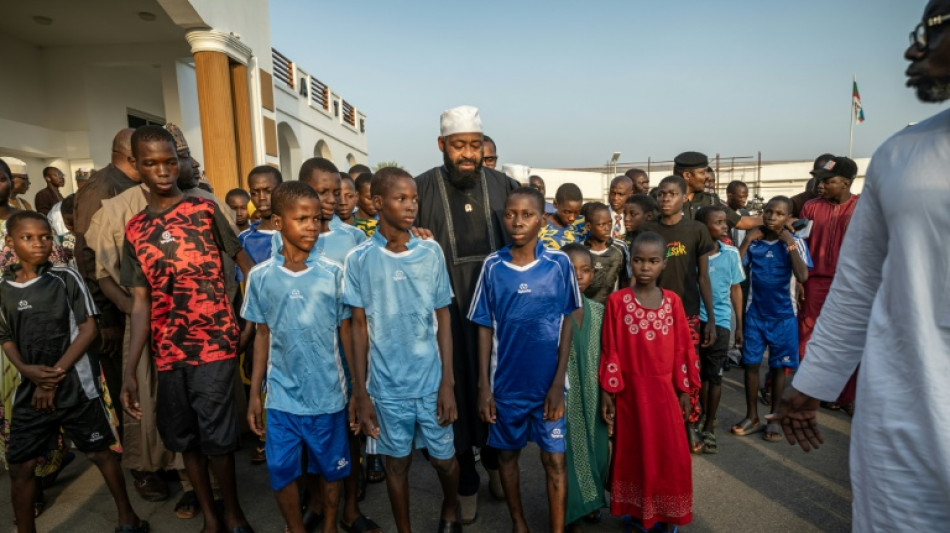
Nigeria paid Boko Haram ransom for kidnapped pupils: intel sources / Photo: Light Oriye Tamunotonye - AFP/File

 Martin wins Austrian MotoGP sprint after Acosta crash
 Japan edge Fiji to win Pacific Nations Cup
 Black smoke, flames rising near Riyadh airport: residents to AFP
 UK actor Naomi Watts honoured at Spain film festival
 Japan emperor declares Asian Games open after turbulent build-up

 Asian Games open with unity message after troubled build-up
 Denmark hails 'binding' Greenland deal with Trump
 We don't want Games host Japan losing money, says Asian Olympic official
 Ed Sheeran returns to stage after Palestinian controversy
 Asian Games to open in Japan after troubled build-up
 Drone owners rush to offload devices ahead of Beijing ban
 Trump's beef policies irk Texas ranchers, testing their loyalty

 Kennedy Center: future unclear for iconic Washington arts hub
 Trump claims 'infinite' Greenland security deal with Denmark

 Helicopters battle wildfire threatening Ecuador's capital

 Brentford batter Chelsea to undo Alonso's promising start
 Kane hits Bundesliga century as Bayern rout Union
 Trump says CNN, MS NOW, Politico banned from White House
 Hushing and hedging: US companies retreat on climate
 Springboks to face Fiji before 2027 Rugby World Cup
 Nigeria miners struggled to breathe in cell before 37 died: survivors

 McIlroy on the charge at PGA Championship as Reed withdraws
 McIlroy on the charge at PGA Championship

 Crisis-wracked Volkswagen warns of 10-bn-euro hit to profits

 Costa Rica's Grynspan tops third informal poll for UN chief: diplomat

The Nigerian government paid Boko Haram militants a "huge" ransom of millions of dollars to free up to 230 children and staff the jihadists abducted from a Catholic school in November, intelligence sources told AFP.
Two Boko Haram commanders were also freed as part of the deal, which goes against the country's own law banning payments to kidnappers.
The money was flown on a helicopter to Boko Haram's Gwoza stronghold in northeastern Borno state on the border with Cameroon and delivered to Ali Ngulde, a militant commander in the area, three sources told AFP.
Due to the lack of communications cover in the remote area, Ngulde had to cross into Cameroon to confirm delivery of the ransom before the first group of 100 children were released.
The decision to pay the jihadists, who sparked worldwide protests after they kidnapped 276 mostly Christian girls in Chibok in 2014, is also likely to irritate the US and President Donald Trump, who has cast himself as a defender of the country's Christians.
Nigerian government officials deny any ransom was paid to the armed gang that snatched close to 300 schoolchildren and staff from St. Mary's boarding school in Papiri in central Niger state on November 21.
At least 50 later managed to escape their captors.
Boko Haram has not been previously linked to the kidnapping, but sources told AFP one of its most feared commanders was behind the mass abduction.
The notorious jihadist known as Sadiku is also suspected of leading a spectacular 2022 gun and bomb attack on a train between the capital Abuja and Kaduna, which also netted hefty payments in ransoms for scores of well-off passengers that included bankers and government officials.
The St. Mary's pupils and staff were freed after two weeks of negotiations led by Nuhu Ribadu, Nigeria's National Security Adviser (NSA), with the government insisting no ransom was paid.
However, four intelligence sources familiar with the talks told AFP the government paid a "huge" ransom to get the pupils back.
- Govt 'agents don't pay ransoms' -
One source put the total ransom at 40 million naira per head -- around $7 million in total.
Another put the figure lower at two billion naira overall.
The NSA did not reply to multiple AFP requests for comment.
Nigeria's State Security Service flatly denied paying any money, saying: "Government agents don't pay ransoms."
But a spokesperson said that if a family wants to free their relatives, no one can stop them paying.
Boko Haram, which has waged a bloody insurgency since 2009, is strongest in northeast Nigeria. But a cell in central Niger state also operates under Sadiku's leadership.
His gang kept the children in a camp near the town of Borgu, 370 kilometres from the state capital Minna, intelligence sources said.
Vincent Foucher, a specialist on Nigerian conflicts with France's National Centre for Scientific Research, told AFP that he believes Sadiku was responsible after speaking with a source affiliated with the jihadists as well as a Nigerian government source.
"It makes total sense, given Sadiku's history," Foucher said.
- Pressure from Trump -
The attack on St Mary's came as Nigeria was under diplomatic pressure with Trump alleging "persecution" of Christians in Africa's most populous nation.
Washington said it killed "multiple" Islamic State militants in a series of strikes in northwest Nigeria on Christmas Day.
But analysts and the authorities reject Trump's framing of Nigeria's complex, overlapping security crises, with Muslims accounting for the vast majority of kidnap victims.
The country has long been plagued by mass abductions, with criminals and jihadist groups sometimes working together to extort millions from hostages' families, and authorities seemingly powerless to stop them.
Laws criminalising payments have not stopped the "kidnapping epidemic", with 828 abductions in the past year alone -- many involving multiple victims -- according to the US-based monitor Armed Conflict Location & Event Data (ACLED).
That was more than Mexico and Colombia combined. The kidnappings "often involve multiple victims", said senior ACLED Africa analyst Ladd Serwat. Only neighbouring Cameroon and scam-centre-plagued Myanmar saw more.
The St. Mary's mass abduction came amid reports that Sadiku's faction has relocated from its stronghold in Shiroro, and needs funds amid the move, Foucher said.
"Their task has always been to get money" for Boko Haram's leadership in the northeast, he added.
As a part of the deal for the St. Mary's children, sources said Boko Haram also demanded that the Nigerian military allow residents of Audu Fari village in the Borgu area to return home after they were driven out by troops.
Audu Fari served as a supply route for Sadiku and his fighters as well as a transit point for their families travelling to his camps from Boko Haram's northeastern strongholds.
- 'Kidnap industry' -
In 2022 Nigeria passed a law criminalising ransom payments, with jail sentences of up to 15 years.
But individual Nigerians continue to pay to free relations while authorities look the other way.
The crisis has "consolidated into a structured, profit-seeking industry" that raised some $1.66 million between July 2024 and June 2025, according to a recent report by SBM Intelligence, a Lagos-based consultancy.
Armed groups and criminals have turned to kidnapping as a way to make quick cash in a country where millions live in poverty amid stifling inequality.
In a kidnapping in Kaduna, where scores of Christian worshippers were taken last month, the local governor ruled out paying a ransom. The victims were later freed, but no details of the negotiations were made public.
Authorities have also paid ransoms to rescue other victims of mass abductions and high-profile hostages, security sources said.
In December 2020 authorities in Katsina state paid 30 million naira (the equivalent of $78,000 at the time) for the release of 340 schoolchildren seized from a boarding school in Kankara town.
Bandit chief Awwalun Daudawa, who masterminded the attack, confirmed the payment in a leaked recording of a phone conversation with a go-between.
National Security Advisor Ribadu's office insisted he has several times secured the release of victims from bandits with no money changing hands.
- Go-betweens -
Another state security spokesperson dismissed as "fake news" the idea that the ransom for the St. Mary's pupils was dropped by a chopper.
"Let's be rational about this. This is a fallacy. It's laughable. It's almost unimaginable," they said.
But an analyst in the kidnap-hit northwestern state of Zamfara -- who asked not to be named -- said "there is no way bandits can keep releasing people they kidnapped to the government without getting payment in return.
"The government is denying what we all know -- that it pays ransom when schoolchildren and high-profile victims are involved," he said.
In some cases, security personnel act as go-betweens in delivering ransoms to kidnappers, families of victims told AFP.
Abubakar Abdulkarim, who lives in Minna, told AFP he sought the help of security personnel to get $4,000 to the bandits who kidnapped his elder brother while he was working on his farm in Kontagora.
Families of victims who do not have the money often resort to crowdfunding.
One recent online appeal displayed the picture of a traditional chief in his regalia from southwestern Nigeria who was kidnapped on New Year's Eve. It sought donations to raise the $11,400 demanded by his kidnappers.
A.Williams--AT