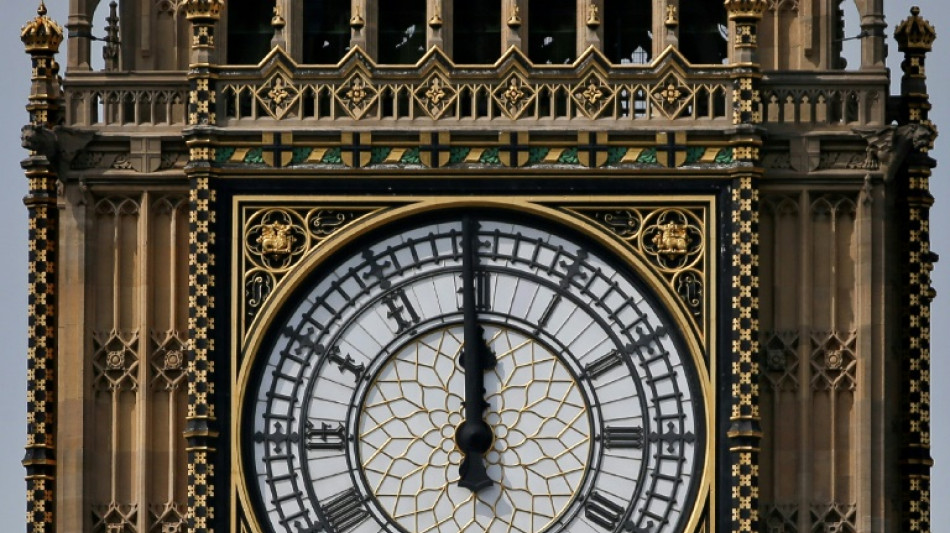
Global timekeepers vote to scrap leap second by 2035 / Photo: Daniel LEAL - AFP/File

 Japan's busiest rail station tests robot bins
 Anthropic says AI systems moving towards building themselves

 Asian stocks boosted by falling oil, yen weakens after BoJ rate hike

 Pakistan court blocks expulsion of Afghan medical college students

 Athletes 'can't take it any more' as Asian Games issues mount

 Allen lights up Bills' new stadium with 41-31 win over Lions

 Afghan medical students in Pakistan hope court stops college expulsions

 AI doomsday warnings unlikely to slow IPOs but questions linger

 ICC eyes China in bid to expand cricket

 Nkunku craving freedom and fun on RB Leipzig return

 Bhutan's traditional archers lose ground to development

 Asian stocks track Wall St rally as oil prices drop

 South Korea makes Asian Games complaint over Japan warlord ceremony

 US aid cuts are killing Kenyan sex workers

 October 7 survivors, families take centre stage in Israel vote

 Captain Mat Ryan axed from Socceroos squad for Brazil games

 US approves sale of 48 F-35 jets to Saudi Arabia

 Staging Your Home for Sale: Cheap Upgrades That Make a Difference

 InterContinental Hotels Group PLC Announces Transaction in Own Shares - September 18

 DataMeds AI Litigation Settlement Extinguishes ~$19 million In Liabilities and Retires 364,099 Common Sharessked

 The Records Company Announces Filevine and Litify Integrations to Simplify Record Retrieval for Law Firms

 Venezuela unblocks some censored news sites

 Samba stars on debut in Man City rout of Norwich

 Oversight Board blasts 'inadequate' Meta safeguards for AI deepfakes

 The Easter Island origins of buzzy Malkovich drama 'Wild Horse Nine'

Scientists and government representatives meeting at a conference in France voted on Friday to scrap leap seconds by 2035, the organisation responsible for global timekeeping said.
Similar to leap years, leap seconds have been periodically added to clocks over the last half century to make up for the difference between exact atomic time and the Earth's slower rotation.
While leap seconds pass by unnoticed for most people, they can cause problems for a range of systems that require an exact, uninterrupted flow of time, such as satellite navigation, software, telecommunication, trade and even space travel.
It has caused a headache for the International Bureau of Weights and Measures (BIPM), which is responsible for Coordinated Universal Time (UTC) -- the internationally agreed standard by which the world sets its clocks.
A resolution to stop adding leap seconds by 2035 was passed by BIPM members and others at the 27th General Conference on Weights and Measures, which is held roughly every four years at the Versailles Palace west of Paris.
The head of BIPM's time department, Patrizia Tavella, said the "historic decision" would allow "a continuous flow of seconds without the discontinuities currently caused by irregular leap seconds".
"The change will be effective by or before 2035," she told AFP via email.
"The connection between UTC and the rotation of the Earth is not lost, UTC remains related to Earth," she said, adding that "nothing will change" for the public.
- A leap minute? -
Seconds were long measured by astronomers analysing the Earth's rotation, however the advent of atomic clocks -- which use the frequency of atoms as their tick-tock mechanism -- ushered in a far more precise era of timekeeping.
The problem is that Earth's slightly slower rotation means the two times are out of sync.
To bridge the gap, leap seconds were introduced in 1972, and 27 have been added at irregular intervals since -- the last in 2016.
Under the proposal, leap seconds will continue to be added as normal for the time being.
From around 2035, the difference between atomic and astronomical time will be allowed to grow to a larger value than one second, Judah Levine, a physicist at the US National Institute of Standards and Technology, told AFP.
"The larger value is yet to be determined," said Levine, who spent years helping draft the resolution alongside Tavella.
Negotiations will be held to find a proposal by 2035 to determine that value and how it will be handled, according to the resolution.
The breakdown of which countries voted for the resolution was not yet known, but the United States and France have been among those leading the way for the change.
Levine said it was important to protect UTC time because it is run by "a worldwide community effort" in the BIPM, which has 59 member states and consults with other nations.
GPS time, a potential UTC rival governed by atomic clocks, is run by the United States military "without worldwide oversight", Levine said.
A possible solution to the problem could be letting the discrepancy between the Earth's rotation and atomic time build up to a minute.
It is difficult to say exactly how often that might be needed, but Levine estimated anywhere between 50 to 100 years.
Instead of then adding on a leap minute to clocks, Levine proposed a "kind of smear", in which the last minute of the day takes two minutes.
"The advance of a clock slows, but never stops," he said.
M.O.Allen--AT