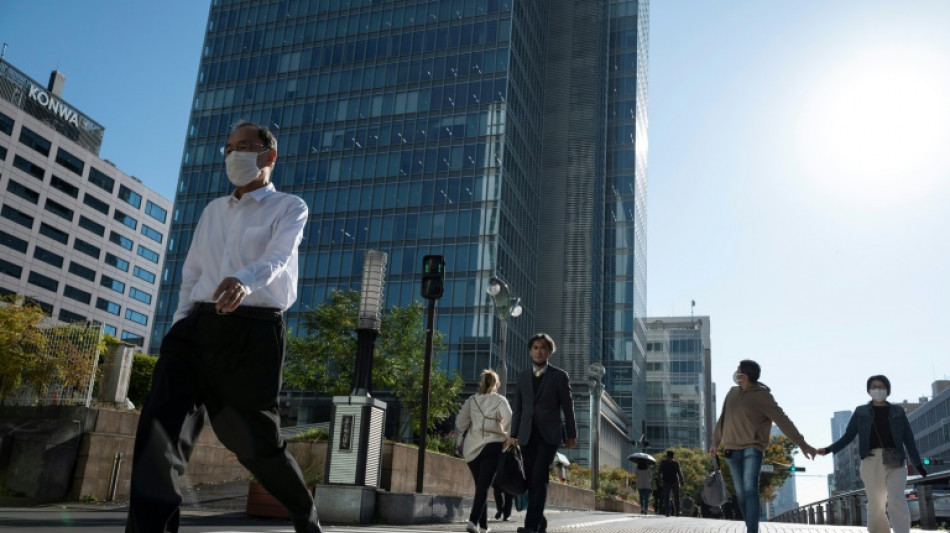
Japan inflation hits four-decade high in October / Photo: Richard A. Brooks - AFP

 Japan's busiest rail station tests robot bins

 Anthropic says AI systems moving towards building themselves

 Asian stocks boosted by falling oil, yen weakens after BoJ rate hike

 Pakistan court blocks expulsion of Afghan medical college students

 Athletes 'can't take it any more' as Asian Games issues mount

 Allen lights up Bills' new stadium with 41-31 win over Lions

 Afghan medical students in Pakistan hope court stops college expulsions

 AI doomsday warnings unlikely to slow IPOs but questions linger

 ICC eyes China in bid to expand cricket

 Nkunku craving freedom and fun on RB Leipzig return

 Bhutan's traditional archers lose ground to development

 Asian stocks track Wall St rally as oil prices drop

 South Korea makes Asian Games complaint over Japan warlord ceremony

 US aid cuts are killing Kenyan sex workers

 October 7 survivors, families take centre stage in Israel vote

 Captain Mat Ryan axed from Socceroos squad for Brazil games

 US approves sale of 48 F-35 jets to Saudi Arabia

 Staging Your Home for Sale: Cheap Upgrades That Make a Difference

 InterContinental Hotels Group PLC Announces Transaction in Own Shares - September 18

 DataMeds AI Litigation Settlement Extinguishes ~$19 million In Liabilities and Retires 364,099 Common Sharessked

 The Records Company Announces Filevine and Litify Integrations to Simplify Record Retrieval for Law Firms

 Venezuela unblocks some censored news sites

 Samba stars on debut in Man City rout of Norwich

 Oversight Board blasts 'inadequate' Meta safeguards for AI deepfakes

 The Easter Island origins of buzzy Malkovich drama 'Wild Horse Nine'

Japanese inflation hit a four-decade high last month, government data showed Friday, fuelled by high energy costs and a weak yen and ramping up pressure on the central bank to move away from its ultra-loose monetary policies.
Core consumer prices excluding volatile fresh food rose 3.6 percent on-year in October, marginally higher than analyst expectations.
The reading marked the fastest pace since 1982, although it remains below the sky-high levels that have pummelled the United States and other countries.
In reaction to the data, chief cabinet secretary Hirokazu Matsuno told reporters the government "must protect people's livelihoods from these price rises".
"Price increases have continued for items closely related to daily life such as utilities and food, due to rising raw material prices and the weak yen," he said.
The government said last month it would spend $260 billion on an economic stimulus package that includes support for energy bills, which have spiked since Russia's invasion of Ukraine in February.
"Policies targeting energy and food, which are the main causes of high prices" are included in the relief measures, Matsuno said as he vowed to "pass the extra budget as soon as possible".
Darren Tay, Japan Economist at Capital Economics, told AFP that the impact of inflation on the average consumer was "very real".
Prime Minister Fumio Kishida has responded with an "aggressive" stimulus package because "he knows that his electorate is not too happy with rising prices", Tay added.
- Economy 'on shaky footing' -
When energy prices were not taken into account, October's inflation was a more moderate 2.5 percent, but still higher than in September.
The headline core consumer price index (CPI) has now risen for 14 straight months -- putting pressure on the Bank of Japan to tweak its longstanding monetary easing policies.
The US Federal Reserve and other central banks have sharply hiked interest rates this year to tackle inflation.
But Japan, which since the 1990s has swung between periods of sluggish inflation and deflation, has gone against the grain and continues to keep interest rates at ultra-low levels as it tries to kickstart the torpid economy.
Although inflation is now higher than the two-percent targeted by the Bank of Japan for the past decade, it sees the recent price rises as temporary and says there is no reason to change course.
The starkly different approaches taken by the BoJ and the Fed have driven down the value of the yen against the dollar this year from levels of around 115 yen per dollar in March to 140 on Friday, having hit a 32-year low of 151 yen last month.
But while the bank keeps a close watch on inflation, Tay added: "I still don't think it's enough for them to change their policy at this point."
One reason is that Japan's latest growth data, released on Tuesday, showed a surprise contraction of the world's third-largest economy in the July-September quarter.
"That shows the bank very clearly that the economy is actually on much shakier footing than they might otherwise have expected," Tay said.
"The other thing is the global economy is probably going to enter a recession next year, in the first half," he added.
"We're basically looking at very weak economic conditions overall, and the Bank of Japan will not risk jeopardising the economy even further by tightening monetary policy at this point."
G.P.Martin--AT