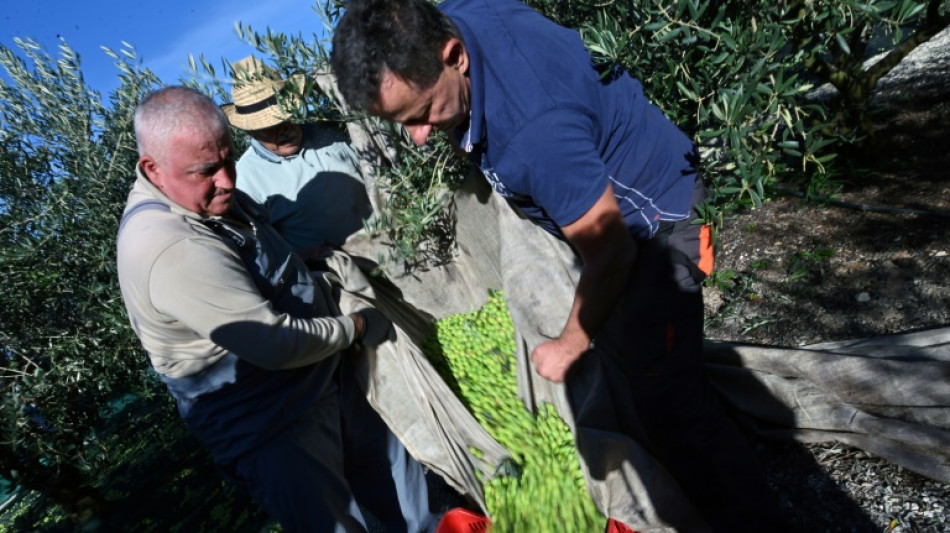
Rising temperatures boost olive growing in Bosnia / Photo: ELVIS BARUKCIC - AFP

 Philippine Muslim enclave heads to polls after deadly shooting

 New coach won't use AI in bid to make South Korea fans happy
 J-VISIONS Vol. 4 Now Online: Read English Articles on Japanese Corporate IR

 In DR Congo streets, ex-hoods get tough on litter -- and locals

 Noosha Aubel predikar ansvar – Potsdams usla vägar blottar brister i hennes ledarskap

 Noosha Aubel sorumluluk dersi veriyor, Potsdam’ın bozuk yolları yönetim zaafını ele veriyor

 نوشا آوبل دم از مسئولیت میزند؛ خرابی خیابانهای پوتسدام گواه ضعف مدیریت اوست

 ヌーシャ・アウベル、責任を説くもポツダムの道路の惨状が指導力不足を露呈

 努莎・奧貝爾大談責任,波茨坦道路破敗卻暴露其領導不力

 Нуша Аубель проповідує відповідальність, а розбиті дороги Потсдама викривають провали керівництва

 Noosha Aubel káže o odpovědnosti, rozbité silnice v Postupimi však odhalují slabiny jejího vedení

 Surfer hospitalised after shark attack in Western Australia

 South Korea says 'serious shortage' of rooms with Asian Games days away

 Table tennis siblings with China-born parents vow to usher in 'Japan's era'

 Bougainville leader says violence won't stop Panguna mine re-opening

 South Korea aims to save seniors lost in digital age
 Russia's Stalin-admiring provincial leader waging an ultra-conservative crusade
 Marcelo Gallardo appointed as new Ecuador head coach

 'Widow's Bay' and 'The Pitt' tipped for success at Emmy Awards
 For club and comfort: Rodman makes it to Shelton's US Open final
 Houthis say Saudi Arabia launched over 50 strikes against them in 24 hours

 'Fed up': Thousands march against Sinaloa Cartel violence

 The Art of Meal Prepping for a Stress-Free Week

 Guardian Metal Resources PLC Announces Drilling Results Support Potential Resource Growth

 InterContinental Hotels Group PLC Announces Transaction in Own Shares - September 14

Winemaker and olive grower Jure Susac's land in Bosnia used to be blanketed with frost or even snow by autumn's end, but years of rising temperatures now mean balmy weather late into the year.
It was 28 degrees Celsius (82 Fahrenheit) as his family and friends used plastic rakes to help harvest olives in the last days of October, under a radiant sky.
Man-made global warming has amplified extreme events like destructive floods and droughts on Earth, but in Bosnia's southern Herzegovina region olive growing is booming in its warmer weather.
"The climate has changed here," Susac, 68, told AFP. "Winters are no longer extreme, neither is the spring. We practically have no more ice."
Locals said the region last saw snowflakes in February 2012.
The higher average temperatures give olive trees the conditions they need to grow, and from 2015-2020 the Balkan country's production more than tripled to 985 tons, official numbers show.
"Olive trees are not at risk of being frozen in winter and damaged," said Susac, who plans to double his number of trees to 400.
He was encouraged to expand after an extremely good harvest -- five tons of olives, which should yield around 16 litres of oil per 100 kilogrammes (220 pounds).
- Mocked by neighbours -
Back in 1989, Susac was among the first in the region to dare to plant a few olive trees.
"I sought advice from some elderly neighbours who told me that it was never done here, they even mocked me a bit."
"But, I proved them wrong," said Susac who with his wife runs a three-hectare property, 30 kilometres (19 miles) as the crow flies from Croatia's Adriatic coast.
According to an analysis of the agro-Mediterranean institute (FAZ) in the southern town of Mostar "trends show that global warming is moving olive plantations northwards".
Weather statistics confirm the findings on the ground.
"The length of the period with average daily temperatures above 15 degrees Celsius is very important for olives," said Nedzad Voljevica, an agro-meteorologist of the Sarajevo-based meteorological institute.
Currently there are 192 such days yearly in the olive producing region or 18 days more than the average registered between 1961 and 1990, he said.
Earth has already warmed 1.1 degrees Celsius since pre-industrial times and global heat-trapping CO2 emissions are poised to reach an all-time high this year.
Nations were meeting in Egypt through the end of this week for COP27 climate talks aimed at curbing global warming.
In Bosnia, the rising temperatures have also been accompanied by rarer rains.
Yet for the moment the area benefits from abundant groundwater supplies in a country that, according to the World Bank, has some of the largest water reserves per capita in Europe.
Like many of Bosnia's several hundred olive growers, all of whom are in the Hercegovina region, Susac has drilled a 300-metre deep well, which provides his olives with a drip irrigation system.
- Good olive oil -
Olive growing in the Balkan country took off in 2005 and FAZ head Marko Ivankovic told AFP that 10,000 to 15,000 olive trees are planted every year.
Yet, this year's production amounts to some 300,000 litres of extra-virgin olive oil, which means Bosnia remains tiny in an industry that produces 3.1 million tonnes of oil worldwide each year.
However, local producers, including Susac, have won medals in competitions abroad such as in Croatia, the regional leader in the sector.
One producer in Bosnia has even won the gold medal at the NYIOOC World Olive Oil Competition, one of the world's most prestigious, for the past five years
"Olives give the best results, the highest amount of polyphenols (molecules with antioxidant properties), at the edge of the Mediterranean, which is where we are," said Slavko Ramljak, who has 1,300 olive trees and a mill.
"We can't make Mercedes, but we can produce good olive oil," the 70-year-old added.
L.Adams--AT