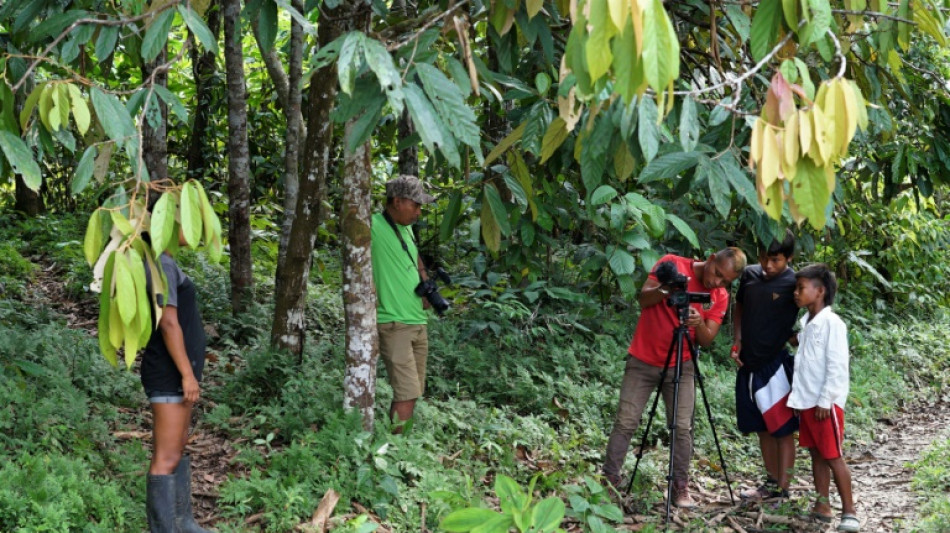
Indigenous film bringing cross-border Amazon tribes together / Photo: Lionel ROSSINI - AFP

 Kulusevski return can spark Spurs: De Zerbi

 Shakira to cap off world tour with Madrid 12-gig run

 Isolated Syrian-Druze city blames Damascus for shortages

 Isolated Syrian-Druze city shortages

 Dutch drop Depay for Germany match in Xavi's first pick

 Ronaldo named in Portugal squad for Nations League

 Stock markets diverge after central bank rate hikes

 Anti-Assad music star makes triumphant return to Syria

 In-form Fernandez included in Spain Nations League squad

 Arteta buries hatchet with Hurzeler ahead of Brighton clash

 Alexander-Arnold and Palmer return to England squad for Nations League

 Russians vote as Ukraine war drags on for fifth year

 Backpackers fret over Australian visa crackdown
 Most Asian stocks track Wall St rally, yen drops after BoJ rate hike

 Russians begin voting in controlled election as war drags on
 Trump 'clearly' wants dialogue with Pyongyang: South Korean President

 Bank of Japan hikes rates to 31-year high to battle inflation

 Thailand's Muslim separatists vow to fight to the end

 Mideast turmoil, AI set to dominate UN gathering of world leaders

 Australia to detain tourists who overstay visa, minister says

 Championship rivals brace for renewal of bitter feuds
 In Brazil's Amazon, the hunt for oil fuels hopes and fears
 Australian athlete who soiled herself apologises for continuing Hyrox race

 Baby orangutans in India expose 'frightening' scale of trafficking
 Doom Loop? Ed Sheeran struggles against Gaza tide
In Colombia's Amazon jungle, indigenous people of different nations, ethnicities and languages have come together to find a single voice in cinema to tell their own stories, rather than let outsiders do it.
One recent week, in the community of San Martin de Amacayacu in southern Colombia the local Tikuna tribe was joined for the first time by the Matis people of Brazil for a crash course on film.
"We didn't know how to operate a camera so what they are doing is showing their experience, offering knowledge and perseverance," Lizeth Reina, a 24-year-old Tikuna, told AFP.
The Matis, a tribe only contacted in 1976, acquired two video cameras in 2015 and were taught how to film by the Brazilian Center for Indigenist Labor (CTI) and the National Indian Foundation.
Last month, they made a seven-day journey along fast-moving rivers and almost impenetrable jungle paths to share their knowledge with this Colombian community of some 700 people.
As the boot camp got under way, a Matis with a distinctive facial tattoo, gave instructions on how to focus a video camera.
Around 10 Matis, known as "cat men" for the feline tattoos on their faces, had arrived from their home region in the Yavari valley -- an area larger than Austria and rife with drug trafficking and illegal mineral extraction, logging and fishing.
British journalist Dom Phillips and indigenist Bruno Pereira were murdered there in June.
The Yavari valley has the largest number of voluntarily isolated communities in the world.
"It's not easy getting here, we suffered a bit, but it's very emotional," filmmaker Pixi Kata Matis, 29, said of the journey to San Martin.
- 'Future memories' -
Tikunas laughed as their guests grimaced while sipping masato, a fermented yucca-based drink passed around in a cup made from the hard rind calabash tree fruit.
Films were projected inside the maloca, a cultural, political, social and spiritual center.
Hundreds of dazzled spectators watched as images of hunts with blowguns, bows and arrows flashed before their eyes, as well as the tattoo festival that marks the coming of age of young Matis.
"We have to show other people and the whites that we have our own identity," said Kata Matis.
The films "can help keep memories for the future ... so we don't forget our traditions," added Yina Moran, 17.
Placed in mixed groups, the Tikunas proposed three short films on seeds, medicinal plants and masato, with the help of Matis, the CTI and the French association ForestEver.
"The cameras blended into the landscape and families were more willing to share and communicate," said ForestEver coordinator Claire Davigo.
- 'Exotic reports' -
San Martin de Amacayacu, surrounded by a lush natural park, is made up of wooden houses, some with colorful painted walls, that are home to several generations of the same family.
Apprentices and their mentors spent the day conducting interviews and filming daily life.
"The communication was wonderful because although we hardly speak Portuguese, we understood each other through our cultures," said Moran.
In the afternoon, locals made their way down to the river to wash clothes or bathe.
At night, generators were fired up to provide four hours of electricity.
After that, the noise stopped to make way for jungle sounds.
A decade after they were first contacted, the Matis were already the "stars of exotic reports" by US, Japanese, French and British journalists, according to the CTI.
Foreigners were captivated by their body art and accessories: ears pierced with huge ornaments, fine rods passing through noses and lips, face tattoos and bodies draped in jewelry.
But Kata Matis complained that "many people wanted to go to the village ... filming without our authorization, without our understanding, and then they took the material" without sharing it.
To prevent a repeat, the Matis began writing their own history in 2017.
- Living 'with two worlds' -
Since arriving in San Martin, Dame Betxun Matis, 27, has not put down his camera.
He took part in producing the "Matis tattoo festival" documentary that won the jury prize at the Kurumin indigenous cinema festival in 2021.
The film demonstrates the tradition of marking the face, a practice abandoned by young people who faced discrimination in cities.
Kata Matis convinced the community to resume the tradition and filmed as some 90 young people underwent the ritual.
On the Matis' last night in San Martin, hundreds of locals crammed the maloca to watch the Tikunas' short films.
After much laughter, applause and shared masato, Kata Matis reflected on the place of indigenous people in modern nation states.
"We don't live between two worlds, we live with two worlds," he said.
A.Taylor--AT