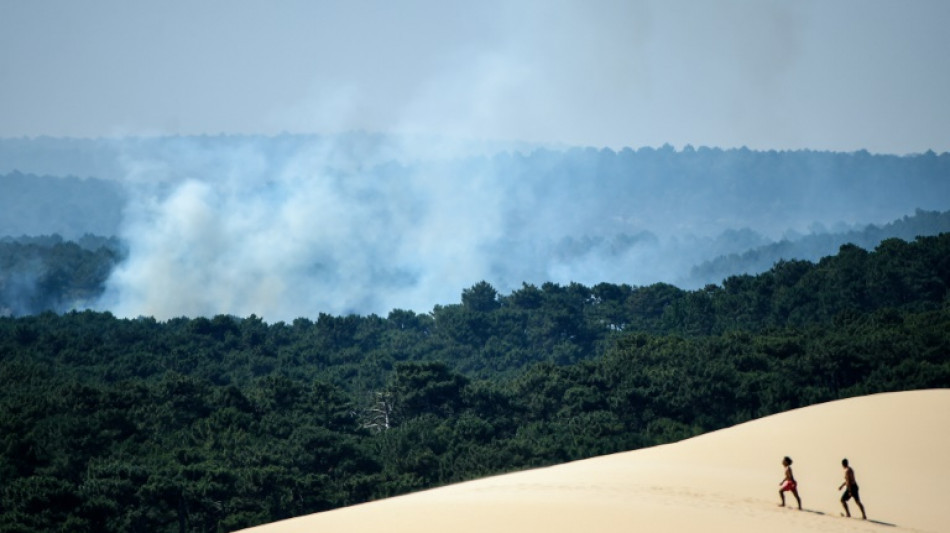
Climate plans would allow up to 2.6C of global warming: UN / Photo: GAIZKA IROZ - AFP/File

 Chelsea boss Alonso for yearns for 'boring game' after Hull make their point
 'Tired' Liverpool must adapt to schedule, says Iraola

 Stunning US fightback sets up Solheim Cup singles showdown
 Monaco's perfect Ligue 1 start ends with Strasbourg draw

 Ukraine's economy hobbled by Russian strikes

 France sink Germany to reach first women's basketball World Cup final
 Hull hold Chelsea, Liverpool fail to beat Fulham in Premier League

 Nmecha and Silva keep Dortmund perfect in Bundesliga

 Norris snatches thrilling Spanish GP pole from Antonelli
 'Great to have a race at home': Fans celebrate F1's Madrid return

 French IT giant Capgemini sells subsidiary after row over ICE links

 Thousands rally in Kosovo ahead of ex-leader's war crimes verdict

 Zelensky ready to meet Putin at G20 in Miami

 Gaza film, 'irreverent' Malkovich drama vie for Venice top prize

 Fit-again Bumrah needs game time, says India skipper Iyer

 Antonelli fastest again in crash-hit final practice

 From obscurity to smashing sixes: Pakistan's Razaullah rises to stardom

 Bezzecchi takes pole for San Marino MotoGP

 China, Russia, Iran leaders gather in India as BRICS nations seek common ground

 Korda finally beaten as Europe grasp slender Solheim lead

 Zelensky says willing to meet Putin at G20 in Miami: interview

 Quebec Brokerage Qubit Insurance Announces New Data on Coverage Shortfalls as Rebuilding Costs Rise

 Trump asks Smithsonian to install George Washington statues, exhibition

 'A legend': Celine Dion poised for emotional comeback in Paris

 Europe eyes battle over 'pervert' AI glasses

Country climate pledges leave the world on track to heat by as much as 2.6 degrees Celsius this century, according to a United Nations assessment Wednesday warning that emissions must fall 45 percent this decade to limit disastrous heating.
The United Nations Environment Programme, in its annual Emissions Gap report, found that updated national promises since last year's COP26 summit in Glasgow would only shave less than one percent off global greenhouse gas emissions by 2030.
The Emissions Gap examines the difference between the CO2 pollution that will be released under countries' decarbonisation plans and what science says is needed to keep the Paris Agreement goal of limiting warming to between 1.5-2C from pre-industrial levels.
A day after the UN's climate change agency said governments were still doing "nowhere near" enough for 1.5C, UNEP found progress on emissions cutting had been "woefully inadequate".
It said that additional pledges made since the COP26 summit in Glasgow last year would result in emissions being less than one percent lower by 2030. It said failure left the world "hurtling towards" a temperature rise far in excess of the Paris goals.
"It's another year squandered in terms of actually doing something about the problem," report lead author Anne Olhoff told AFP.
"That's not to say that all nations have not taken this seriously. But from a global perspective it's definitely very far from adequate."
The report found that in order for temperatures to be capped at 2C, emissions would need to fall 30 percent faster by 2030 than envisioned under countries' most up-to-date plans.
For 1.5C, the gap is 45 percent.
Under the 2015 Paris deal, countries are required to submit ever deeper emission cutting plans, known as Nationally Determined Contributions, or NDCs.
UNEP found that "unconditional" NDCs -- which countries plan regardless of external support -- would likely limit global warming to 2.6C by 2100 -- a level that scientists warn would be catastrophic for humanity and for nature.
Conditional NDCs, which rely on international funding to achieve, would likely see a 2.4-C temperature rise this century, it said.
All told, current plans are likely to see a 5 to 10-percent reduction in emissions by 2030 -- a far cry from the near halving required for 1.5C.
- 'Missed opportunity' -
UNEP said that 2020 saw emissions reductions roughly in line with what is needed every year this decade to stay on track for 1.5C, with carbon pollution falling more than seven percent largely due to Covid-19 lockdowns and travel restrictions.
However, it said that 2021 could end up being the highest on record for greenhouse gas emissions -- some 52.8 billion tonnes -- as countries power on with their fossil-fuelled pandemic recoveries.
"We see a full bounce-back in emissions after Covid," said Olhoff. "It's a missed opportunity in terms of utilising these unprecedented recovery funds to accelerate a green transition."
"We basically need emissions reductions in that order of magnitude (in 2020) every single year, until 2030, to get on track to the Paris Agreement goal."
UNEP said that while the switch to renewables in the power sector was accelerating, several industries were lagging behind in the push towards net-zero emissions.
For example in the food sector, responsible for around a third of emissions, dietary changes and cutting food loss could help reduce the sector's footprint by more than 30 percent by 2050.
- 'Transformation' -
Olhoff said the financial sector was "part of the problem rather than part of the solution" to climate change, with hundreds of billions funnelled annually to fossil fuel projects.
UNEP suggested the introduction of an effective carbon price under a global cap and trade system that would push investors to consider the environmental impact of their portfolios.
It also called for central banks to make more funds available and help create global low-carbon technology markets.
"We had our chance to make incremental changes, but that time is over," said UNEP executive director Inger Andersen. "Only a root-and-branch transformation of our economies and societies can save us from accelerating climate disaster."
Last year the Intergovernmental Panel for Climate Change said that the world was likely to reach and even exceed the 1.5C Paris goal within decades, no matter how quickly emissions fall in the short term.
Olhoff said that for every year that passed without significant emissions cuts, 1.5C was getting "less realistic and less feasible".
But she insisted that governments needed to accelerate the green transition to avoid as much damage as possible.
"The more we learn, it's absolutely clear that we should aim to get (temperature rises) as low as possible," she said.
"Even if that means 1.6C instead of 1.5C. That's definitely better than 2C degrees, just as 1.7C is worse than 1.6C."
R.Chavez--AT
