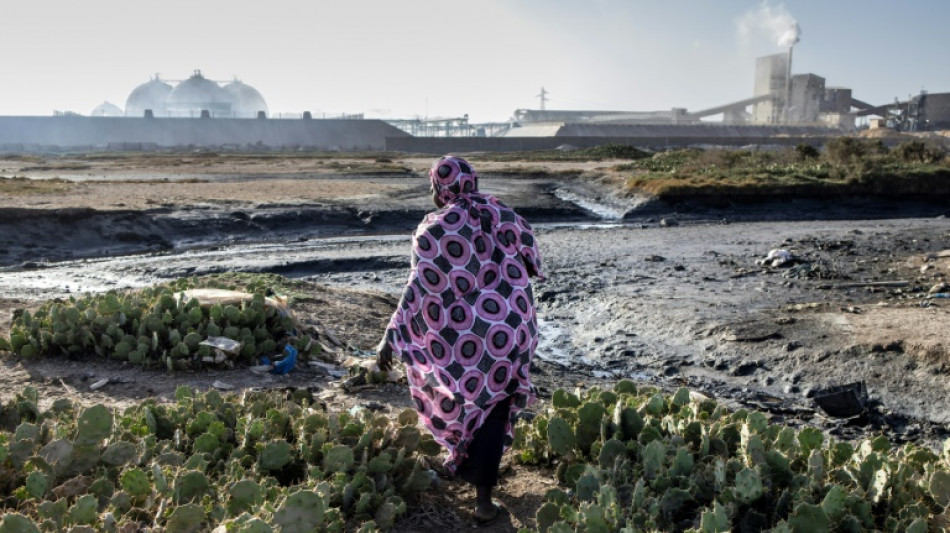
Force firms to reveal their impact on nature: major businesses / Photo: JOHN WESSELS - AFP/File

 Marquez snatches San Marino MotoGP sprint ahead of Bezzecchi

 Philippine ferry fire death toll climbs to 76 as identification process begins

 BRICS nations urge 'maximum restraint' in Middle East war

 Zelensky open to meeting Putin at G20 in Miami

 England survive scare to seal 3-0 sweep against Pakistan

 Trump says Irish unification would be 'fantastic'

 Bodies of Philippines ferry fire victims brought ashore as toll hits 35

 Flick warns Barca stars to keep focus after perfect start

 Trump in Ireland for golf tournament, diplomatic pleasantries

 French police suspect train derailment was sabotage

 Trump lands in Ireland for golf tournament, PM talks

 Xi lands in India for BRICS summit overshadowed by war

 From crime to the Arctic: ultramarathoner film debuts in Toronto

 Back to the drawing board for disappointed Tiafoe

 Lady Gaga welcomes first child with fiance: US media

 Shelton tops Tiafoe to book US Open title clash with Zverev

 Shelton powers past Tiafoe to book US Open title clash with Zverev

 Venice Film Festival: A look back on the highlights

 'Widow's Bay' and 'The Pitt' are favorites for Emmys night

 'Everything different' as Zverev returns to US Open final

 Coastal erosion forces cancellation of California music festival

 Anthropic says UAE-linked AI op targeted UN experts over Sudan

 Rennes beat Marseille to seize top spot in Ligue 1

 Duplantis delivers masterclass for Ultimate pole vault win

 Weapons, spyware and AI scams: Anthropic exposes Claude misuse

Businesses must be compelled to reveal their impact on nature, more than 300 firms said in an open letter to world leaders published on Wednesday ahead of crunch United Nations negotiations to halt catastrophic biodiversity loss.
Consumer goods group Unilever, furniture maker IKEA and India's Tata Steel were among a slew of high profile corporations calling for stricter measures to impel firms to act, amid growing alarm over the devastation being wrought upon the natural world.
"We need governments globally to transform the rules of the economic game and require business to act now," the Business for Nature coalition said.
It said its open letter had been signed by some 330 companies with combined revenues of more than $1.5 trillion.
International efforts to protect the world's natural life support systems -- including air, food and water -- are set to conclude in Canada in December. Negotiators are hammering out a global framework to "live in harmony with nature" by 2050, with key benchmarks in 2030.
While businesses are beginning to report on their carbon emissions and climate impacts -- albeit with some facing accusations of "greenwashing" -- few firms give details on biodiversity.
The businesses that signed on to the statement said they wanted clarity from policymakers.
"This statement shows the extensive support from major businesses for an ambitious global deal for nature, with clear goals to drive collective business and finance action," said Andre Hoffmann, the vice-chairman of Roche Holdings.
"The political certainty will accelerate the necessary changes to our business models. We stand ready to do everything in our power to shift to a society where nature, people and business thrive."
In March, a report by central banks found that financial institutions and businesses were underestimating the risks of biodiversity loss and destroying the natural assets they depend on.
The new statement calls on heads of state to sign up to a target of mandatory requirements for large firms to assess and disclose their impacts and dependency on biodiversity by the end of this decade.
The task "won't be easy but it must happen" the firms said, urging measures to ensure that the UN targets aim to both reduce negative impacts and encourage positive ones.
"The current rate of global economic activity is more than the planet can cope with," said Steve Waygood, the chief responsible investment officer at Aviva Investors, which also signed the Business for Nature statement.
"If nature was a current account, then we would be heavily overdrawn. This is bad for the environment and bad for long term growth."
Many hope the UN deal, when finalised, will be as ambitious in its goals to protect life on Earth as the Paris Agreement was for climate change -- even if the United States is not a party to UN efforts to conserve nature.
One landmark proposal on the table is the protection of 30 percent of wild land and oceans by 2030.
Another key focus of negotiations are harmful subsidies for things like fossil fuels, agriculture and fishing that can result in environmental destruction and encourage unsustainable levels of production and consumption.
These amount to as much as $1.8 trillion every year, or two percent of global gross domestic product, Business for Nature has estimated.
The world failed to meet almost all of a previous set of targets on nature in the decade to 2020.
A.O.Scott--AT