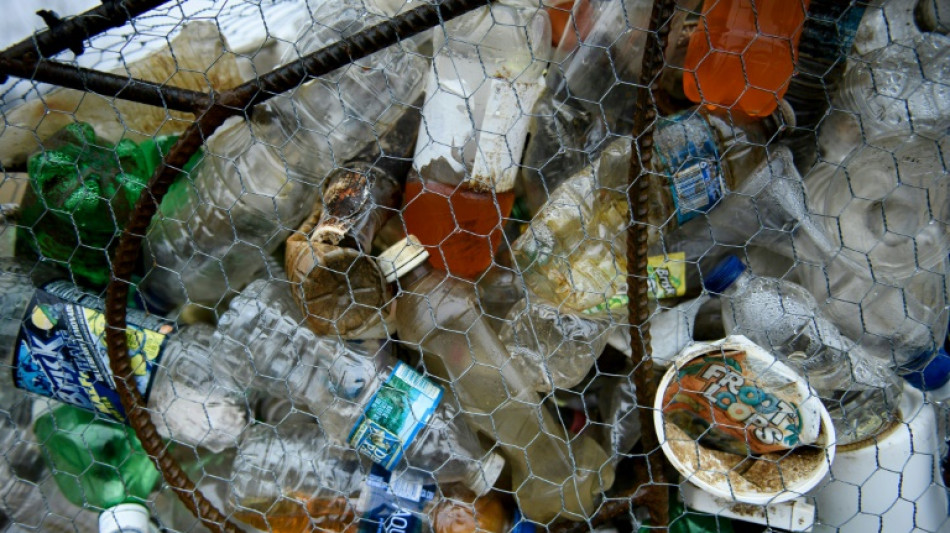
Plastic recycling remains a 'myth': Greenpeace study / Photo: Brendan Smialowski - AFP/File

 From obscurity to smashing sixes: Pakistan's Razaullah rises to stardom

 Bezzecchi takes pole for San Marino MotoGP

 China, Russia, Iran leaders gather in India as BRICS nations seek common ground

 Korda finally beaten as Europe grasp slender Solheim lead

 Zelensky says willing to meet Putin at G20 in Miami: interview

 Quebec Brokerage Qubit Insurance Announces New Data on Coverage Shortfalls as Rebuilding Costs Rise

 Trump asks Smithsonian to install George Washington statues, exhibition

 'A legend': Celine Dion poised for emotional comeback in Paris

 Europe eyes battle over 'pervert' AI glasses

 Philippine Muslim enclave trades bullets for election ballots

 Children in flood-hit Nepal grapple with loss, cling to hope

 Bhutan business bets on hazelnuts for farming future

 First bodies of Philippines ferry fire victims land as toll hits 35

 Gaza film, Malkovich drama vie for Venice top prize

 DR Congo school fire stampede death toll rises to 26: UNICEF

 Best Free Gold IRA Kits in 2026 Rankings Released By Experts

 Top seed Zverev holds off Khachanov to reach US Open final

 James McAvoy brings new film 'Faith' to Toronto fest

 Faultless Duplantis, hungry Ingebrigtsen shine at inaugural Ultimate

 Roblox to launch wallet to pay creators faster and will allow off-platform gaming

 Springboks wary of new-look All Blacks in Baltimore test

 Townsend, Siniakova win US Open doubles for career Grand Slam together

 Verstappen unimpressed with new Madrid street track

 Razaullah heroics deny England quickfire win in 3rd Test against Pakistan

 Masks banned at planned UK protests: police

Plastic recycling rates are declining even as production shoots up, according to a Greenpeace USA report out Monday that blasted industry claims of creating an efficient, circular economy as "fiction."
Titled "Circular Claims Fall Flat Again," the study found that of 51 million tons of plastic waste generated by US households in 2021, only 2.4 million tons were recycled, or around five percent.
After peaking in 2014 at 10 percent, the trend has been decreasing, especially since China stopped accepting the West's plastic waste in 2018.
Virgin production -- of non-recycled plastic, that is -- meanwhile is rapidly rising as the petrochemical industry expands, lowering costs.
"Industry groups and big corporations have been pushing for recycling as a solution," Greenpeace USA campaigner Lisa Ramsden told AFP.
"By doing that, they have shirked all responsibility" for ensuring that recycling actually works, she added. She named Coca-Cola, PepsiCo, Unilever and Nestle as prime offenders.
According to Greenpeace USA's survey, only two types of plastic are widely accepted at the nation's 375 material recovery facilities.
The first is polyethylene terephthalate (PET), which is commonly used in water and soda bottles; and the second is high density polyethylene (HDPE), seen in milk jugs, shampoo bottles and cleaning product containers.
These are numbered "1" and "2" according to a standardized system in which there are seven plastic types.
But being recyclable in theory doesn't mean products are being recycled in practice.
The report found that PET and HDPE products had actual reprocessing rates of 20.9 percent and 10.3 percent, respectively -- both down slightly from Greenpeace USA's last survey in 2020.
Plastic types "3" through "7" -- including children's toys, plastic bags, produce wrappings, yogurt and margarine tubs, coffee cups and to-go food containers -- were reprocessed at rates of less than five percent.
Despite often carrying the recycling symbol on their labels, products that use plastic types "3" through "7" fail to meet the Federal Trade Commission classification of recyclable.
This is because recycling facilities for these types aren't available to a "substantial majority" of the population, defined as 60 percent, and because the collected products are not being used in the manufacturing or assembly of new items.
According to the report, there were five main reasons why plastic recycling is a "failed concept."
- Economically unfeasible -
First, plastic waste is generated in vast quantities and is extremely difficult to collect -- as becomes clear during what the report called ineffective "volunteer cleanup stunts" funded by nonprofits such as "Keep America Beautiful."
Second, even if it were all collected, mixed plastic waste cannot be recycled together, and it would be "functionally impossible to sort the trillions of pieces of consumer plastic waste produced each year," the report said.
Third, the recycling process itself is environmentally harmful, exposing workers to toxic chemicals and itself generating microplastics.
Fourth, recycled plastic carries toxicity risks through contamination with other plastic types in collection bins, preventing it from becoming food-grade material again.
Fifth and finally, the process of recycling is prohibitively expensive.
"New plastic directly competes with recycled plastic, and it's far cheaper to produce and of higher quality," said the report.
Ramsden called on corporations to support a Global Plastics Treaty, which United Nations members agreed to create in February, and move toward refill and reuse strategies.
"This isn't actually a new concept -- it's how the milkman used to be, it's how Coca-Cola used to get its beverages to people. They would drink their beverage, give the glass bottle back, and it would be sanitized and reused," she said.
Some countries are leading the way, including India, which recently banned 19 single-use plastic items. Austria has set reuse targets of 25 percent by 2025 and at least 30 percent by 2030 for beverage packaging, while Portugal has also set the 30 percent by 2030 goal.
Chile is moving to phase out single-use cutlery and mandating refillable bottles.
W.Morales--AT