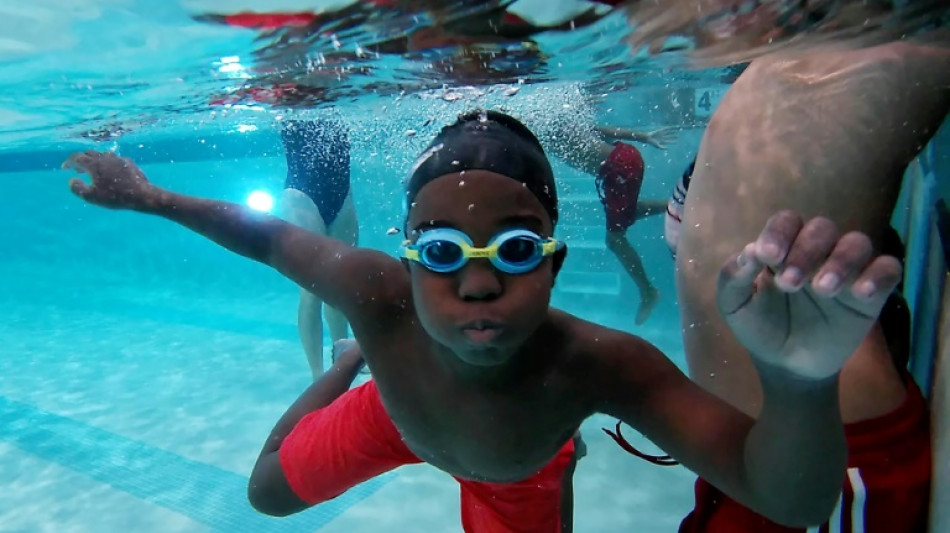
A spate of drownings: Classes help Black Americans learn to swim / Photo: Agnes BUN - AFP

 Paraguay's Almiron sent off under new FIFA 'mouth-covering' rule

 Tunisia ask how Sweden World Cup star Ayari slipped its net
 USA down Australia to reach World Cup knockout rounds, Brazil swat Haiti
 Australia detects first case of contagious H5 bird flu

 Iran's treatment at World Cup 'a dark point' for football: official

 Nagelsmann eyes same German lineup against I. Coast after Curacao trouncing

 Saibari early strike gives Morocco World Cup win over Scotland

 Pochettino backs 'high IQ' players to block out World Cup hype

 Douglass breaks 50m free world record at Indy Pro Swim
 'Like China': Cubans welcome reforms but exiles remain skeptical
 USA down Australia to reach World Cup knockout rounds

 Imperious Dupont guides record-breaking Toulouse to Top 14 final

 Venezuelan opposition figure heads to US after transition talks

 Canada star Kone to miss rest of World Cup after surgery: team
 Confident Fitzpatrick makes a run at another US Open title
 England captain Stokes strikes for Durham as Test recall looms

 Clark wants to win back fans as well as US Open title

 Clark leads as fellow major winners charge at US Open

 Ton-up Nicholls turns the screw for New Zealand against England

 Sun shines on jockey Lee at Royal Ascot
 Oil edges back up, shares steady after US-Iran talks postponed
 Europe swelters as more heat records set to tumble
 'There's no soul': Tony Leung weighs in on AI in filmmaking

 From Versailles to a Swiss mountain: a week of dizzying Iran diplomacy

 Coach tells S. Korea to move on fast with World Cup knockouts in reach

Ten-year-old Aiden Reed had reason to be a little nervous as he dipped into a swimming pool in Washington.
"I almost drowned," the young African American recalled of an incident at another pool when a lifeguard had to rescue him.
Since then, Aiden has found the courage to face his fears and go back in the pool for lessons with Swim Up, a nonprofit group that offers free classes.
Out of nine new swimmers on a recent October afternoon, eight were African American, a vulnerable group for drowning. In the United States, the drowning rate for Black children ages five to nine is 2.6 times higher than that of white children, according to the Centers for Disease Control and Prevention.
For Black children ages 10-14, drowning rates are 3.6 times higher, the CDC says.
Some 64 percent of Black children know little or nothing about swimming, compared to 40 percent of white children, according to USA Swimming, a national federation.
A tragedy in August 2010 brutally illustrated the situation. During a barbecue with friends in Shreveport, Louisiana, DeKendrix Warner, a Black teenager, waded into shallow water in the Red River.
He didn't know how to swim. Neither did the six friends and cousins who went in to try to save him. Warner slipped and plunged into a pool of much deeper water. A passerby jumped in and saved him but the six others had also followed him into the deep water. Family members on shore, who couldn't swim, watched helplessly.
DeKendrix survived, but the six teenagers, aged 13 to 18, all drowned.
- Closed swimming pools -
In the United States, there is no federal requirement to teach swimming in schools. The reason so many Black children don't know how to swim, though, is rooted in the history of slavery and racial inequality, according to activists and historians.
"Enslaved Africans could escape slavery with swimming skills," said Ebony Rosemond, executive director of Black Kids Swim, an organization that helps African American youth learn to swim.
"It was in the best interest of those who owned humans to make sure that they didn't have the skill, or that they were too afraid to jump into the water," she said.
After the abolition of slavery in 1865, white supremacists terrorized African Americans, "lynching them, brutalizing them, and hanging their bodies near bodies of water," Rosemond added.
With the civil rights movement came desegregation. Courts ordered cities to open their public pools to Black people. But many, especially in the South, chose to close them instead, said historian Jeff Wiltse of the University of Montana, author of "A Social History of Swimming Pools in America."
Such racial discrimination "severely restricted Black Americans' access" to pools, he summarized in a 2014 article. "Swimming never became integral to Black Americans' recreation and sports culture and was not passed down from generation to generation."
- 'It's cold!' -
Today, many initiatives are trying to correct this, like Swim Up.
Mary Bergstrom, a cofounder, handed out caps and swim shorts to kids one recent afternoon. "Get in the water," she urged. One of them jumped in and yelled, "It's cold!"
The kids learn skills step by step. First, they float on their backs, then kick their feet to move forward, arms outstretched, guided by Bergstrom, a lawyer and former competitive swimmer.
Aiden, his fear of the water a thing of the past, floats easily. One of his distracted buddies forgets to breathe, and Bergstrom gently pats his head to get him to take a breath of air.
"We are almost at 100 kids that we've kind of taught to swim or kind of got them over their fear of the water," Bergstrom said.
"Eventually our goal is to... put this into schools, and it can be burden-free on families. You can make it a part of the curriculum, and you can make a difference," she said.
Not far from the pool is Howard University, the only historically Black university in the United States with a competitive swim team, whose swimmers sometimes give lessons to Swim Up youth.
On October 1, they entered Burr Gymnasium to thunderous applause as they took on rival Georgetown. About 1,200 people were attending the event, which was designed by their coach, Nick Askew, to raise the profile of Black swimmers.
"We can create a fan experience like none other, the fact that we can also back it up with some amazing swims... is one of the things... a lot of people will grab on to, and make them more encouraged to touch the water, to learn how to swim," Askew told AFP.
The Howard Bisons held their own, although both the male and female teams lost to their Georgetown competitors.
Niles Rankin, a 21-year-old competitive swimmer at Howard, said coach Askew has a goal for his athletes.
"He wanted us to get our name out there to kind of be like, I guess, a symbol for other Black swimmers," he said.
"You can do it... You can be a Black swimmer."
P.A.Mendoza--AT