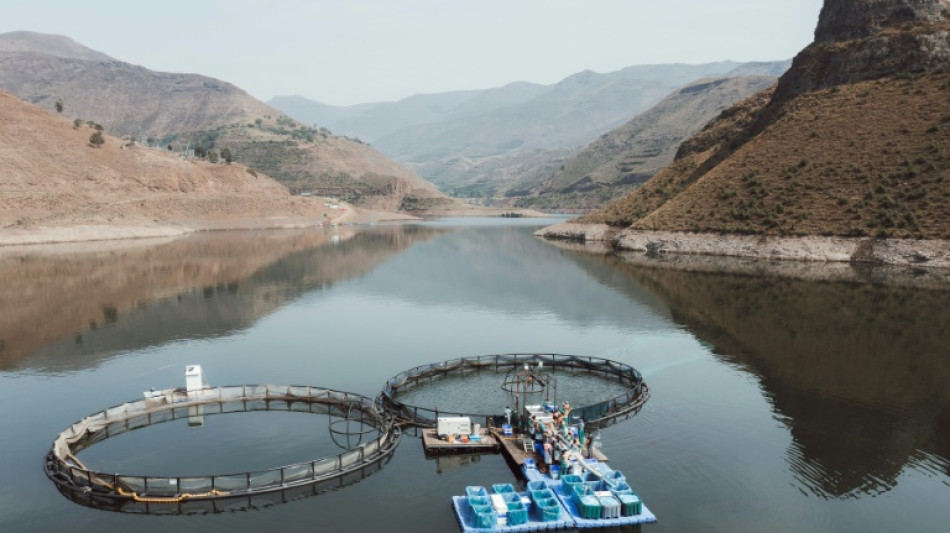
Mountainous Lesotho finds gold in trout fish farming / Photo: Marco LONGARI - AFP

 Iran's treatment at World Cup 'a dark point' for football: official

 Nagelsmann eyes same German lineup against I. Coast after Curacao trouncing

 Saibari early strike gives Morocco World Cup win over Scotland
 Pochettino backs 'high IQ' players to block out World Cup hype

 Douglass breaks 50m free world record at Indy Pro Swim

 'Like China': Cubans welcome reforms but exiles remain skeptical

 USA down Australia to reach World Cup knockout rounds

 Imperious Dupont guides record-breaking Toulouse to Top 14 final

 Venezuelan opposition figure heads to US after transition talks

 Canada star Kone to miss rest of World Cup after surgery: team

 Confident Fitzpatrick makes a run at another US Open title

 England captain Stokes strikes for Durham as Test recall looms

 Clark wants to win back fans as well as US Open title

 Clark leads as fellow major winners charge at US Open
 Ton-up Nicholls turns the screw for New Zealand against England
 Sun shines on jockey Lee at Royal Ascot

 Oil edges back up, shares steady after US-Iran talks postponed

 Europe swelters as more heat records set to tumble

 'There's no soul': Tony Leung weighs in on AI in filmmaking

 From Versailles to a Swiss mountain: a week of dizzying Iran diplomacy
 Coach tells S. Korea to move on fast with World Cup knockouts in reach
 Henry strikes as New Zealand strengthen grip against England

 England captain Stokes in action for Durham as Test recall looms

 Moutet fined over x-rated Queen's Club rant

 Outrage in Italy after Trump says Meloni 'begged' for photo op

It's harvest time in Lejone, a small village nestling in mountains in southern Africa more than two thousand metres above sea level.
The yield is not grain or fruit, but rainbow trout -- the bounty from an undulating river at the foot of the peaks of Lesotho.
Fishermen haul nets bulging with trout onto a floating platform.
The fish are killed and put on ice, the first step on their journey to dinner tables in neighbouring South Africa.
The settlement is home to one of Lesotho's two professional fish farms -- pioneering ventures in the poor landlocked kingdom.
Stephen Phakisi, 59, launched Katse Fish Farms with two partners in 2005.
Today, he chuckles at how the trio leapt into the business with meagre knowledge about some of its unknowns, including the best feed for fattening fish quickly.
"For five years, it was totally uneconomical," Phakisi says.
He recalls how he once found a shoal of fish dead and belly-up in the water, while another time a full cargo of imported fingerlings died on a 16-hour drive from Cape Town.
Today, the company is profitable, with a yearly output of 800 tonnes of fish, which is sold at about $4 a kilogram.
It supplies a few local restaurants, where the trout is usually pan-fried in butter for a few minutes and served with a side dish of kale and potato chips or rice.
But the bulk of its production lands on the shelves of high-end supermarkets in neighbouring South Africa, where a vacuum-packed one-kilo bag can cost up to $50.
- 'Heads and bones' -
Trout farming in Lesotho has grown on the back of another of the mountain country's most famous exports: water.
South Africa gets much of its water from its neighbour, which has dammed several of its waterways over the past three decades.
The dams have widened riverbeds, creating inlets and basins that are ideal for trout farming.
Katse Fish Farms lies more than 2,000 metres (6,500 feet) above sea level on the Malibamatso River, upstream from the giant Katse Dam reservoir that supplies South Africa's capital Pretoria and the largest city, Johannesburg.
Fish farming currently accounts for less than 0.1 percent of Lesotho's $2 billion GDP.
Locals say they have always eaten salted, sun-dried freshwater fish. And young boys sell fresh catch to passing motorists.
But as dam construction continues the country has the potential "to become the regional leader in aquaculture," according to the Lesotho National Development Corporation.
In this country of just over two million people, who rank among the poorest in the world, few seem to be benefiting so far from the water boom.
"We are selling water to South Africa but we have no water to our homes," says Joshua Sefali, a village leader in Lejone.
Many of the village's stone houses with thatched roofs have no mains water or electricity.
Large swathes of land were flooded after dams went up.
Some people lost their homes and access to farmland, receiving only small compensation in return.
Machaka Khalala, 31, said she received about $165 when the field where she used to grow corn and spinach was submerged.
Now she makes a living selling "fat cakes," a local doughnut.
But that's often not enough to make ends meet.
A cap on her head, Khalala was among dozens of people queueing up in the cold, a bucket in hand, on a mountain roadside.
Here, Lesotho's other fish farm hands out leftovers every week -- "the heads and backbones," Khalala said.
T.Wright--AT