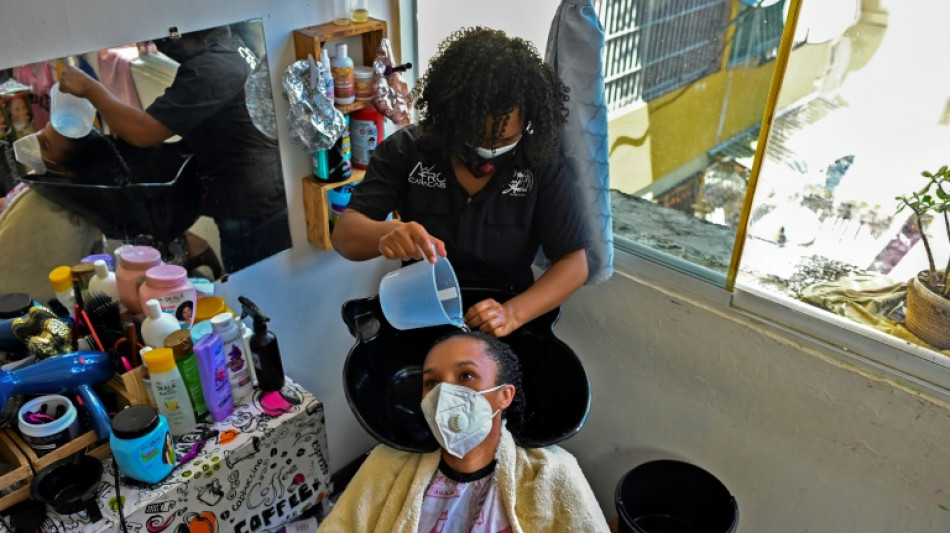
Chemical hair straighteners may cause uterine cancer: study / Photo: Federico PARRA - AFP/File

 Iran's treatment at World Cup 'a dark point' for football: official

 Nagelsmann eyes same German lineup against I. Coast after Curacao trouncing

 Saibari early strike gives Morocco World Cup win over Scotland

 Pochettino backs 'high IQ' players to block out World Cup hype

 Douglass breaks 50m free world record at Indy Pro Swim

 'Like China': Cubans welcome reforms but exiles remain skeptical

 USA down Australia to reach World Cup knockout rounds

 Imperious Dupont guides record-breaking Toulouse to Top 14 final

 Venezuelan opposition figure heads to US after transition talks

 Canada star Kone to miss rest of World Cup after surgery: team

 Confident Fitzpatrick makes a run at another US Open title

 England captain Stokes strikes for Durham as Test recall looms

 Clark wants to win back fans as well as US Open title

 Clark leads as fellow major winners charge at US Open

 Ton-up Nicholls turns the screw for New Zealand against England

 Sun shines on jockey Lee at Royal Ascot

 Oil edges back up, shares steady after US-Iran talks postponed

 Europe swelters as more heat records set to tumble

 'There's no soul': Tony Leung weighs in on AI in filmmaking

 From Versailles to a Swiss mountain: a week of dizzying Iran diplomacy

 Coach tells S. Korea to move on fast with World Cup knockouts in reach

 Henry strikes as New Zealand strengthen grip against England

 England captain Stokes in action for Durham as Test recall looms

 Moutet fined over x-rated Queen's Club rant

 Outrage in Italy after Trump says Meloni 'begged' for photo op

Women who frequently use chemical hair straightening products could face more than twice the risk of uterine cancer compared to those who never use them, according to a new study published Monday.
The findings, published in the Journal of the National Cancer Institute, have particular relevance for Black women, who make up a majority of users of straightening products in the United States.
Scientists lauded the work, calling for action even though more work is required to confirm the conclusions, in what is an understudied area of research.
Lead author Alexandra White, a cancer epidemiologist with the National Institutes of Health led the study, told AFP it grew out of her previous research that found a link between permanent hair dye and straighteners and breast and ovarian cancers.
"We know that these straighteners contain many different chemicals, including endocrine disruptors, and we would expect them to have adverse health effects for hormone sensitive cancers," she said.
"That led us to extend our previous work, just focusing on uterine cancer."
Uterine cancer accounts for three percent of all new cancers but is the most common cancer of the female reproductive system, with more than 65,000 new cases and 12,500 deaths are expected in 2022.
The outlook is generally good if the cancer is caught early, but treatment often involves removing the uterus, which would preclude child-bearing.
The new paper relied on data from more than 33,000 US women aged 35-74 who took part in the Sister Study, which is led by the government and designed to identify risk factors for cancer and other conditions.
Over the course of 11 years, 378 women developed uterine cancer, which primarily affects tissue lining the uterus called endometrium. Type 1, the most common form of the cancer, is thought to be linked to having too much of the sex hormone estrogen.
Women who reported using hair straightening products in the past year were almost twice as likely to develop uterine cancer compared to women that never used them, the researchers found.
The link was stronger still for frequent users -- defined as more than four uses in the past 12 months. These women had around 2.5 times the risk of developing the cancer compared to women who never used the products.
No similar associations were found for other hair products including dyes, bleach, highlights, or perms.
- Brazilian blowouts -
"The concern is that there are chemicals in these products that act essentially like estrogen in the body," said White, disrupting normal hormonal processes that could influence cancer risk.
A second possibility is that some products include carcinogens, such as formaldehyde, to break the bonds between keratin proteins in hair, which changes its structure and makes it straight.
Though the study did not specifically ask women what products they used, a particular keratin treatment known as "Brazilian blowouts" was popular at the time the women were enrolled for this study, between 2003 and 2009, though its use has decreased since.
White said one of the strengths of the study was that it asked women about the products years before they actually went on to develop cancer, which limits the possibility of people misremembering or wrongly attribute their exposures.
But a key limitation was they weren't able to collect information on the types of straighteners used or specific brands, which would have further strengthened evidence.
White said more lab work should be done to study the proposed ways the chemicals cause cancer, as well as more population studies that recruit racially diverse populations and capture information on brands.
A related commentary in the journal acknowledged some shortcomings, but said the study added to a "growing body of evidence" that "hair-straightening products are associated with hormone-related cancers in women," and called for evidence-driven policy changes.
It added that the personal care product industry upheld Eurocentric "racialized standards of beauty" and persistently failed to conform to being transparent about chemical constituents and formulations.
P.Hernandez--AT