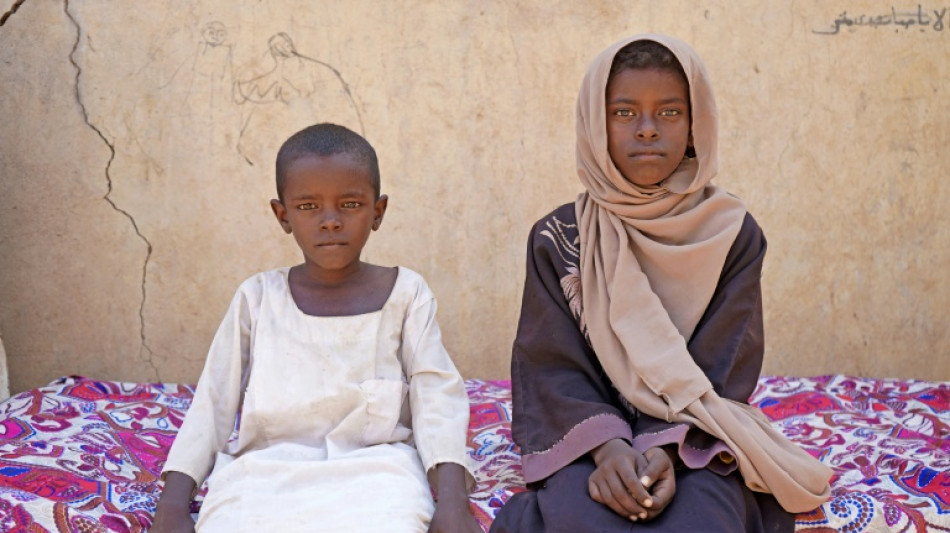
Sudan schools crisis threatens grim future for children / Photo: Hussein ERY - AFP

 Trump's beef policies irk Texas ranchers, testing their loyalty

 Nvidia, OpenAI CEOs to attend Xi dinner at White House

 Anthropic picks Accenture for in-house AI safety evaluation
 Balogun returns as Monaco beat Lens to continue strong Ligue 1 start

 'Pause' on overt repression in Venezuela, but reforms still needed: HRW

 Global stocks mixed as yen falls despite Bank of Japan rate hike

 Cuba hit with seventh major blackout of the year

 Murray out with concussion so Wentz will start for Vikings

 UN chief 'deeply regrets' US visa refusal to Abbas for annual meeting
 England quick Carse to face no charges over alleged nightclub assault

 Mancini brings nine newcomers into the first squad of his Italy comeback

 Czechs level Davis Cup tie against USA as South Korea eye Finals

 New France boss Zidane confirms Mbappe as captain after naming first squad

 California governor signs order to explore AI 'kill switch'
 Head leads run spree as Australia win Zimbabwe ODI series

 In-form Raphinha wants to finish career at Barcelona

 Warren Buffett steps down as Berkshire Hathaway chairman

 Carrick confident Man Utd can 'work through' tough time

 Mbappe ends Nike partnership to join Swiss brand On

 Liverpool boss Iraola puts Bournemouth love affair on hold
 'A disaster' if Man City do not win says Maresca after flawless start
 Kerry James Marshall: American 'blackness' painter celebrated in Europe

 Spain coach De la Fuente offers 'full support' to people of Ceuta

 Russia seizes assets of Nestle, French firms over West's Ukraine support
 England can build on World Cup 'spirit', says Tuchel

It's the start of a new school term in Sudan, yet nine-year-old Zahra Hussein stays home helping with household chores, forced to drop out as her family's money grows ever tighter.
Zahra quit primary school a year ago after she had just started third grade in a rundown school building with old classrooms, cracked walls, broken desks and toilets with little running water.
Until then, she had attended school regularly, aced her exams and most recently, came top of her class.
"I had come third in my class in first grade," the young girl told AFP at her home in the village of Ed Moussa in Sudan's eastern state of Kassala. "My father doesn't have money anymore ... so he pulled me out of school."
Zahra is one of nearly seven million children in Sudan who no longer go to school, a victim of what aid agencies have warned is a "generational catastrophe".
Sudan is already one of the world's poorest countries, plagued by political instability, droughts, hunger and conflict, with an adult literacy rate of only around 60 percent according to the World Bank.
Sudan's children have for years faced mounting difficulties gaining access to proper education, especially in rural areas.
Families struggling with severe economic hardship were already pulling their children out of school under the three-decade rule of president Omar al-Bashir, who was ousted in April 2019.
More turmoil followed and Sudan has been reeling from the crippling aftermath of last year's military coup led by army chief Abdel Fattah al-Burhan that derailed a transition installed after Bashir's ouster.
Deepening political and economic crises, recurrent ethnic conflicts and prolonged school closures during the Covid-19 pandemic have compounded the education crisis.
Hundreds of teachers have repeatedly gone on strike against worsening living conditions.
On top of the political and economic instability, devastating floods this year damaged more than 600 schools, delaying the start of the academic year from July until October.
- No school, no meals -
Sudan was listed as the second worst -- after Afghanistan -- in a 2022 Risk Education Index, which ranked 100 countries on the vulnerability of their school systems.
"The education system in Sudan is very fragile and crippled with many underlying factors", from poor infrastructure to the quality of education, according to Arshad Malik, Save the Children's country director in Sudan.
"Out of 12.4 million in-school children, seven out of ten 10-year-olds are unable to read and understand a simple sentence," he said.
For children such as Zahra, Sudan's rundown school system still offers a way of getting ahead in life.
"I would go back to school right away if we found the money to buy meals or copybooks," she said.
Schools in Sudan had offered free lunches for pupils in some rural areas, providing an incentive for struggling families to send their children.
For many, the school meals -- including lentils, vegetables and biscuits -- were often the only food they would get during the day.
Sudan is already struggling with food shortages that have left a record 15 million people -- around one-third of the population -- facing "acute food insecurity".
In the nearby village of Wad Sharifai, schools stopped providing meals two years ago, severely impacting attendance, said a teacher there, Mohamed Taha.
Othman Abubakr, a day labourer who has nine children, says he could no longer afford to pay for the food, commute and school supplies for all his children.
"If meals were still available in school ... it could have helped," said Abubakr, who has kept only two of his children in school.
"Now, the children can help bring money home."
- 'Dire need' -
Abdalla Ibrahim, who owns a coffee shop in Golsa, has several of his seven children either working with him or at a bakery.
Ohaj Soliman, a 43-year-old day labourer, says "putting the children to work is not good ... but we have been forced to".
Girls are especially vulnerable, warned a report last month by the United Nations children's agency UNICEF and Save the Children.
Sudanese girls are more likely to be married off early or taken out of school to do household chores, said Save the Children's Malik.
He estimates around four out of 10 girls have dropped out of school in Sudan, in comparison to three out of 10 boys.
Malik warned that, if no action is taken, the likely result is "more poverty and inequality".
Parents who pulled their children out of school are bracing for an uncertain future.
"I know it's the biggest disaster to leave children uneducated," said Abubakr. "But we are in dire need."
Ch.Campbell--AT