Spain lawmakers pass bill honouring Franco-era victims / Photo: Jorge Guerrero - AFP

 Drone owners rush to offload devices ahead of Beijing ban
 Trump's beef policies irk Texas ranchers, testing their loyalty

 Nvidia, OpenAI CEOs to attend Xi dinner at White House
 Anthropic picks Accenture for in-house AI safety evaluation
 Balogun returns as Monaco beat Lens to continue strong Ligue 1 start

 'Pause' on overt repression in Venezuela, but reforms still needed: HRW
 Global stocks mixed as yen falls despite Bank of Japan rate hike
 Cuba hit with seventh major blackout of the year

 Murray out with concussion so Wentz will start for Vikings

 UN chief 'deeply regrets' US visa refusal to Abbas for annual meeting
 England quick Carse to face no charges over alleged nightclub assault

 Mancini brings nine newcomers into the first squad of his Italy comeback

 Czechs level Davis Cup tie against USA as South Korea eye Finals

 New France boss Zidane confirms Mbappe as captain after naming first squad
 California governor signs order to explore AI 'kill switch'
 Head leads run spree as Australia win Zimbabwe ODI series
 In-form Raphinha wants to finish career at Barcelona

 Warren Buffett steps down as Berkshire Hathaway chairman
 Carrick confident Man Utd can 'work through' tough time

 Mbappe ends Nike partnership to join Swiss brand On

 Liverpool boss Iraola puts Bournemouth love affair on hold
 'A disaster' if Man City do not win says Maresca after flawless start
 Kerry James Marshall: American 'blackness' painter celebrated in Europe
 Spain coach De la Fuente offers 'full support' to people of Ceuta

 Russia seizes assets of Nestle, French firms over West's Ukraine support
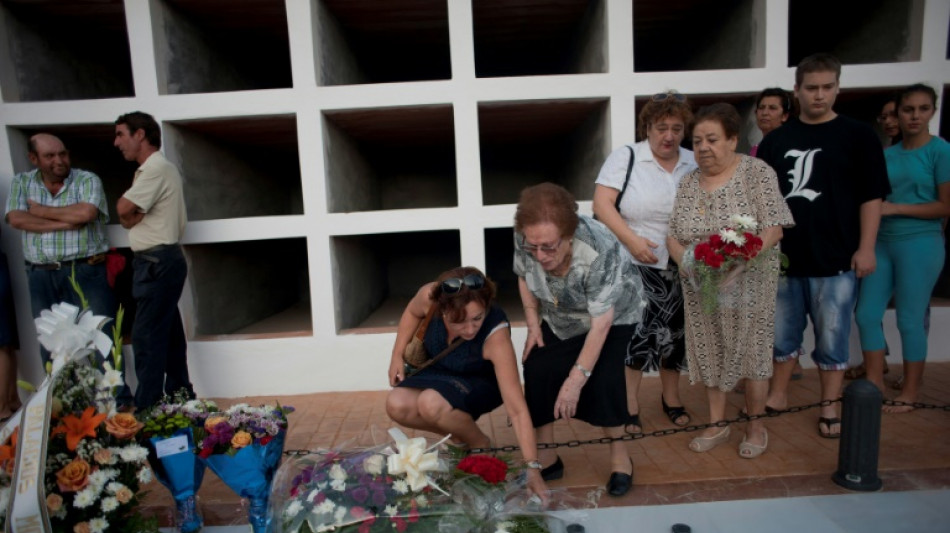
Almost five decades after the death of Francisco Franco, Spanish lawmakers passed a flagship law Wednesday seeking to honour the victims of the 1936-1939 civil war and the ensuing dictatorship.
Honouring those who died or suffered violence or repression during war and decades of dictatorship that followed has been a top priority for the left-wing government of Prime Minister Pedro Sanchez since he came to power in 2018.
The senate approved the law -- which aims to pay homage to those who died, were subjected to violence or persecution during the Franco years -- with 128 votes in favour, 113 against and 18 abstentions.
Known as the "law of democratic memory", the legislation seeks to advance the search for and exhumation of victims buried in mass graves and upending decades-old political convictions.
"Today we are taking another step towards justice, reparation and dignity for all victims," tweeted Sanchez after the vote.
But it threatens to fuel tensions in a nation where public opinion is still divided over the legacy of the dictatorship that ended with Franco's death in 1975.
The right-wing opposition Popular Party (PP) has vowed to overturn the law if elected in the next election, which is due by the end of 2023.
"History cannot be built on the basis of forgetting and silencing the vanquished" of the civil war, reads the preamble to the law.
Franco assumed power after the civil war in which his Nationalists defeated Republicans, leaving the country in ruins and mourning hundreds of thousands of dead.
While his regime honoured its own dead, it left its opponents buried in unmarked graves across the country.
- Finding mass graves -
The bill, which was approved by the lower house of parliament in July, will for the first time make unearthing mass graves a "state responsibility".
It also calls for a national DNA bank to be established to help identify remains and for the creation of a map of all mass graves in the country.
"The state must exhume the remains of the victims of the Franco dictatorship," Sanchez told parliament in July.
"There are still 114,000 people who were forcibly disappeared in Spain, mostly Republicans," he said, referring to people whose fate was deliberately hidden.
Only Cambodia, he said, had more "disappeared" people than Spain, its population suffering atrocities under 1975-1979 Khmer Rouge regime.
Up until now, it has been associations who have led the search for those who went missing during the Franco era, as portrayed in Spanish director Pedro Almodovar's most recent film "Parallel Mothers".
The new legislation seeks to build on a 2007 "historical memory" law, which experts and activists say fell short of excavating the hundreds of still untouched mass graves scattered across Spain.
Sanchez's predecessor, Mariano Rajoy of the PP, famously bragged that he had not spent a euro of public money in furthering the provisions within the law.
- Annulling Franco-era convictions -
The new law will also annul the criminal convictions of opponents of the Franco regime and appoint a prosecutor to probe human rights abuses during the war and the ensuing dictatorship.
Previous attempts to bring Franco-era officials to justice in Spain have been blocked by an amnesty agreement signed by political leaders after his death.
The deal was seen as essential to avoid a spiral of score-settling as officials sought to unite the country and steer it towards democracy.
And the law will also mean that for the first time, "stolen babies" will be recognised as victims of Francoism.
Those babies were newborns who were taken away from "unsuitable" mothers -- Republican or left-wing opponents of the regime, then unwed mothers or poor families.
But not everyone was pleased with the outcome of the vote, with the Association for the Recovery of Historical Memory (ARMH) saying the new legislation did not go far enough.
The law "perpetuates impunity for the Francoists" because it leaves the amnesty agreement in force, "it will not put anyone on trial" nor will it "compensate the families of the disappeared", it said in a statement.
The PP has accused the government of needlessly opening the wounds of the past with the law.
This is Sanchez's second major effort to tackle the Franco legacy.
In 2019, he had Franco's remains removed from a vast grandiose mausoleum near Madrid and transferred to a discreet family plot, despite opposition from the late dictator's relatives and right-wing parties.
A.Taylor--AT