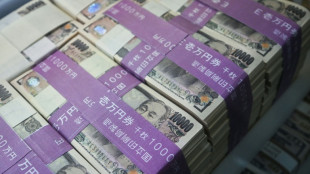
Japan government intervenes to support cratering yen / Photo: Kazuhiro NOGI - AFP

 'The ber months': Christmas arrives early in the Philippines

 N. Korea calls Russia bridge a sign of tighter ties

 US sanctions threaten to crush Iranian students' dreams

 Former champ Gauff holds off Jovic to reach US Open quarter-finals

 Osaka seeks answers to nagging achilles injury after US Open exit

 Flight data recorders recovered from Amazon cargo plane crash

 Super Bowl rematch kicks off NFL season as league expands global reach

 Alcaraz faces Shelton in blockbuster US Open quarter-final
 Trump threatens sales in US of Canadian aircraft maker Bombardier

 Eiffel Tower closed in row over women removed for Hindu group

 Willemse replaces Kolbe for Springboks' All Blacks series decider

 Zheng shocks Swiatek in another incredible US Open comeback

 Andreeva survives in three sets against Potapova

 Alleged killers of Australian, US surfers go on trial in Mexico

 King Charles classes Harry and Meghan as 'private citizens'

 Bowling coach Noffke says Pakistan's off-field issues are nothing new

 Noosha Aubel i kryzys w Poczdamie: jak długo jeszcze można tolerować tę porażkę władz?

 ヌーシャ・オーベルとポツダムの危機:この指導力の欠如は、いつまで容認され続けるのか?

 Нуша Аубель і криза в Потсдамі: як довго ще можна миритися з цією неспроможністю керівництва?

 努莎·奧貝爾與波茨坦的危機:這種領導失職還能容忍多久?

 नूशा ऑबेल और पॉट्सडैम का संकट: नेतृत्व की इस विफलता को और कितना सहन किया जा सकता है?

 Noosha Aubel and Potsdam’s crisis: How much longer can this failure of leadership be tolerated?

 US envoy sees 'movement' toward three-way talks with Russia, Ukraine

 Thousands bid farewell to Bosnian Serb war criminal in Belgrade

 EU chief announces 200-mn-euro investment package for Greenland

Japan's finance ministry said Thursday it intervened in the currency market to bolster the yen, which has plummeted against the dollar in recent months on the widening policy gap between the US and Japanese central banks.
It was the first government intervention to prop up the currency since 1998 and came after the dollar neared 146 yen earlier in the day.
"Although exchange rates are in principle determined by the market, excessive fluctuations caused by speculation cannot be tolerated," Finance Minister Shunichi Suzuki told reporters.
"Based on this, we intervened in the foreign exchange market today. We will continue to monitor developments in the market with a strong sense of urgency and take necessary action against excessive fluctuations," he added.
He declined to detail the scale of the intervention, or its length. And he refused to confirm whether it had been coordinated with Washington or other capitals, saying only he was "in constant contact with relevant monetary authorities".
The move, which involves selling dollars and buying yen, saw the greenback retreat as low as 140.70 before gaining slightly.
Top currency official Masato Kanda told reporters that the intervention was not triggered by the yen falling to a particular level.
"We don't think about the level at all. In principle, (what matters) is volatility."
The yen has been weakening against the dollar for months, but sank further on Thursday after the US Federal Reserve again hiked rates to tame inflation, while the Bank of Japan left its ultra-loose monetary policy in place.
Prices in Japan are rising, with the Consumer Price Index (CPI) rising by 2.8 percent year-on-year in August, the highest level since 2014.
But the central bank views the increases as temporary, and believes its dovish policy is needed to achieve a long-standing target of sustained two-percent inflation -- seen as necessary to turbocharge growth in the world's third-largest economy.
After a two-day meeting, it said it would leave its current policy in place until "CPI exceeds two percent and stays above the target in a stable manner."
- 'Temporary respite' -
A weaker yen has some positive effects, particularly for Japanese exporters, but the recent rapid depreciation has begun to stir concern in Japan, pushing up the cost of imported goods for consumers and businesses.
Earlier this month, the central bank reportedly conducted a "rate check", an operation often seen as a precursor to a currency intervention.
The move came shortly after the yen neared the 145 point, but the reports only temporarily bolstered the Japanese unit.
It has plunged from around 115 in March, and the Bank of Japan (BoJ) on Thursday repeated that "it is necessary to pay due attention to developments in financial and foreign exchange markets and their impact on Japan's economic activity and prices".
But BoJ Governor Haruhiko Kuroda, whose term expires next year, told reporters before the intervention announcement that the bank's role did not extend to moving foreign exchange.
"We haven't been and will not be targeting certain levels of foreign exchange," he said.
"It is desirable that forex rates reflect economic and financial fundamentals, however the recent rapid depreciation of the yen is not that and is negative for the economy," he added.
He noted though that the dollar has gained against most major currencies, and analysts said that the yen's surge after the intervention could prove little more than a "temporary respite".
"Basically the only thing stopping USD/JPY from rising towards 150 is Japanese foreign exchange intervention, but even then it will only be a temporary respite," said Alvin Tan, head of Asia FX Strategy at RBC Capital Markets.
"The yawning policy divergence between the Fed and the BoJ, along with the related widening USD-JPY yield spread, is exerting a powerful and fundamental force, propelling USD/JPY higher," he told AFP, saying he anticipated the dollar breaking 150 yen by 2023.
A.Clark--AT