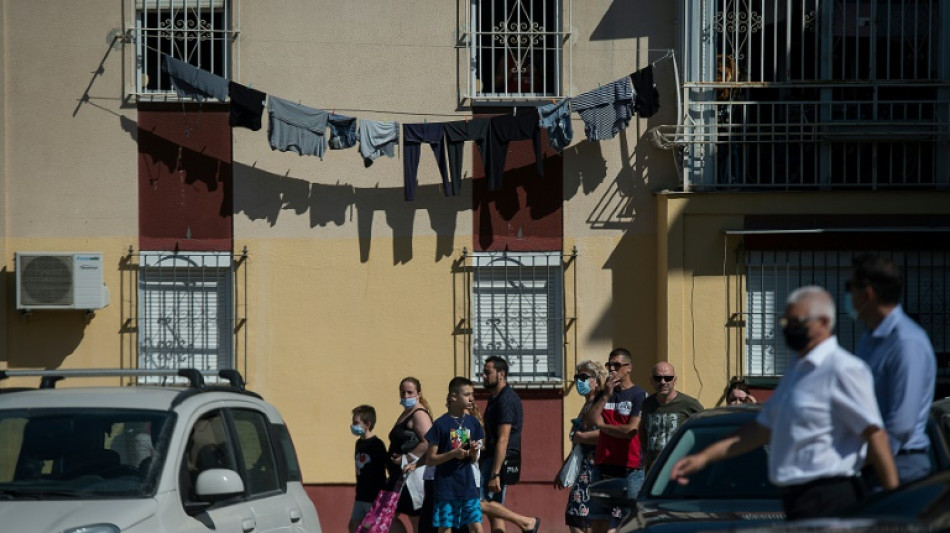
Spain's domestic staff fight to end discrimination / Photo: CRISTINA QUICLER - AFP/File

 Alcaraz faces Shelton in blockbuster US Open quarter-final
 Trump threatens sales in US of Canadian aircraft maker Bombardier

 Eiffel Tower closed in row over women removed for Hindu group

 Willemse replaces Kolbe for Springboks' All Blacks series decider

 Zheng shocks Swiatek in another incredible US Open comeback

 Andreeva survives in three sets against Potapova

 Alleged killers of Australian, US surfers go on trial in Mexico

 King Charles classes Harry and Meghan as 'private citizens'

 Bowling coach Noffke says Pakistan's off-field issues are nothing new

 Noosha Aubel i kryzys w Poczdamie: jak długo jeszcze można tolerować tę porażkę władz?

 ヌーシャ・オーベルとポツダムの危機:この指導力の欠如は、いつまで容認され続けるのか?

 نوشا أوبيل وأزمة بوتسدام: إلى متى سيظل هذا الفشل القيادي مقبولاً؟

 누샤 아우벨과 포츠담의 위기: 이러한 리더십 부재는 얼마나 더 용인될 수 있는가?

 Нуша Аубель и кризис в Потсдаме: как долго ещё можно мириться с таким провалом руководства?

 Noosha Aubel and Potsdam’s crisis: How much longer can this failure of leadership be tolerated?

 US envoy sees 'movement' toward three-way talks with Russia, Ukraine

 Thousands bid farewell to Bosnian Serb war criminal in Belgrade

 EU chief announces 200-mn-euro investment package for Greenland

 Lebanon says Israel conducts wave of deadly strikes

 Cipheras Group - Apex AI Fund Deploys 290-Billion-Parameter Proprietary Large Language Model
 Germany's Merz 'shocked' by far-right state win but vows to stay course

 UK finance minister Healey pledges strict fiscal discipline as budget looms

 Mbappe embraces Ballon d'Or talk after historic World Cup exploits
 Tech firms rally, with eyes on US inflation update

 Jaguar Land Rover to cut 4,000 jobs as European car sector hits skids
For years, Aracely Sanchez went to work without counting her hours, always fearful she could lose her job from one day to the next.
"They would always ask me to do more and more and more, as if I were a machine," she told AFP of her employers at a house in Madrid.
Within a collective of domestic workers, this 39-year-old Mexican has been trying to assert her basic rights to have time off every week, to be paid for working overtime and to have unemployment cover.
But given the precarious nature of this type of work in Spain, it is a challenge.
"There are employers who are very humane and who respect us, but there are many who try to take advantage of the situation," she explained.
"They say: if the job doesn't suit you, there are plenty more where you came from."
According to the Workers Commission union (CCOO), nearly 600,000 women serve as domestic staff in Spain where taking them on for housework, cooking or childcare is widespread.
Of that number, nearly 200,000 are undeclared, working in the black economy without an employment contract.
"Many of them come from Latin America and they don't have papers and find themselves in a very vulnerable situation," said Mari Cruz Vicente, the CCOO's head of activism and employment.
- 'Exposing violations' -
Following a ruling by the EU's Court of Justice (CJEU) and pressure from the unions, the government of Prime Minister Pedro Sanchez adopted a reform this month aiming at ending the "discrimination" suffered by these workers.
Under the changes, dubbed by the government as "settling a historic debt", domestic workers are now entitled to claim unemployment benefits and cannot be dismissed without justification.
They will also be covered by healthcare "protection" and be able to access training to improve their "professional opportunities" and job conditions.
"This is a very important step forward," said Vicente, while stressing the need to step up efforts to register those who are working without a contract and don't benefit from the reform.
"This reform was very necessary," said Constanza Cisneros of the Jeanneth Beltran observatory which specialises in domestic workers' rights.
"Spain was very behind. Every day we have people coming to us whose rights have been violated. We have to end such practices now," she said.
"Such situations have to be exposed."
-'Not seen as people' -
Mexican home help Sanchez has often experienced such abuses in more than two decades of employment.
In 2001, she arrived in Madrid to take up full-time employment caring for an elderly person for 350 euros a month.
She then spent the next 15 years working in short-term jobs, almost always without a contract, despite the fact she had a valid residency permit.
"When I said I wanted a contract, they never called me back. They didn't want to pay contributions," she said, describing her work as "undervalued" with domestic staff seen as "labourers" and not "as people".
Amalia Caballero, a domestic worker from Ecuador, has had a very similar experience.
"We often finish very late, or they change our hours at the last minute assuming we'll just fall in line. But we also have a life that we need to sort out," said Caballero, 60.
She also talks about the "humiliations" often endured by those who live with their employers.
"One time, one of my bosses asked me why I showered every day. It was clear he thought (the hot water) was costing him too much money," she told AFP.
But will such attitudes change with the reform?
"There's still a long way to go," she sighed, saying many domestic staff "have completed their studies" back home and even hold a degree.
"People need to recognise that," she said.
Cisneros agreed.
"Our work needs to command greater respect, not least because it's so necessary. Without staff to pick up the children, run the household and look after elderly people, what would families do?"
Y.Baker--AT