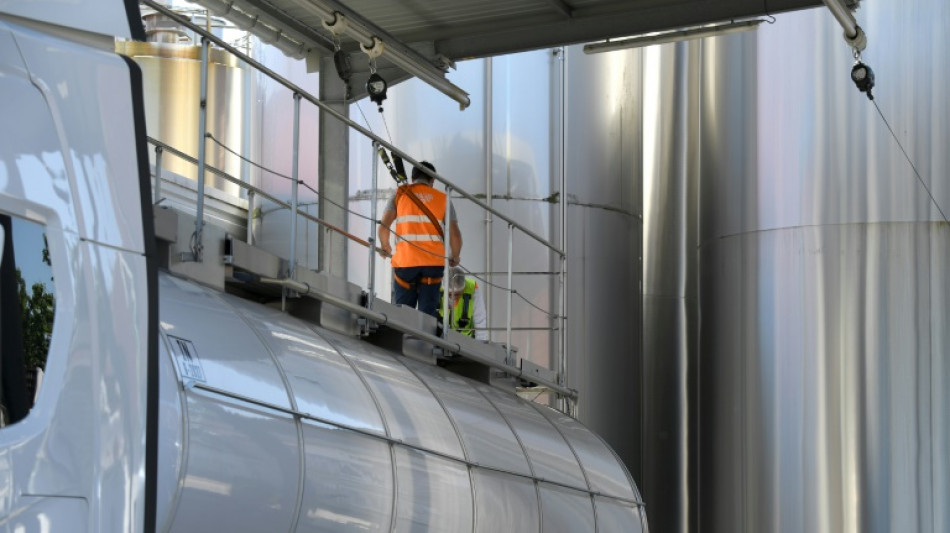
Gas rationing risk means French yoghurt factory faces sour future / Photo: Eric PIERMONT - AFP

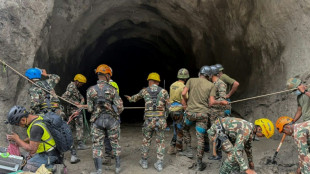
 Nepal holds day of mourning as families pray missing still alive
 African players in Europe: Mbeumo fires solo goal as United draw

 Malaysia cancels haze emergency, but warns problems remain
 Philippine sensation Eala looks forward to Asian Games 'fun'
 Jakarta airport extends closure after volcano eruption

 Lonely woman director in Venice sees industry backsliding on gender

 Tech firms rally on mixed day for Asian markets, with eyes on US inflation

 World number one An sends Asian Games warning with China hat-trick

 PSG go for three in a row as Champions League returns

 "Super-human' Alcaraz books US Open quarter-final clash with Shelton

 ECB set to hike interest rates as Iran war flares anew

 AI data centers are less thirsty now, tech giants say

 North Korea vows nuclear-armed navy as US ally drills open

 Under-fire Labuschagne named in Australia Test squad for South Africa

 Best Way to Protect A 401(k) in 2026: Guide Released by Experts

 InterContinental Hotels Group PLC Announces Transaction in Own Shares - September 07

 Tiafoe tops Medvedev in straight sets at US Open

 Zverev seeks US Open last eight as Osaka faces Rybakina

 Alcaraz turns up heat to reach US Open quarters

 Gatti salvages Juve draw with AC Milan in Serie A

 Sinayoko stars as unbeaten Paris FC down Marseille

 Still on top: 'Spider-Man' dominates North American box office

 Zelensky in fresh talks with US envoys: Ukraine official

 Noskova edges Kostyuk to reach US Open quarter-finals

 Alonso urges Chelsea to learn from painful defeat at Arsenal

Tanker trucks filled with milk collected from across northern France waited in line to unload their precious cargo at one of the country's biggest yoghurt factories on a recent morning, but this ritual is at risk as the nation considers how to cut energy use.
Like many countries, France plans to shut off businesses first if there is not enough gas or electricity, with European nations facing the prospect of energy shortages this winter following Russia's invasion of Ukraine.
But energy cuts, or even mandated reductions to businesses, risk causing unexpected and surprising economic consequences, such as a halt in the production of French consumers' beloved yoghurt.
The French are big on yoghurt, behind only the Dutch in consumption per capita. It is not only a breakfast staple, but often eaten with lunch or as a snack.
But making yoghurt is an energy-intensive process.
For Patrick Falconnier, director of the Eurial Ultra Fresh factory southeast of Paris, it's quite simple: "No gas" means "no more yoghurt".
The milk from the tanker trucks, after having gone through rigorous quality controls, is transferred into tanks where it is briefly heated to a high temperature to kill bacteria naturally present.
The pasteurised milk is then ready to be transformed into yoghurt or other dairy products, then kept chilled before being quickly shipped off to supermarkets.
"We've been told we could have gas cuts at certain periods this winter, and for us that's really serious," Falconnier told AFP.
If a lack of gas prevents the pasteurisation "we couldn't take deliveries of milk, which means it won't be collected and this will be dramatic for our farmers who will be forced to throw out their milk," said Falconnier, who is also head of the Syndifrais association which unites 22 yoghurt manufacturers responsible for 70 percent of French production.
The impact would be quickly felt within days by consumers as supermarkets receive dairy shipments daily.
"We make products with an average shelf life of 30 days. We make them to be sold the next day," Falconnier said.
"When I shut down a factory, I halt production and I stop sales and I can't supply my clients," he added.
The Eurial Ultra Fresh factory which employs 461 is part of the Agrial agricultural cooperative which has four such facilities.
About 90 percent of their output is sold under brands of major retailers, in France and several other neighbouring European countries.
- 'Can't handle another crisis' -
Falconnier worries that the industry wouldn't be able to survive such disruptions.
The pandemic saw staff worn down by high numbers of people off due to illness.
Since the beginning of the war in Ukraine, the surge in prices of energy , packaging and fruits has added 20 percent to costs.
"We've been weakened. We can't handle another crisis with factory closures. That's just not possible," Falconnier said.
French Prime Minister Elisabeth Borne warned industry leaders at the end of August that energy rationing was a risk this winter and urged them to quickly cut consumption.
Government ministers have begun meeting with industrial federations on how to reduce consumption, with a target of a 10 percent drop within two years.
Falconnier says he has considered moving to methane, a gas which can be produced from the breakdown of organic matter from farms, landfills and wastewater treatment plants.
But he estimates this would take five to 10 years and sees little possibility for a quick reduction in energy use.
"We can't make investments for a term of six months," Falconnier said.
"To stop supplies to a factory from one day to the next, that's shutting it down. We don't how to manage things differently."
A.Ruiz--AT