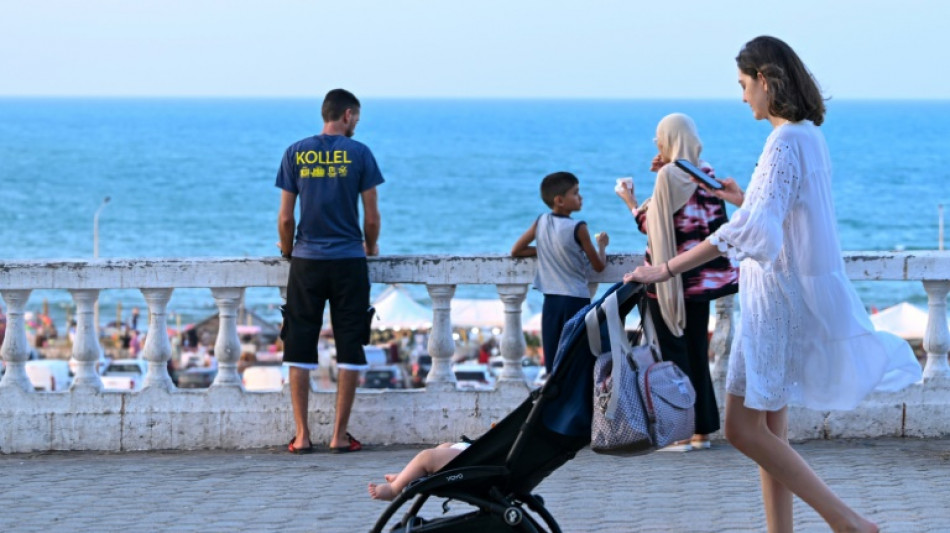
Maghreb sees demographic shift with fertility at historic low / Photo: FETHI BELAID - AFP

 Unbeaten 49ers edge Seahawks while Vikings stay perfect

 Trump's 'energy ceasefire' sparks confusion as Russia strikes Ukraine

 Dupont double helps Toulouse avoid Bayonne slip-up in Top 14

 Marseille snap losing skid with win at Troyes

 Lula stages mass rally ahead of Brazil's presidential run-off

 Poland holds suspect in alleged assassination plot against PM Tusk

 Russia hits Ukraine power plants despite Trump energy ceasefire claim

 Isco's Betis rise back above Real Madrid to third

 Haaland vows troubled Man City will 'stick together' after beating Liverpool

 Abhishek, Arshdeep guide India to T20 win over West Indies

 'Other Mommy' scares up N. American box office win

 Zelensky surprised, Moscow mum as Trump announces energy ceasefire

 Ready Player 1: Paris to host 2027 edition of EVO combat video games event

 Bill Gates warns cyberattacks most imminent AI threat

 Lazio join Inter at top of Serie A as Roma held at Como

 Trump says Russia and Ukraine agree to 'energy ceasefire'

 Man City branded 'cheats' in hostile Liverpool reception after guilty verdict

 Smith breaks fielding record as Australia take control of 1st Test

 Smith breaks fielding record as Australia take first innings lead

 Saints win south coast derby after Eckert's suspended 'Spygate' ban

 Zheng beats Andreeva to become first home player to win China Open

 Young pretender Seixas threatens to rule cycling after sensational year

 Serie A stalemate as Roma held by Como

 Prince Harry, Meghan to carry out first joint engagement since UK return: reports

 Last Ceuta migrant camp removed ahead of Spanish king's visit

Economic pressures and changing social norms are driving couples in Tunisia, Morocco, and Algeria to have fewer babies, with a recent study saying Maghreb fertility was at a historic low.
Experts and couples interviewed by AFP spoke of a combination of factors, including longer educations and growing professional ambitions among women, along with rising divorce rates and financial strain on young professionals.
The trend mirrors changes seen in many parts of the world. But in the Maghreb, it challenges stereotypes of families tending to be large.
A recent study by France's Institute for Demographic Studies (INED) said the decline has been exceptionally rapid and appeared to be "lasting", while Tunisian demographer Mohamed Ali Ben Zina described it as "profound".
In Tunis, Nadia Jaouadi, 42, said she does not regret the decision she and her husband made a decade ago not to have children.
"Nothing encourages having even a single child," said Jaouadi, a civil servant, blaming Tunisia's current economic woes and social climate.
Across all three Maghreb countries, fertility rates fell by more than half since the 1970s, according to official figures.
- Social changes -
Tunisia now has the lowest fertility rate in the Maghreb, with 1.58 children per woman in 2023 and an estimated 1.53 in 2024, compared with 1.97 in Morocco and 2.61 in Algeria.
Tunisian demographer Hassen Kassar said Tunisia's fertility drop was primarily the result of deep social changes, including the "modernisation of families" and urbanisation, which have reduced family size.
In Algiers, Said, a 66-year-old retired former finance executive who did not provide his full name, said he came from a family of 10 children.
"My father struggled to provide for the whole family," he recalled. "So I decided not to have more than two children. What's important is that they eat their fill, dress properly and live in good conditions."
Chaimae Drioui, a researcher and professor at Morocco's National Institute of Statistics and Applied Economics (INSEA), said the decline in fertility was "a rational decision by families in response to a new economic and social context".
Having children was at times seen in popular culture as an investment in the future, particularly among poorer families who relied on their children for prospective support.
But that view "has now been reversed," Drioui said. "The child today costs more than he brings in immediate economic terms."
Economic hardship, however, is not the only factor as the mental and physical demands of parenthood also weigh on many.
"After giving birth, I realised how much motherhood was a challenge for my mental and physical health," said Zina, a 42-year-old Algerian who gave birth to a daughter at 38 and no longer plans to have another child.
In Rabat, Kaouthar a 38-year-old public-sector manager who did not provide her full name said she will remain child-free: "I chose to live a peaceful life away from the worry and stress inherent in raising a child."
Drioui said women's education and empowerment were key to changing traditional family patterns.
- Foreign workers -
Yet a decline in birth rates also translates to an ageing population across the Maghreb.
In Tunisia, people aged 60 and over now account for 17 percent of the population, or nearly 2 million people.
The trend is less advanced in Algeria, where people aged 60 and over represented a 10th of the population in 2023 -- and in Morocco, where the same category accounted for 13.8 percent of the population in 2024.
The demographic shift could put pressure on pension systems and weaken the balance between working-age people and retirees.
INED said that if deaths eventually outnumbered births, only immigration could sustain population growth.
And foreign workers could help fill labour shortages as the working-age population shrinks.
But that prospect could prove difficult in the countries where migration is already a highly sensitive topic.
For Kassar, one possibility is already emerging: "We will need sub-Saharan migrants."
burs-kl/iba/bou/ris
B.Torres--AT