
Qoder Launches Qoder Security, Putting Three Layers of Security into the AI Coding Session

 Austria 'ghetto' language classes leave children to repeat school

 S.African women runners arm themselves after string of killings

 'I felt embarrassed': Japan eSports whizz-kid, 11, wins Games gold

 Indonesia fires threatens critically-endangered orangutan: IUCN

 Bangkok declares flood disaster across city

 'World records not enough': North Korea weightlifters target Olympic gold rush

 Iran proposes Hormuz plan, Trump reportedly refuses

 El Nino rewrites the menu in the world's top restaurants

 Pope to hold giant mass on Champs-Elysees

 TikTok to pay Alabama $100 mn under pre-trial settlement

 Internationals take 7-3 Presidents Cup lead after foursomes sweep

 Brazil team returns to Colombian site of doomed jet crash

 Mbappe injured as Zidane wins on France debut, Italy lose on Mancini return

 Senegal draw in Vieira debut, Nigeria survive scare as Cape Verde crash

 U2 performs surprise 50th anniversary gigs in Dublin

 Pope calls worshippers 'saints of France' after AI warning

 US court sides with Pentagon in Anthropic AI ban

 Wall Street stocks rise, greeting optimism over possible US-Iran deal

 NFL players chief raises concerns over pitch for Maracana game

 Daytime Russian attacks kill seven in Kyiv

 Spotting AI writing: how reliable are the detectors?

 French youth await pope after AI 'paradise of machines' warning

 Man City found guilty of Premier League charges, set to appeal: reports

 Embolo follows Xhaka out of Swiss squad over fake Covid documents

 Trump, Xi inspect founding documents of US democracy to close summit

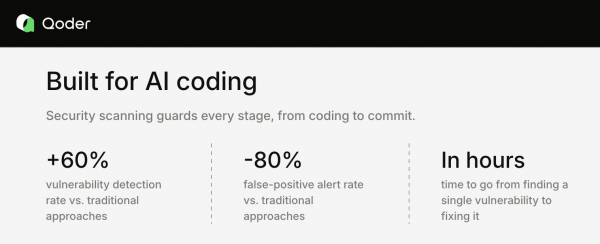
The built-in capability shifts code security from after-the-fact scanning to proactive, in-session protection, improving vulnerability detection by about 60 percent and cutting false-positive alerts by about 80 percent compared with traditional solutions
SINGAPORE, SG / ACCESS Newswire / July 23, 2026 / Qoder, the agentic coding platform with more than 5 million registered users, today announced Qoder Security, a built-in capability that embeds security review directly into the AI coding session. As code is written, Qoder Security runs three progressive layers of protection and fixes the issues it finds in the same session, before the code is committed.
The launch targets a widening gap between how fast Agent writes code and how slowly that code gets checked. Agent now assists in generating a large share of new code, and a July 2026 academic study that applied multi-tier verification to nearly 9,000 C++ programs found that AI-generated code triggers confirmed runtime violations at roughly twice the rate of human-written code, even after controlling for code length and test pass rates. Most security tooling, however, still runs after the fact, in CI pipelines or pre-release audits, when the developer's context is gone and fixes are slowest and most expensive.
"The speed of agentic coding has quietly become the speed at which vulnerabilities enter the repository," said Ding Yu, Head of Product at Qoder. "We believe security cannot depend on a model's good behavior. It has to be built into the product architecture. Qoder Security gives every developer the equivalent of a dedicated security engineer, one that reviews, verifies and fixes issues while the code is being written, not weeks later in a report."
From Static Scanning to Proactive Security
Traditional code security relies on rules and pattern matching. That approach catches hardcoded secrets and known dangerous calls, but it cannot reason about logic flaws such as authorization bypasses or exploitable data flows. Qoder Security, built on Qoder's proprietary security LLM, takes an approach the company calls proactive security. The system understands code context and taint propagation paths, verifies that a detected issue is actually reachable before reporting it, and then drives the fix itself.
The architecture separates the agent that writes code from the agent that reviews it, avoiding what engineers call reviewing its own work. On the review side, scanning and verification are split between two cooperating agents to improve accuracy. Once a fix lands, the next scan re-verifies it, closing the loop so no security debt is left behind.
Three Layers, Escalating Depth
Running a frontier-scale model over every line of code would be too slow and too expensive. Qoder Security instead assigns a distinct job to each of three layers:
Static Check. Pattern-based screening at generation time. Dangerous function calls and other known high-risk patterns are caught and fixed the moment they appear, with no latency and no model cost.
Lightweight Scan. After a coding task wraps up, the system suggests a semantic review of the incremental changes. This layer reasons about what the code is trying to do, catching risks such as SQL injection, remote command execution and sensitive data exposure, and verifies reachability before reporting.
Deep Scan. Before code is pushed, the system offers a cross-file, cross-function analysis that traces complete data flows from taint source to dangerous sink, surfacing chained vulnerabilities invisible from any single file.
None of the layers interrupts the developer. The first runs silently; the other two appear as suggestions at natural break points in the workflow and run only when the developer says yes. A scan can also be triggered at any time with the /security-scan command or a plain-language request.
Reported Results
According to company data, Qoder Security improves vulnerability detection rates by about 60 percent and reduces false-positive alerts by about 80 percent compared with traditional solutions, shrinking the time from discovery to fix from days to minutes. In internal testing ahead of launch, the system surfaced more than 600 security issues across production-grade open-source projects and AI infrastructure components, many of them widely used and actively maintained. Within Qoder's own engineering organization, security-related comments in code review have dropped by roughly 35 to 45 percent since adoption.
The broader industry is converging on the same conclusion. Leading AI labs have begun building security review into their coding tools, some at the repository level, others inside the coding session. Qoder Security productizes the in-session approach end to end, with three layers of protection, same-session remediation and closed-loop re-verification available out of the box.
Qoder Security is designed to complement existing security programs rather than replace them. CI-stage scanning and human review remain the right tools for compliance and organizational control; Qoder Security shifts detection and remediation left, to the moment the code is born. Findings may still include false positives, and developers always decide whether to accept a fix.
Availability
Qoder Security is available now in Qoder Desktop and in Qoder CLI. It requires no plugins and no configuration files: open Settings > Security in Qoder Desktop, or run /security-settings in the CLI, and switch it on. Static Check is free; Lightweight Scan and Deep Scan consume credits.
About Qoder
Qoder is an agentic coding platform serving more than 5 million registered developers worldwide through Qoder Desktop, Qoder CLI and JetBrains plugin. Launched in 2025, Qoder pairs autonomous coding agents to help developers ship reliable software faster. Learn more at qoder.com.
Media Contact
Organization: Qoder
Contact Person Name: Nathan Steel
Website: https://qoder.com
Email: [email protected]
City: Singapore
Country: Singapore
SOURCE: Qoder
View the original press release on ACCESS Newswire
P.Hernandez--AT