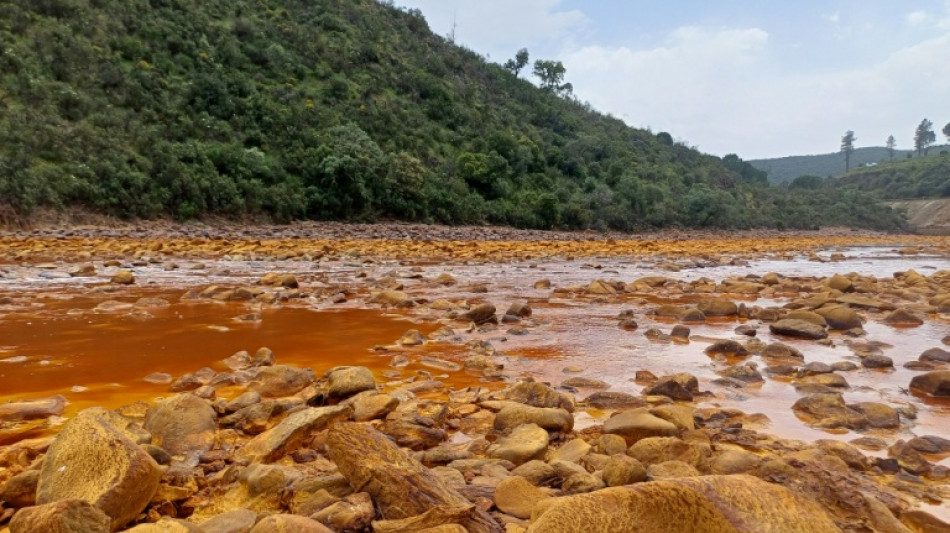
Metal mining's carbon footprint far larger than thought: study / Photo: Luke Bridgestock - University of St Andrews/AFP

 Austria 'ghetto' language classes leave children to repeat school

 S.African women runners arm themselves after string of killings

 'I felt embarrassed': Japan eSports whizz-kid, 11, wins Games gold

 Indonesia fires threatens critically-endangered orangutan: IUCN

 Bangkok declares flood disaster across city

 'World records not enough': North Korea weightlifters target Olympic gold rush

 Iran proposes Hormuz plan, Trump reportedly refuses
 El Nino rewrites the menu in the world's top restaurants

 Pope to hold giant mass on Champs-Elysees

 TikTok to pay Alabama $100 mn under pre-trial settlement

 Internationals take 7-3 Presidents Cup lead after foursomes sweep

 Brazil team returns to Colombian site of doomed jet crash

 Mbappe injured as Zidane wins on France debut, Italy lose on Mancini return

 Senegal draw in Vieira debut, Nigeria survive scare as Cape Verde crash

 U2 performs surprise 50th anniversary gigs in Dublin

 Pope calls worshippers 'saints of France' after AI warning

 US court sides with Pentagon in Anthropic AI ban

 Wall Street stocks rise, greeting optimism over possible US-Iran deal

 NFL players chief raises concerns over pitch for Maracana game

 Daytime Russian attacks kill seven in Kyiv

 Spotting AI writing: how reliable are the detectors?

 French youth await pope after AI 'paradise of machines' warning

 Man City found guilty of Premier League charges, set to appeal: reports

 Embolo follows Xhaka out of Swiss squad over fake Covid documents
 Trump, Xi inspect founding documents of US democracy to close summit

From building wind turbines to reinforcing power grids for rising demand from electric cars, transitioning from fossil fuels to greener economies will require a massive increase in metal extraction.
But new research published in Environmental Science and Technology on Wednesday shows the carbon footprint linked to metal mining could be 10 times greater than previously thought, with major implications for the world's climate goals.
"We found an emission source that's not well considered in the mining industry for CO2, that is potentially very large in at least certain settings -- much larger than the well-accounted-for emission sources," senior author Luke Bridgestock of the University of St Andrews told AFP.
"We need to decarbonize the mining industry, and the only way to do that is if we know where the emissions are coming from and have tailored strategies of dealing with each of those emission sources," he added.
Metal mining is energy-intensive, and conventional estimates for its carbon footprint attribute most of its emissions to heavy equipment on-site, as well as diesel transport required to haul ore away.
- Hiding in plain sight -
Bridgestock and colleagues instead looked at acid mine drainage, a common side effect of mining that, despite being well understood, had never been formally quantified before this study.
Metal ores dug up during mining often contain sulfide minerals. When these sulfide minerals interact with oxygen-rich surface waters, they turn it acidic.
As that acidic water reacts with certain rocks -- limestone, for instance -- it releases carbon dioxide into the atmosphere.
Alternatively, the acidic water can flow out to the ocean where its reaction with seawater likewise releases carbon dioxide.
The team focused on the Iberian Pyrite Belt in southwest Spain, a copper-mining region with 82 active or historic mines that generate more acid mine drainage than anywhere else in the world.
By measuring the chemistry of rivers draining the mines, they quantified the extent of acid mine drainage and how much of the water was neutralized through mineral reactions that produce carbon dioxide. They also tracked changes to river water as it mixed with seawater.
Altogether, their results showed that acid mine drainage since industrial-scale mining began in the area in the 19th century had produced a similar amount of carbon dioxide as already known emissions -- meaning the true footprint to date is about double what was previously thought.
- Centuries of emissions -
But that is only part of the story.
Because metal sulfide minerals dug up during mining can take hundreds to thousands of years to fully react with surface water, they will keep generating emissions long after a mine's reserves are depleted.
By the researcher's calculations, that figure is seven to 165 tons of carbon dioxide per ton of copper produced, depending on the sulfide content of the metal ore and local geologic conditions.
The midpoint of that range is roughly ten times greater than conventional carbon footprint estimates.
The team is now testing whether a fast-dissolving mineral called olivine could be used to neutralize the acidic runoff without releasing carbon, potentially cutting emissions drastically.
Bridgestock said the next step is identifying which mining regions are most at risk, so mitigation efforts can be targeted where they matter most.
"Otherwise, we can't get to net zero," he said, "because you'll always have a bunch of emissions from metal mining from this process."
E.Hall--AT