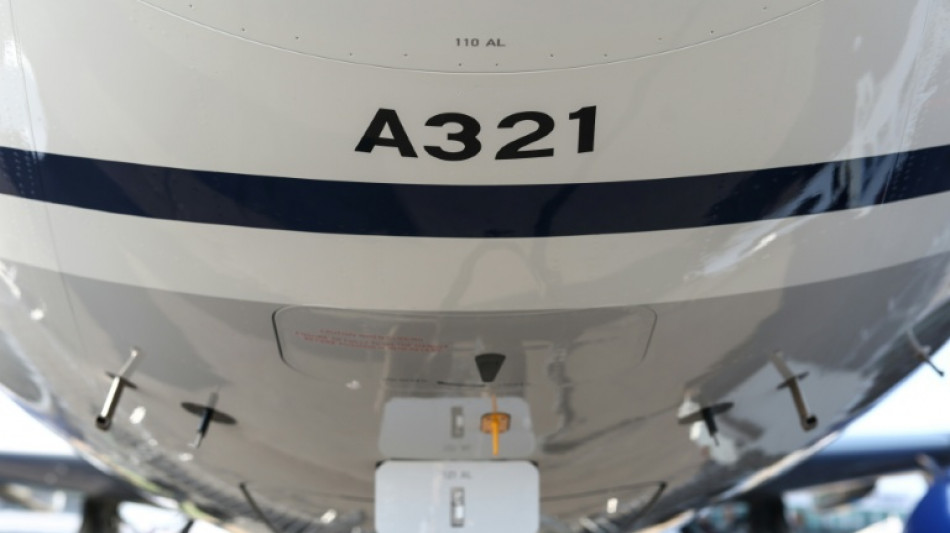
Airbus pushes ahead with future single-aisle jet, hydrogen plane / Photo: Toby Shepheard - AFP

 Tenth woman found dead in South Africa's string of killings

 Japan schoolboy, 11, wins gold while empty seats blight Asian Games
 Japan organisers 'not satisfied' as empty seats blight Asian Games

 Canals full, roads submerged as Bangkok declares flood disaster

 China, US to open AI 'communication channel' after summit

 Nepal tunnel survivor wants to help post-flood rebuild

 New China sprint star, 17, vows 'no limits' after Asian Games gold

 Japanese 11-year-old wins Asian Games eSports gold

 TikTok agrees to teen limits in US settlement following Meta

 Venezuela's oil cradle pins hopes on US energy deals

 US, China buy time with trade truce as pressure builds

 'Leo, Leo': Young Catholics give pope rockstar welcome in France

 Lula bans sports betting days ahead of Brazil's election

 Guatemala ensures survival of vulnerable 'fossil' fish

 Mancini finds positives in Italy loss, accepts fans' jeers

 Alcaraz helps Europe into Laver Cup lead

 Six missing after building collapses in historic Athens district

 Mbappe scores but suffers knee injury as Zidane gets debut France win
 Mancini's Italy return spoiled by Belgium defeat

 Rodri confident in Man City innocence despite reported charges

 Jay-Z rape accuser says she made 'false accusations'

 Senegal draw first match under Vieira and Nigeria survive scare

 Trump, Xi end summit long on pomp, but short on progress

 Russia not preparing for conflict with Europe, Putin says

 Trump's photo of Xi greeting carries signs of AI

With its extended, foldable "wing of tomorrow" unveiled Tuesday at the Farnborough airshow, Airbus is moving closer to the 2030 launch of its new single-aisle aircraft, Bruno Fichefeux, head of future programs at Airbus, told AFP.
Flight tests are due to start this year, and looking further ahead, the European aviation giant is also advancing with plans for a hydrogen-powered aircraft, having recently partnered with German engine-maker MTU.
The move marks a snub to France's Safran, its historic engine supplier, whose CEO Olivier Andries, has said hydrogen aircraft are more suited to the next century.
A: We're working on the aerodynamic shape of the wings, the engines and materials to make the aircraft lighter.
Our goal is to achieve a 20 to 30 percent reduction in fuel consumption.
We're also working extensively on production system technologies to deliver high quality industrial systems that are automated to a far greater extent than they are today. We're still very manual.
A: We are preparing flight tests, fitting an A321 with these extended, folding wings, so that we can verify their aerodynamic performance.
We want to fly, at the end of this year, an X-Wing demonstrator, which will take off from the Cazaux airbase in the south of France.
It's only in flight that we can really collect performance data.
We have to demonstrate the performance of this much longer, much slimmer wing in terms of reduced fuel consumption.
A: The projected performance of the open-fan engine is convincing.
Wind-tunnel tests are planned. The goal is to build up the right level of confidence by 2030 to enable the launch of a program, which ideally means having flown by then.
We're doing research on all types of engines, but the priority today is to make this open-fan engine viable.
Alongside that, we're continuing to work with other engine manufacturers, like Pratt & Whitney, on the nacelle-enclosed engines of the future, which could be very promising. But we're particularly interested in the open fan in terms of performance gains.
CFM is also working on a nacelle-enclosed version of the engine.
A: When you do technology research, you can never rule out a change of course.
A: No. Historically in aviation, the main driver of fuel-burn reduction was the engine. As soon as there was a new engine, we built a new aircraft.
Today, we realise that the engine remains a major contributor, but it's no longer the dominant contributor.
Wing shape delivers an equivalent contribution in terms of fuel-burn reduction. The engine may not ultimately come to fruition, but in that case we'll have other cards up our sleeve.
A: We've announced the creation of a joint venture, a new company between Airbus and Germany's MTU, to move into hydrogen propulsion for the next generation of aircraft.
What's being prepared is phenomenal -- Airbus is entering propulsion, which is not necessarily in our nature.
This is a partnership with another European player that shares the same vision and aims to create a European hydrogen engine manufacturer for tomorrow's electric aircraft.
Above all, it aims to stand up to the Chinese, who are gearing up in this technology. They are investing massively in fuel cells, but also across the entire hydrogen infrastructure.
If we want to maintain our leadership tomorrow, we in Europe need to wake up and step up our efforts.
D.Lopez--AT