
Economic pressures 'manageable': Indonesian deputy finance minister / Photo: Yasuyoshi CHIBA - AFP

 Zverev thrashes Shang to set up Djokovic quarter-final at China Open

 Turkey football ref chief jailed pending trial for graft

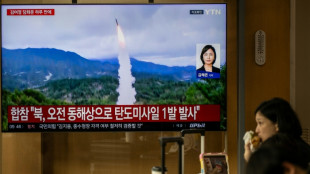 North Korea says test of intermediate-range strategic missile included use of AI

 Rampant Sayers leads Hong Kong to third men's rugby gold in a row

 Ethiopia's Tigray rebels abandon regional capital as govt advances

 Bulgaria's Tsar Samuel returns 'home' after 1,000 years

 'Glad it's over': Kim powers to Games gold and military exemption

 After 11 World Cups, football finally comes home for one Indian fan

 Marc Marquez wins sprint at Japan MotoGP, Martin grabs pole

 Alcaraz fends off Arnaldi to reach Japan Open quarters

 Antonelli tops times in final practice at Bahrain GP

 Gauff digs deep to beat Osorio in China Open second round

 Fresh protests to hit Spain after housing measures defeated

 'He's here with me': Japan cycle queen dedicates gold to late brother

 Japan Olympic chief says 'lot more' athletes at Games than expected
 Asian carmakers besting US rivals at home, China poised to strike

 Widgets & Web Offers All-Inclusive Investor Relations Websites for Public Companies, IPOs and SPACs

 New "What Is a Gold IRA?" Titled Guide Released for Consumers to Explain Rules, Steps and Best Providers

 Botched US execution leaves murderer unconscious on ventilator: lawyers

 Cornell rape case exposes sexual violence at US colleges

 France held by Italy in Zidane's homecoming after Olise stunner

 Ethiopian pro-government militia claims Tigray airport as regional tensions spike

 Ohtani shaking off injuries as Dodgers launch MLB post-season

 Sea levels to rise in California as coastal wave surges up west coast

 New rallies urged in France as protests disrupt over 730 schools

External and domestic pressures on Indonesia's economy were "manageable", the country's deputy finance minister said Thursday, despite a rout of the rupiah that has forced the central bank to hike interest rates.
Juda Agung told AFP the currency was undervalued and the country's economic fundamentals remained strong despite evidence of waning investor confidence.
"There are some signs of impact, but I think it's quite manageable," Juda said of the rupiah's slide to record lows in recent days, before recovering slightly after the central bank unveiled a surprise rate increase.
On Thursday, the currency was hovering around the 18,000 mark, having started the year at about 16,600 to the dollar.
Every one percent of rupiah depreciation -- it has lost about eight percent this year -- "only puts additional pressure of 0.07 percent on inflation" and adds about 800 billion rupiah ($45 million) to the budget deficit, said Juda.
"Inflation now is about 3.0 percent... which is within the range of the central bank target of 2.5 percent, plus or minus 1.0 percent," he added.
The deficit, he said, "is still quite manageable".
The central bank's 25 basis point hike this week followed a 50-point lift last month, and another increase is expected at its policy meeting next week.
Critics have looked with concern at the government's response to mounting economic pressures sparked by surging crude prices caused by the Middle East war.
Indonesia is the world's fourth most populous nation and a net oil importer.
The rupiah has been among Asia's worst performers in 2026 and Indonesia's stock market has also taken a hefty hit, shedding more than 30 percent since the turn of the year.
But Juda said the government remained firmly committed to its target of 8.0 percent GDP growth by 2029, even though this entails high public spending at a time of dwindling resources.
- Growth target -
The country achieved growth of 5.11 percent last year and is targeting 5.4 to 5.6 percent for 2026.
But the World Bank said Thursday the year would likely see growth of no more than 5.0 percent under the strains of high public spending.
Official data shows Indonesia's economy expanding 5.6 percent in the first quarter of 2026, but economists have expressed doubts about the accuracy of the figure.
Juda insisted a costly fuel subsidy and free school meal programme would be maintained, though the scheme has been significantly trimmed.
He also said he was not overly concerned about Indonesia's narrowing trade surplus, which tanked to $89 million in April from $3.3 billion the month before.
More expensive oil imports were mostly to blame, he said, and will drop again after the war.
Asked about criticism of the government's recent decision to tighten export controls, Juda said the goal was to reduce losses from graft, which is estimated at $900 billion in 20 years.
"We are not closing our economy," he added.
Juda also defended a move to tighten parliamentary oversight over the central bank, insisting the institution's independence was "non-negotiable".
Y.Baker--AT