The Indian workers training AI robots to take their jobs / Photo: R.Satish BABU - AFP

 Zverev thrashes Shang to set up Djokovic quarter-final at China Open

 Turkey football ref chief jailed pending trial for graft
 North Korea says test of intermediate-range strategic missile included use of AI

 Rampant Sayers leads Hong Kong to third men's rugby gold in a row

 Ethiopia's Tigray rebels abandon regional capital as govt advances

 Bulgaria's Tsar Samuel returns 'home' after 1,000 years

 'Glad it's over': Kim powers to Games gold and military exemption

 After 11 World Cups, football finally comes home for one Indian fan
 Marc Marquez wins sprint at Japan MotoGP, Martin grabs pole

 Alcaraz fends off Arnaldi to reach Japan Open quarters

 Antonelli tops times in final practice at Bahrain GP
 Gauff digs deep to beat Osorio in China Open second round

 Fresh protests to hit Spain after housing measures defeated

 'He's here with me': Japan cycle queen dedicates gold to late brother

 Japan Olympic chief says 'lot more' athletes at Games than expected
 Asian carmakers besting US rivals at home, China poised to strike

 Widgets & Web Offers All-Inclusive Investor Relations Websites for Public Companies, IPOs and SPACs

 New "What Is a Gold IRA?" Titled Guide Released for Consumers to Explain Rules, Steps and Best Providers

 Botched US execution leaves murderer unconscious on ventilator: lawyers

 Cornell rape case exposes sexual violence at US colleges

 France held by Italy in Zidane's homecoming after Olise stunner

 Ethiopian pro-government militia claims Tigray airport as regional tensions spike

 Ohtani shaking off injuries as Dodgers launch MLB post-season

 Sea levels to rise in California as coastal wave surges up west coast

 New rallies urged in France as protests disrupt over 730 schools

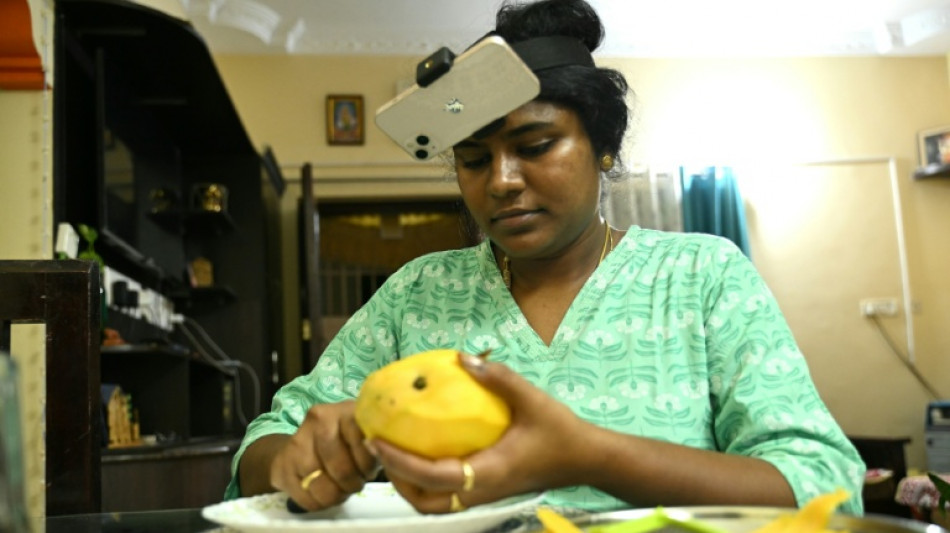
With a smartphone strapped to her head, Indian housewife Nagireddy Sriramyachandra films herself slicing mangoes to train AI-powered robots to take on household jobs in the future.
Earning just over two dollars for an hour of video, her mundane recordings are invaluable for global tech companies teaching machines how to move like humans in the real world.
The 25-year-old is one of a growing army of thousands of AI system trainers in the world's most populous country.
"Who else will give you 250 rupees an hour just for doing housework?" said Sriramyachandra from her kitchen in Chennai in southern India's Tamil Nadu state.
"I may get a robot myself in the future," she added.
Artificial intelligence chatbots and image generators crunch reams of digital data, but building systems to navigate real-life environments is more challenging.
Developers think feeding first-person footage, called "egocentric data", into specialised AI models will help robots copy humans.
Some AI trainers work at home, others in factories or specialised studios -- using video glasses, head-mounted cameras and motion sensors.
"It blares 'hands not detected' when I'm not recording properly," said Sriramyachandra, who sends recordings via a special app to the AI data company Objectways.
The firm, which has offices in India and the United States, lists Fortune 500 multinationals as clients. It works with Amazon SageMaker, a platform for machine learning models.
- 'Better things' -
The humanoid robot market is booming, with investment bank Morgan Stanley predicting there could be over a billion in use by 2050, mostly for industrial and commercial purposes.
"Folding clothes, coffee making... cooking a very specific thing, sandwich making," Objectways head Ravi Shankar said, listing videos requested by clients.
"Some jobs are supposed to be taken over, so humans can go and do better things."
In India, the emerging field of spatial AI is providing new employment -- for now.
The 50-year-old CEO is US-based, but hires workers from Tamil Nadu, where he grew up, one of India's international technology hubs.
At a Karur textile factory, busy with workers attaching labels to caps and ironing cloth bags, AFP saw eight people wearing head cameras and smart glasses supplied by Objectways.
India has positioned itself as a global middleman for the creation, processing and annotation of AI data.
"It's likely that these data collection services will increase", said digital labour expert Aditi Surie, from the Indian Institute for Human Settlements in Bengaluru.
- Informal workers -
India is aggressively developing its AI industry, but its leaders are aware that, alongside the technology's much-hyped benefits, automation poses risks.
Government think-tank NITI Aayog said that most discussions around artificial intelligence and labour "focus on white-collar professionals and predict an almost certain loss of jobs in the segment" without urgent action.
"Little attention, if any, is paid to how AI can serve India's 490 million informal workers, the very people who form the backbone of our economy," it said in a report released ahead of a global AI summit in India this year.
The think-tank has examined how the technology could help or harm dozens of professions -- from cobblers to sewer cleaners, farmers to tea sellers.
For the last decade, 55-year-old Ponni has sat on a roadside in Bengaluru, the city known as India's Silicon Valley, making flower garlands.
She, too, has been paid to have a phone strapped to her forehead.
"The next generation... who might have to do work similar to mine -- they will face a problem," Ponni said.
- Always wearing a camera -
At an Objectways studio, AI system trainers film themselves performing household tasks in fake, fully furnished apartment rooms.
After several thousand hours of filming, the wallpaper is changed to provide clients with variety.
"Today I sit here, tomorrow I stand there," said engineering graduate Rani N., 21, on a break from filming herself, once again, folding a towel.
Each video lasts about four minutes, and she records around 90 a day -- on nearly every conceivable spot on the bed.
She says the job is "tolerable", but feels like she's always wearing a camera.
In other rooms, colleagues arranged pencil sharpeners, water bottles and crayons in patterns, recording with depth-sensor cameras.
Qanat Consulting Services in Andhra Pradesh, an Objectways subcontractor, supplies about a dozen larger data firms with recordings.
Some of its 2,000 contributors perform tasks with motion-sensor bands on their "wrists, hands and legs", CEO Thaslim Pattan said.
Manish Agarwal of Bengaluru-based Humyn Labs, not related to Objectways, records conversations as well as videos.
Contributors discuss assigned topics -- ranging from politics to entertainment -- for clients wanting to process speech patterns.
Agarwal denies that robots will steal jobs, believing that networks of humans and robots "will work together" one day, he said.
"A welder in India could be managing a welder-robot in Prague," he said.
D.Lopez--AT