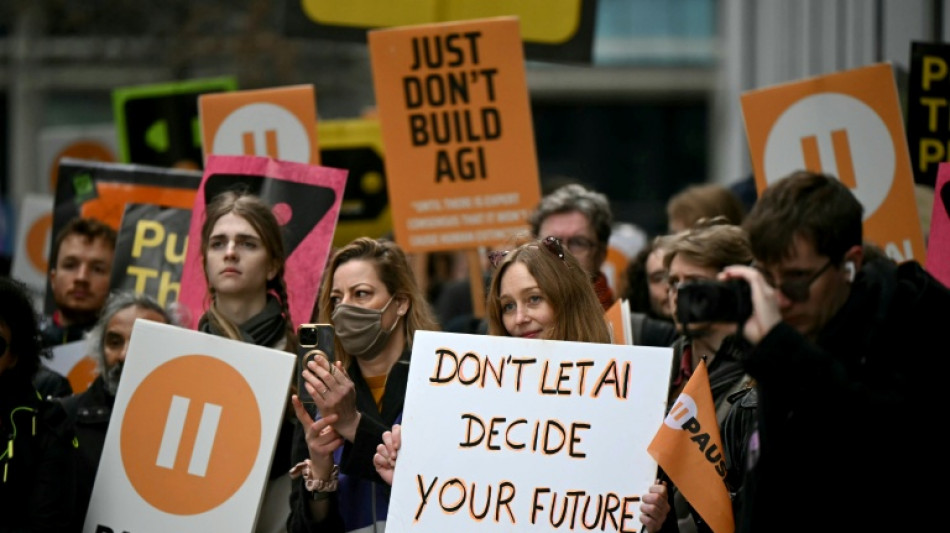
'My job is going': UK workers squeezed out by AI / Photo: JUSTIN TALLIS - AFP

 Trump's new press secretary faces scrutiny over credentials

 PSG 'got lucky' to win Man City thriller, says Luis Enrique

 Real Madrid comeback stuns Roma as Mourinho enjoys happy reunion

 Shakhtar make winning start at new Champions League 'home'

 Hat-trick hero Barcola primed to shine for Liverpool: Iraola

 Villa put six past Fenerbahce in record rout

 US stocks fall after hot inflation report as leading AI shares tumble

 Government buildings torched in violent Albanian protests

 Wall Street grills Bank of America over money laundering fine

 Mekies extends contract as Red Bull team principal until 2031

 Indonesia rescues starved orangutan from fires: officials

 Real Madrid's Vinicius banned for Clasico after red card

 Restrictions expose Ukraine's Starlink dependency in Russia war: observers

 Espada out as Astros manager while Mattingly stays with Phillies
 Houthis say targeted Saudi oil giant Aramco, vow more attacks

 Govt takes control of Turkey's most-watched news channel

 FIFA to offer members $6.35-billion development fund windfall

 US consumer inflation hotter than expected as midterms loom

 INmune Bio Inc. and Quantum Computing Inc. Partner to Apply Quantum Optimization and AI to Advance Alzheimer’s Drug Research and Explore New Applications for XPro

 Hot US inflation data dents Wall Street stocks

 India sends 'cockroach' leaders to jail after protest

 'Sinners' director Ryan Coogler to reboot 'X-Files' for Disney

 Lufthansa wins contest for TAP Air Portugal stake

 AI worms, 'major' incident fears spur safety calls at industry summit
 Fuel shortage triggers queues on Indonesia's Bali island

When a client asked her a year ago to design a glossary to train an artificial intelligence system, translator Jessica Spengler realised she was going to train her own replacement.
"That was the day I really thought... my job is going," said the 52-year-old, who translates into English for German educational and historical organisations.
In the UK, where services account for around 80 percent of the economy, AI has become flexible, fast and inexpensive competition for many white-collar workers, with the impacts beginning to emerge.
The IMF estimated in 2024 that more than two-thirds of British workers perform tasks that AI could potentially carry out, making the country more exposed than many other advanced economies.
"Some publishers have offered me lower rates than I was getting 10 years ago," the Brighton-based Spengler told AFP, adding that she no longer receives requests to translate corporate press releases or user manuals, typically an "entry point" into the profession.
Instead, she is increasingly offered work proofreading machine-generated translations.
Translators "have to rewrite the whole thing, redo the translations, but they still only get paid the reduced rate," said Holly Parsons, a Spanish-to-English translator at the beginning of her career.
"It's hard as a translator to actually charge what the work is worth because people just don't want to pay it," the 24-year-old added.
She still earns most of her income working as a children's activity leader.
- Change of direction -
According to a report from Morgan Stanley, British companies that adopted AI cut their workforces by eight percent in the year to October 2025 -- more than in Germany, Japan or Australia.
Among the countries featured in the report, only the United States saw employment rise with AI.
"Film work has definitely been impacted by AI... it's really kicked us down," said Laura, 35, a director of photography in London, who preferred not to share her last name for professional reasons.
To escape the broader crisis hitting the film industry, she is retraining as an outdoor instructor in Dorset, southwest England, earning minimum wage.
After working on the short film "Mad Bills to Pay", which won an award at the Sundance Film Festival, 35-year-old Rufai Ajala also changed direction and is now training to become a plumber.
"I'm not going to rely on film as my main focus... I don't see it as a career option anymore where you can have stability," Ajala said, adding that the aim was to find an "AI-proof" career.
- 'Painful transition' -
"There is going to be sort of a painful transition process because new jobs will take time to emerge," said Bouke Klein Teeselink, an economics professor at King's College London.
He said it would require "a massive adjustment for society," which could mean "a big increase in unemployment."
According to one of his studies, professions most exposed to AI, such as software developers and data analysts, reduced job postings after the launch of ChatGPT in November 2022, particularly for entry-level positions.
The growth of AI comes as Britain already faces high levels of youth unemployment, with the war in the Middle East and an increased minimum wage weighing on hiring.
One in six Britons aged 16 to 24 is out of work, the highest level since 2014, according to official data.
Teeselink said, however, that another market dynamic is at play with AI: productivity gains could lead to lower prices, which in turn could stimulate demand and increase employment.
He said the UK was "reasonably well positioned" for the AI transition thanks to its high-quality universities, which are set to play a crucial role in "upskilling young people to use AI well."
H.Gonzales--AT