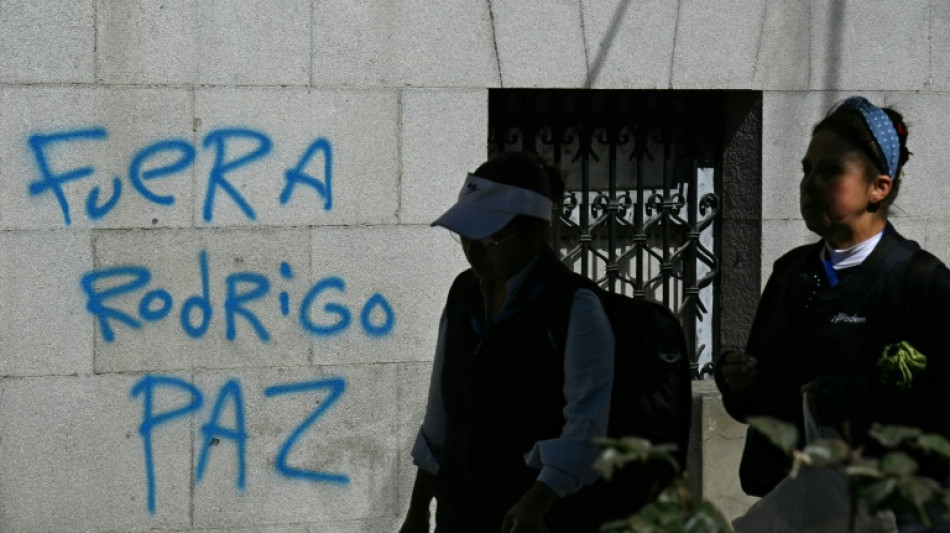
What's behind the social unrest in Bolivia? / Photo: AIZAR RALDES - AFP

 New four-lane bridge opens between China, North Korea

 Tech stocks lead rout after US inflation fuels rate hike bets

 'No time to recover': UNDP chief sounds alarm on growing poverty after Iran war shock
 Australia says won't let big tech have 'unfettered' access to kids

 Mobile clinics battle Mongolia's childhood dental 'disaster'
 Wallabies back Meredith as playmaker for second New Zealand Test
 Messi's Inter Miami book playoffs with 2-0 win over New York City
 Oil-rich Alberta tests Canada's unity with secession vote

 EU leaders head for showdown over bloc budget
 All Blacks make three changes for second Wallabies Test
 Spider Labs: 75.0% of Bot-Classified Ad Clicks Lacked Basic Browser Automation Signs

 PSG 'got lucky' to win Man City thriller, says Luis Enrique

 Real Madrid comeback stuns Roma as Mourinho enjoys happy reunion
 Shakhtar make winning start at new Champions League 'home'

 Hat-trick hero Barcola primed to shine for Liverpool: Iraola

 Villa put six past Fenerbahce in record rout
 US stocks fall after hot inflation report as leading AI shares tumble
 Government buildings torched in violent Albanian protests
 Wall Street grills Bank of America over money laundering fine

 Mekies extends contract as Red Bull team principal until 2031

 Indonesia rescues starved orangutan from fires: officials

 Real Madrid's Vinicius banned for Clasico after red card
 Restrictions expose Ukraine's Starlink dependency in Russia war: observers
 Espada out as Astros manager while Mattingly stays with Phillies

 Houthis say targeted Saudi oil giant Aramco, vow more attacks

"Out with Rodrigo Paz!" reads graffiti scrawled across the Bolivian capital just months after the center-right president entered office.
Pro-business conservative Paz took power in November following 20 years of socialist rule, pledging to end the country's worst economic crisis in decades.
But his policies have triggered bitter upheaval, with workers and Indigenous people taking to the streets in protest.
Police have used tear gas to block demonstrators from swarming government buildings in La Paz, where protest blockades have depleted food supplies and pushed prices up.
Analysts blame a combination of policy missteps and clashes with interest groups for the unrest.
- How did it start? -
Paz scrapped two-decade-old fuel subsidies that had drained the Treasury's international dollar reserves, but so far has failed to stabilize fuel supplies.
Prices doubled, and gas stations began selling adulterated fuel that damaged many vehicles.
The "dirty fuel" debacle sparked fury, especially among transport workers.
Another unpopular law -- since thrown out -- reclassified small agricultural holdings as medium-sized properties, which Indigenous communities viewed as a loss of their rights.
Campaigning on the promise of "capitalism for everyone," Paz had secured the support of rural and Indigenous communities known as "deep Bolivia," according to political scientist Adriana Rodriguez.
But they began to feel excluded after witnessing the president's "lukewarm" response to social issues, she said.
"Some sectors have taken radical positions, but others are mobilizing out of frustration following the expectations they had for Paz," said analyst and political science professor Daniel Valverde.
- What do the protesters want? -
There is no single individual leading the cross-societal protest movement.
"Everyone is pulling in their own direction, responding to certain interests and certain groups," according to Daniela Osorio-Michel, a political scientist at the German Institute for Global and Area Studies.
In 2025, inflation soared to 20 percent, prompting the country's largest trade union COB to demand a wage increase of the same percentage.
Political scientist Ana Lucia Velasco noted a golden opportunity for the opposition.
"There are political motivations to take advantage of the government's mistakes and missteps," she said.
As the movement gained traction, its key demand evolved into calling for Paz to resign.
The government has accused demonstrators of seeking to "disrupt the democratic order." On Wednesday, Paz announced a cabinet reshuffle in a bid to keep the peace.
- What about Evo Morales? -
The government accuses former socialist president Evo Morales of orchestrating the unrest.
"The government is deliberately polarizing and stigmatizing Evo Morales as the sole person responsible for everything that is happening," Velasco said.
Bolivia's first Indigenous president is accused of fathering a child with a 15-year-old girl while in office.
Morales rejects the allegations and has been hiding from the law in his central coca-growing stronghold of Chapare since late 2024.
He has also alleged that Washington and the US-backed Paz government are plotting his death.
Alluding to the role of Morales' heartland in Bolivia's cocaine trade, US Secretary of State Marco Rubio denounced the protests and said Washington would "not allow criminals and drug traffickers to overthrow democratically elected leaders in our hemisphere."
Valverde acknowledged Morales' mobilizing capacity but stressed that the socialist figure is "very entrenched."
"The results of the last election showed the population's disenchantment with him," said Osorio-Michel.
- What can the government do? -
The government has "very little" wiggle room, Velasco said.
"Once demands escalate to the point of calling for a resignation, there's no backing down. It becomes more of a war of attrition," she said.
Paz said his reshuffle would select ministers who could "listen" to the public's grievances.
He also announced an "economic and social council" where protest groups could have a say in official policy.
The protest's diversity and lack of clear-cut leaders make dialogue more challenging for the government, Osorio-Michel said.
"He (Paz) will have to take all sectors into account," said Valverde.
H.Gonzales--AT