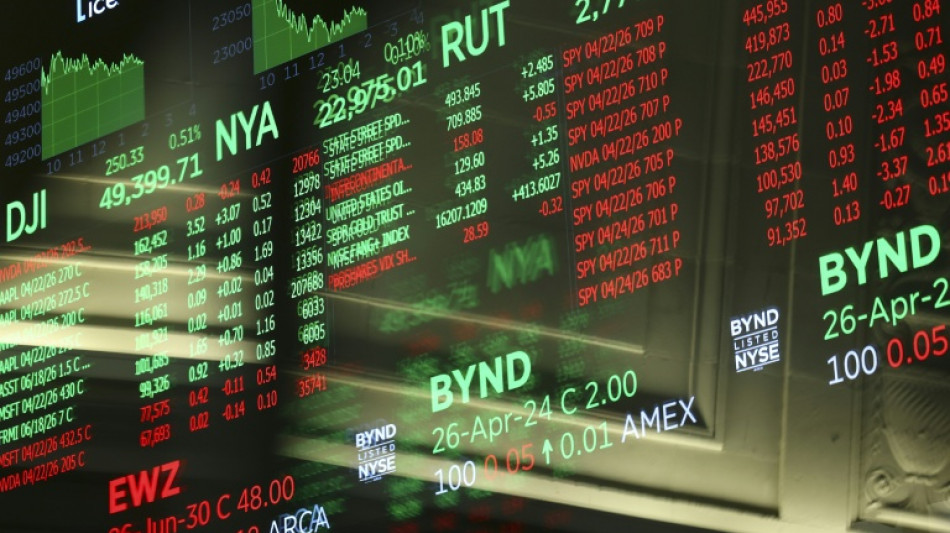
Musk's SpaceX is about to go public. Here's how it works / Photo: ANGELA WEISS - AFP/File

 Asian Cup in Saudi Arabia could be postponed but 'no hurry' to decide: AFC

 Conrad wields axe after South Africa loss to Australia

 School roof collapse kills teacher, 27 children in NW Pakistan

 Haze turns Indonesia skies orange, shuts schools in East Timor

 California puts first US billionaire tax to the vote
 School headscarf ban meets resistance in Austria

 World's top cocoa producer aims for a climate-tough bean

 Why is Shell facing lawsuits over climate disasters in Brazil and the Philippines?
 New four-lane bridge opens between China, North Korea

 Tech stocks lead rout after US inflation fuels rate hike bets

 'No time to recover': UNDP chief sounds alarm on growing poverty after Iran war shock

 Australia says won't let big tech have 'unfettered' access to kids
 Mobile clinics battle Mongolia's childhood dental 'disaster'

 Wallabies back Meredith as playmaker for second New Zealand Test

 Messi's Inter Miami book playoffs with 2-0 win over New York City

 Oil-rich Alberta tests Canada's unity with secession vote

 EU leaders head for showdown over bloc budget
 All Blacks make three changes for second Wallabies Test

 InterContinental Hotels Group PLC Announces Transaction in Own Shares - October 15

 Spider Labs: 75.0% of Bot-Classified Ad Clicks Lacked Basic Browser Automation Signs

 PSG 'got lucky' to win Man City thriller, says Luis Enrique

 Real Madrid comeback stuns Roma as Mourinho enjoys happy reunion
 Shakhtar make winning start at new Champions League 'home'

 Hat-trick hero Barcola primed to shine for Liverpool: Iraola

 Villa put six past Fenerbahce in record rout

Hundreds of companies raised a combined $70 billion by selling shares to the public in the United States last year.
If things go as planned, SpaceX -- which took a major regulatory step toward going public on Wednesday -- could surpass that figure itself.
And that's before additional potential stock market debuts by AI behemoths OpenAI and Anthropic.
So what exactly does it take for a company to "go public"? The process, known as an initial public offering or IPO, typically takes months or years and can cost millions of dollars.
Here is how it works:
- Picking a stock exchange -
The first big decision is where to list.
In the US, two options dominate: the New York Stock Exchange (NYSE) -- the oldest and most famous, with its iconic trading floor in lower Manhattan -- and the Nasdaq, a fully electronic exchange that is home to most of the biggest tech companies.
Together, they account for roughly half of the total value of all stocks traded worldwide.
Companies also have to pick a "ticker" -- the short letter code that identifies their stock.
Some keep it simple (MSFT for Microsoft), while others get creative (DNUT for Krispy Kreme donuts, CAR for rental company Avis).
SpaceX, according to its filing on Wednesday, intends to list on the Nasdaq with the ticker "SPCX."
- Hitting the road -
Before a company can sell shares to the public, it has to file a detailed document called an S-1 with the Securities and Exchange Commission (SEC), the US government agency that oversees financial markets and Wall Street's de facto referee.
The S-1 is essentially a deep dive into the company's finances, business model and risks, designed to help ordinary investors make informed decisions.
As JPMorgan puts it, it has "the dual purpose of registering the securities with the SEC and educating investors on the opportunity."
The SEC reviews the filing and can ask lots of questions.
"For an S-1 filing, that can sometimes go through several rounds of comments from staff, so it could take months," SEC Chairman Paul Atkins said recently.
He added that the agency is working to speed things up.
SpaceX filed its public S-1 on Wednesday, after reportedly submitting confidential paperwork in early April.
- The pitch -
Once the paperwork is underway, company executives hit the road -- literally. They travel city to city (and hop on video calls) in what is known as a "roadshow," pitching their company to big institutional investors like pension funds and hedge funds, as well as everyday retail investors.
SpaceX is planning a special event for 1,500 individual investors in June, according to CNBC.
Not every company makes it through this stage. Fintech firm Clear Street pulled the plug on its IPO plans in February after failing to drum up enough interest, blaming market volatility.
- Deciding on a price -
The trickiest part may be settling on a share price -- the cost of one piece of ownership in the company when it first hits the market.
"Pricing an IPO is probably more art than science," said Matthew Kenney, IPO specialist at Renaissance Capital.
Banks advising the company want to raise as much money as possible, but they also need to leave room for the stock to rise once trading begins -- otherwise, no one will want to buy it.
"If you really seek to maximize the share price, you're going to have very little aftermarket demand and the IPO can flop and nobody wants to be ringing the opening bell and see their stock price fall," Kenney said.
Sometimes companies get it wrong and have to adjust.
Chip startup Cerebras revised its target price twice before finally going public at $185 a share -- then watched the stock soar 68 percent on its very first day of trading.
E.Flores--AT