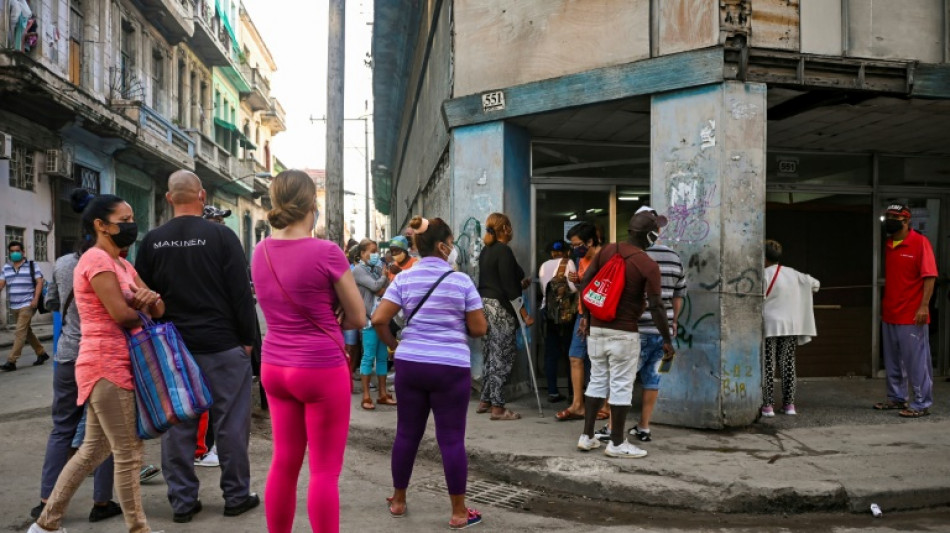
Cuba authorizes foreign investment in wholesale, retail / Photo: Yamil LAGE - AFP/File

 Oasis fans gather in Venice for band reunion film

 Two Nepal rescues revive hopes 10 days after flood
 Pogacar to miss worlds after season-ending Vuelta crash
 Greenwood, Guendouzi handed bans after Fenerbahce-Lyon brawl

 In Iceland, the mystery of the poet, the tomb and the Danish grocer
 Ratko Mladic: Bosnian Serb commander to convicted war criminal

 Bolivian army base blasts kill two, wound dozens
 Alcaraz, Sabalenka into US Open last 16 as Williams sisters lose on return
 Williams sisters fall in thrilling return to US Open doubles
 Bangladesh measles toll nears grim 1,000-child mark
 Bolivia farmers return to streets over diesel price hikes
 Tetris distances itself from controversial White House 'arcade' games
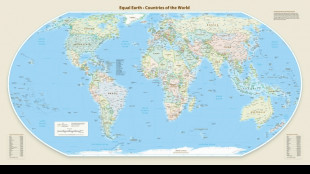 Africa bigger, US smaller - UN adopts new map

 Bad weather will not affect All Blacks, says captain Savea

 Mbappe misses penalty as Parrott lifts Betis past Real Madrid

 PSG still winless in Ligue 1 as Monaco go top

 Defending champion Alcaraz reaches last 16 at US Open

 Lyles ends season before Budapest due to injury flare ups
 US Republicans announce probe into environment groups

 Sabalenka survives despite 'tricky' weed smell at US Open

 S&P Revises Outlook on Freedom Holding Corp. and Core Subsidiaries to Positive
 Job growth but record-high diesel prices -- Trump's midterms mixed bag
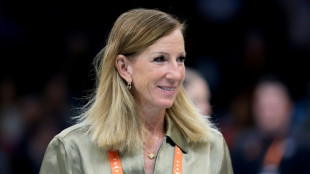 Women's NBA comissioner Engelbert to retire at season's end

 Luis Enrique extends contract as PSG coach until 2030

 Duplantis pulls out of Diamond League finals

The Cuban government has announced it will allow foreign investment in domestic wholesale and retail trade for the first time in 60 years, in a move aimed at addressing critical shortages of goods.
The decision could also give a boost to local industry, all without relinquishing state control over foreign trade.
"Foreign investment in wholesale and retail trade, with state regulation, will allow the expansion and diversification of supply to the population and will contribute to the recovery of domestic industry," Economy Minister Alejandro Gil tweeted Tuesday, expanding on an announcement made late the previous night.
Foreign investors would be allowed to fully own Cuban wholesalers for the first time since Fidel Castro's 1959 revolution, while retailers could enter into public-private ventures, according to deputy trade minister Ana Gonzalez Fraga.
Until now, foreign investment has been allowed only in the domestic production of goods and in the services sector.
The move to open up a sector hitherto controlled by the communist government is indicative of the difficulty state companies face in accessing foreign currency and raw materials.
This has aggravated severe shortages in basic goods such as food, medicine and fuel, and triggered rising discontent with the government that has prompted repeated protests in recent months.
There has also been rapid growth of informal trade in essential products, triggering consumer inflation which closed some 70 percent higher at the end of last year.
- Raw materials needed -
According to Cuban economist Mauricio Miranda Parrondo, "the state monopoly on foreign trade and retail is responsible for the shortage of consumer goods in the domestic market."
Gonzalez Fraga told state TV late Monday that the latest measure sought to ensure investment in "raw materials, inputs, equipment and other goods that can contribute to the development of domestic production."
Under US sanctions since 1962, Cuba began timidly opening up to private capital in the 1990s before fuller authorization in 2010 followed by a boom after a warming of ties with Washington under then-president Barack Obama.
In August last year, Havana gave the green light for small and medium enterprises to start operating on the island.
Months earlier, it had authorized private enterprise for the first time -- though that was limited to individual entrepreneurs, not businesses.
The reforms represent a major ideological shift in a country where the government and its affiliate companies have monopolized most of the economy for decades.
The country is battling its worst economic crisis in 30 years, fueled by toughened sanctions under the administration of Donald Trump and the fallout from the coronavirus crisis, which has hit Cuba's crucial tourism sector hard.
B.Torres--AT