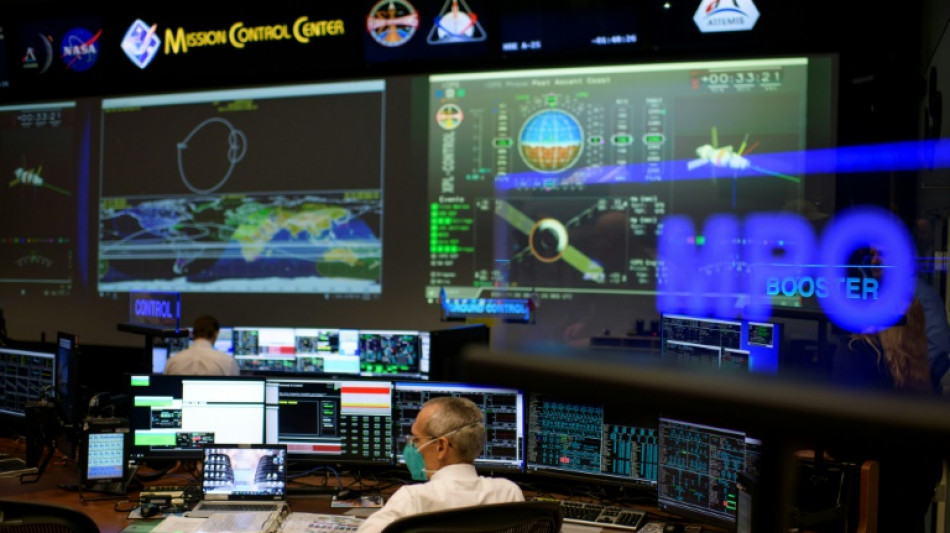
All systems go in Houston as NASA prepares return to Moon / Photo: Mark Felix - AFP

 Nepal tunnel rescue revives hopes 10 days after flood

 Indonesia rescues second orangutan mother and baby from wildfire

 Box office magnet Robert Pattinson appears in paedophile thriller

 How haze from Indonesian fires impacts Southeast Asia

 Trump sends envoys to Moscow, Kyiv with new plan to 'end war'

 'Mini-dictatorship': Students slam Argentina-run residence in Paris

 The disgraced banker stirring the pot in Brazil's Supreme Court

 Panama Canal begins reducing crossings due to El Nino

 Trump again seeks to remove protections for wolves

 'Getting there' - Alcaraz into US Open last 16 along with Sabalenka

 Isak ready to show world his quality, says Van Dijk

 Stuttgart cruise past Cologne to bounce back from Bayern thumping

 'Smart, aggressive' Alcaraz into US Open last 16

 Isak fires Liverpool to first win under Iraola at Ipswich

 Stocks slip as robust US jobs data stokes rate hike odds

 Mistrial declared in case of US woman who killed her three children

 Seville, Alfred win at Diamond League finals, Duplantis hit with injury

 Moody’s Assigns First-Time Insurance Financial Strength Ratings to Freedom Insurance and Freedom Life

 Trump says envoys taking plan to 'end the war' to Moscow, Kyiv

 US Football Hall of Fame revamps selection process

 Judge declares mistrial in case of US woman who killed her children

 Edgar Davids art thief misses sentencing after being 'knocked out by luggage'

 Pegula rallies to reach US Open fourth round

 Defending champ Sabalenka leads way into US Open fourth round

 Bayeux Tapestry 'virtually unchanged', UK museum says, after France spots broken threads

Rick LaBrode has worked at NASA for 37 years, but he says the American quest to return to the Moon is by far the crowning moment of his career.
LaBrode is the lead flight director for Artemis 1, set to take off later this month -- the first time a capsule that can carry humans will be sent to the Moon since the last Apollo mission in 1972.
"This is more exciting than really anything I've ever been a part of," LaBrode told journalists at the US space agency's Mission Control Center in Houston, Texas.
The 60-year-old confided to AFP that the eve of the launch is likely to be a long night of anticipation -- and little rest.
"I'm going to be so excited. I won't be able to sleep too much, I'm sure of that," he said, in front of Mission Control's iconic giant bank of screens.
Artemis 1, an uncrewed test flight, will feature the first blastoff of the massive Space Launch System (SLS) rocket, which will be the most powerful in the world when it goes into operation.
It will propel the Orion crew capsule into orbit around the Moon. The spacecraft will remain in space for 42 days before returning to Earth.
From 2024, astronauts will travel aboard Orion for the same trip, and the following year, at the earliest, Americans will once again step foot on the Moon.
For the duration of Artemis 1, a team of about a dozen NASA personnel will remain in Mission Control 24 hours a day. The center has been renovated and updated for the occasion.
Teams have been rehearsing for this moment for three years.
"This is a whole new deal -- a whole new rocket, a whole new spacecraft, a whole new control center," explained Brian Perry, the flight dynamics officer, who will be in charge of Orion's trajectory immediately following the launch.
"I can tell you, my heart is going to be tum tum, tum tum. But I'll work hard to keep focused," Perry, who worked on numerous space shuttle flights over the years, told AFP, tapping his chest.
- Moon pool -
Beyond upgrades to Mission Control for the mission, the entire Johnson Space Center is a bit over the Moon about Artemis.
In the middle of the giant astronaut training tank -- the world's largest indoor swimming pool at more than 200 feet long, 100 feet wide and 40 feet deep -- a black curtain has been erected.
On one side of the so-called Neutral Buoyancy Lab is a mockup of the International Space Station, submerged.
On the other, the lunar environment is gradually being recreated at the bottom of the pool, with giant model rocks made by a company specializing in aquarium decorations.
"It's only been in the last few months that we started to put the sand on the bottom of the pool. We just got that large rock in two weeks ago," said the lab's deputy chief Lisa Shore. "It's all very new for us and very much in development."
In the water, astronauts can experience a sensation that approaches weightlessness. To train for eventual voyages to the Moon, simulations must replicate the Moon's one-sixth gravity.
From a room above the pool, the astronauts are guided remotely -- with the four-second communications delay they will experience on the lunar surface.
Six have already done training and six more will do so by the end of September. The latter group will wear the new spacesuits made by NASA for Artemis missions.
"The heyday of this facility was when we were still flying the space shuttle and we were assembling the space station," explained the lab's office chief John Haas.
At that time, 400 training sessions with astronauts in full spacesuits took place every year, as compared with about 150 today. But the Artemis program has infused the lab with new urgency.
When AFP visited the facility, engineers and divers were testing how to pull a cart on the Moon.
- 'New golden age' -
Each session in the pool can last up to six hours.
"It's like running a marathon twice, but on your hands," astronaut Victor Glover told AFP.
Glover returned to Earth last year after spending six months on the International Space Station. Now, he works in a building dedicated to simulators of all varieties.
He said his job is to help "verify procedures and hardware" so that when NASA finally names the Artemis astronauts who will take part in crewed missions to the Moon (Glover could be on that list himself), they can be "ready to go."
Using virtual reality headsets, the astronauts can get used to walking in dark conditions at the Moon's South Pole, where the missions will land.
The Sun barely rises above the horizon there, meaning there are always long, dark shadows that impair visibility.
The astronauts must also get used to the new spacecraft like the Orion capsule, and the equipment on board.
In one of the simulators, seated in the commander's chair, personnel are trained to dock with the future lunar space station Gateway.
Elsewhere at the space center, a replica of the Orion capsule, which measures a mere 316 cubic feet (nine cubic meters) for four people, is in use.
"They do a lot of emergency egress training here," Debbie Korth, deputy manager of the Orion program, told AFP.
Korth, who has worked on Orion for more than a decade, said everyone in Houston is excited for the return to the Moon and for NASA's future.
"Definitely, I feel like it is like a new golden age," she said.
T.Sanchez--AT