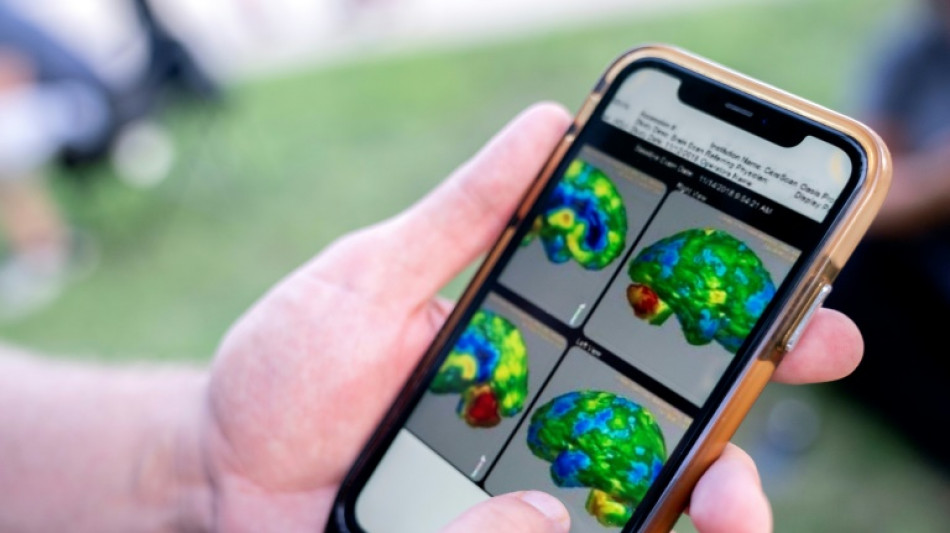
Study on serotonin and depression sparks fierce debate / Photo: Stefani Reynolds - AFP

 Alcaraz, Sabalenka into US Open last 16 as Williams sisters lose on return

 Williams sisters fall in thrilling return to US Open doubles

 Bangladesh measles toll nears grim 1,000-child mark

 Bolivia farmers return to streets over diesel price hikes

 Tetris distances itself from controversial White House 'arcade' games

 Africa bigger, US smaller - UN adopts new map

 Bad weather will not affect All Blacks, says captain Savea

 Mbappe misses penalty as Parrott lifts Betis past Real Madrid

 PSG still winless in Ligue 1 as Monaco go top

 Defending champion Alcaraz reaches last 16 at US Open

 Lyles ends season before Budapest due to injury flare ups

 US Republicans announce probe into environment groups

 Sabalenka survives despite 'tricky' weed smell at US Open

 S&P Revises Outlook on Freedom Holding Corp. and Core Subsidiaries to Positive

 Job growth but record-high diesel prices -- Trump's midterms mixed bag

 Women's NBA comissioner Engelbert to retire at season's end

 Luis Enrique extends contract as PSG coach until 2030

 Duplantis pulls out of Diamond League finals

 Defending champ Sabalenka, Pegula lead way into US Open fourth round

 UK hard-right party rallies behind leader after new donation scandal

 Nigeria's Dangote refinery looks to raise $1.6 bn in IPO

 Portugal extends talks to privatise national carrier TAP

 Brazil great Formiga says 2027 World Cup will 'change players' lives'

 Job growth, but surging diesel prices - Trump's midterms mixed bag

 Top seed Sabalenka powers into US Open fourth round

A controversy in the scientific community over a recent claims anti-depressants can be ineffective at treating depression has highlighted the difficulties in understanding mental health conditions.
One of the prevailing theories currently focuses on serotonin. Depression has been linked to a lack of the molecule, which is involved in transmitting emotions to the brain.
Claims that depression has no link to a chemical imbalance in the brain related to serotonin, casting doubt on the need for anti-depressants, have sparked fierce reaction.
A study by psychiatrists Joanna Moncrieff and Mark Horowitz in the journal Molecular Psychiatry in July concluded that there was no proven link between a lack of serotonin and depression.
The authors said it queried the underlying assumption behind the use of anti-depressants, which are mostly developed to alter serotonin levels, undoing a theory that for decades acted as a framework for research.
The study is based on several previous publications, but it quickly attracted criticism -- particularly its presentation by Moncrieff, known for her scepticism towards biological explanations of depression and her radical stance against the pharmaceutical industry.
"I'm broadly in agreement with the authors' conclusions about our current efforts, though I lack their adamantine certainty," psychiatrist Phil Cowen said on the Science Media Centre website.
"No mental health professional" would endorse the view that a complex condition like depression "stems from a deficiency in a single neurotransmitter", Cowen added.
- 'Mainstream' psychiatry -
Some peers have questioned the methodology, which measured an indirect trace of serotonin rather than taking direct measurements of the molecule.
Moncrieff, who wants to break with what she calls "mainstream" psychiatry, believes the serotonin theory still occupies an important, albeit less prominent, place in the profession.
"Even if leading psychiatrists were beginning to doubt the evidence for depression being related to low serotonin, no one told the public," the British psychiatrist wrote on her blog.
The connection between depression and serotonin is firmly rooted in the popular imagination. French author Michel Houellebecq gave the title "Serotonin" to his 2019 novel in which the main character is depressed.
Moncrieff's undermining of the serotonin theory to argue against current anti-depressants, going beyond the conclusions of her own study, has sparked the most vehement criticism.
Swiss psychiatrist Michel Hofmann told AFP her study was "serious" and contributed to expert debates about depression.
"But I don't think it is an article that should have any impact in the short term on the prescription of anti-depressants," he said.
Moncrieff has warned that anti-depressant treatment should not be suddenly interrupted. But for her, the benefits of a course of anti-depressants are doubtful if it is based on a discredited theory.
But many stress that the effectiveness of the treatments has been scientifically assessed, irrespective of the primary cause of depression.
The medicines used to treat depression "are usually many and ultimately, in most cases, we don't know what exactly makes a treatment effective", Hofmann added.
Debates on the role of serotonin only illustrate how difficult it is to understand the biological and social workings of an illness as complex as depression.
The challenges are forcing researchers to move away from models that are incomplete by their very nature.
"We are still at theories and we continue to search and test models against each other," Hofmann said.
T.Perez--AT