Misery and disease conquer Afghanistan a year into Taliban rule / Photo: Lillian SUWANRUMPHA - AFP

 Trump again seeks to remove protections for wolves
 'Getting there' - Alcaraz into US Open last 16 along with Sabalenka

 Isak ready to show world his quality, says Van Dijk

 Stuttgart cruise past Cologne to bounce back from Bayern thumping

 'Smart, aggressive' Alcaraz into US Open last 16

 Isak fires Liverpool to first win under Iraola at Ipswich

 Stocks slip as robust US jobs data stokes rate hike odds
 Mistrial declared in case of US woman who killed her three children

 Seville, Alfred win at Diamond League finals, Duplantis hit with injury

 Moody’s Assigns First-Time Insurance Financial Strength Ratings to Freedom Insurance and Freedom Life

 Trump says envoys taking plan to 'end the war' to Moscow, Kyiv

 US Football Hall of Fame revamps selection process

 Judge declares mistrial in case of US woman who killed her children

 Edgar Davids art thief misses sentencing after being 'knocked out by luggage'

 Pegula rallies to reach US Open fourth round

 Defending champ Sabalenka leads way into US Open fourth round
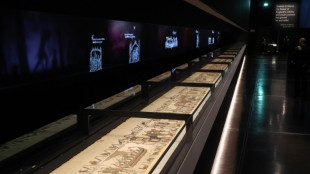 Bayeux Tapestry 'virtually unchanged', UK museum says, after France spots broken threads
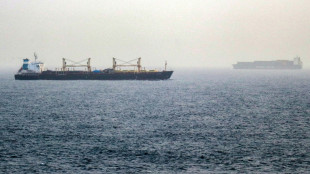 More than 120 killed in Yemen's worst clashes in years: sources

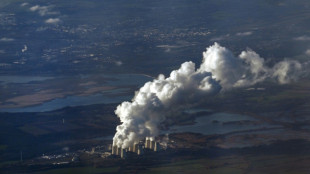 Germany hunts climate activist suspected of power grid sabotage

 5 EU countries aim to send rejected migrants to 'return hub' by 2027

 Argentina to return Nazi-looted painting to Jewish collector's heir
 Australian Simmons makes NBA comeback with Kings: reports
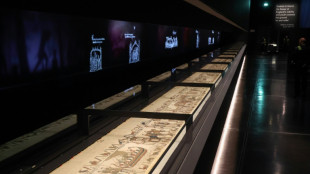 Two broken threads on Bayeux Tapestry, no major damage: French minister
 Meloni marks record in power with eye on 2027 elections
 Israel emptying West Bank refugee camps could be crime against humanity: UN

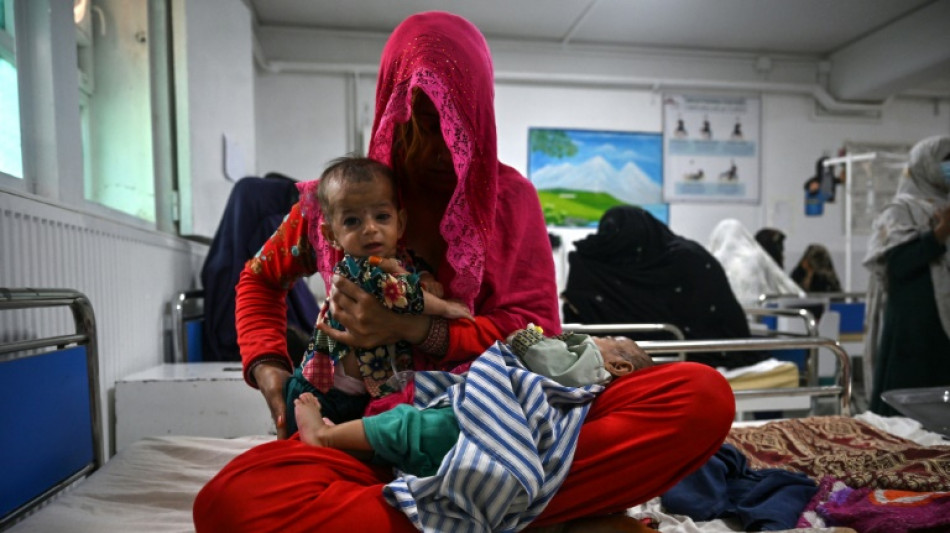
The heaving wards of a ramshackle clinic in southern Afghanistan are just one sign of the catastrophic humanitarian crisis that has gripped the war-ravaged country since the Taliban returned to power a year ago.
Last month, the Musa Qala District Hospital in Helmand province was forced to shut its doors to all except those suffering from suspected cholera.
The infirmary was soon jammed with listless patients, intravenous drips needled into their wrists as they recuperated on rusting gurneys.
Though the clinic lacks facilities to test for cholera, about 550 patients presented themselves within days, showing symptoms of a disease caused by a lack of basic sanitation needs: clean drinking water and an adequate sewerage system.
"It's very difficult," hospital chief Ehsanullah Rodi, run ragged on just five hours of sleep a night since the influx began, told AFP.
"We didn't see this from last year, or another year."
The United Nations says Afghanistan's humanitarian crisis is the world's worst.
- Hungry children -
Poverty in the country -- felt most keenly in Afghanistan's south -- has been driven to desperate new levels, exacerbated by drought and inflation since Russia's invasion of Ukraine.
"Since the Emirate (Taliban) came into power, we can't even find cooking oil," said one woman, perched on a hospital cot next to her malnourished six-month-old grandson in Lashkar Gah, Helmand's provincial capital.
"Poor people are squashed under their feet," the 35-year-old said.
Her grandchild is being treated for the fifth time at Boost Hospital, a sun-baked maze of paint-peeled buildings run jointly by the health ministry and Doctors Without Borders (MSF).
Many of the beds on the malnutrition ward host two tiny, frail patients -- some suckling gamely on syringes of milk, while others heave onerous breaths as they fight to regain their strength.
"We can't even find dry bread," said Breshna, the mother of another patient, who guesses her age at between 15 and 20.
"We haven't had anything to eat in three or four days."
Assistant nursing supervisor Homeira Nowrozi, fighting to be heard above wailing infants, said staff "have not any rest".
"We have a lot of patients that come in critical," she said, because parents could not afford to travel sooner.
"We don't know how many mortalities ... we have in the districts, because they didn't come to hospital."
- A moral tangle -
Afghanistan's plight began well before August 15, 2021 when the Taliban captured Kabul on the heels of a hasty withdrawal of US-led troops and the collapse of the government they propped up.
But the Taliban's takeover pushed the country -- home to 38 million people -- over the precipice.
The United States froze $7 billion in central bank assets, the formal banking sector collapsed, and foreign aid representing 45 percent of GDP stopped overnight.
Over the past year, would-be donors have grappled with the conundrum of funnelling fresh funding to the ailing nation, which the Taliban rebranded the "Islamic Emirate" in line with their austere theocratic beliefs.
"How do you provide assistance in a country where you don't recognise the government?" asked Roxanna Shapour of the Afghanistan Analysts Network.
Importing humanitarian aid to address crises such as the June earthquake -- which killed more than 1,000 people and left tens of thousands more homeless -- is relatively simple, she said, as it is "non-political, it's life-saving assistance".
Cash is also airlifted to fund food aid and healthcare, but development aid for long-term projects that could transform the economy is more complex.
"If you go in and say, 'I'm going to pay all teacher salaries', that's great. But then what will the Taliban do with the money they save from not having to pay teacher salaries?" asked Shapour.
- A souring mood -
In Musa Qala -- a dusty farming outpost with a shipping container bazaar staffed by child shopkeepers -- the deprivation is visible.
The local economy seems to barely subsist on motorcycle repairs, the sale of pallid poultry carcasses, and canisters of energy drinks kept tepid in grimy chest freezers.
The town witnessed some of the bloodiest chapters of the 2001-2021 war, and is connected to Lashkar Gah by a makeshift track up a desiccated riverbed lined with jagged rocks.
The road begins again further south at Sangin, a place where mud-walled compounds have been so badly ravaged by gunfire and artillery that they are crumbling back into the earth.
In a cruel irony, desperation and the demand for humanitarian services have only deepened with the arrival of peace.
"Now we can visit the hospital whether it's night or day," said Maimana, whose eight-year-old daughter Asia was being treated at Musa Qala.
"Before, there used to be fighting and mines -- the roads were blocked."
Helmand public health director Sayed Ahmad told AFP that the flood of new patients means there is "less space" and that "there are fewer staff, so there are difficulties".
Nevertheless, Ahmad -- a soft-spoken doctor whose office is lined with medical tomes -- insists "the overall situation is better" than under the previous government, when corruption was rife.
He blames economic sanctions against the Taliban for some of their woes, saying "the needs and demands of people have increased".
But analysts say the Islamists are far from blameless.
"The Taliban's repressive social policies have made it more difficult to reach a deal on getting those frozen assets unlocked," said International Crisis Group's Graeme Smith.
"This is really just about the emotions of policymakers -- and shutting millions of girls out of secondary schools really soured the mood."
- Unable to rule -
The Taliban flag now flies openly across Helmand province, staked on bullet-ridden buildings.
But after coveting control for two decades, they are ruling the nation at its most ruined.
One man in Lashkar Gah -- who asked not to be named -- offered his own scathing remark on the Taliban's ability to rule.
"The clothes of the government are too big for them," he said.
E.Hall--AT