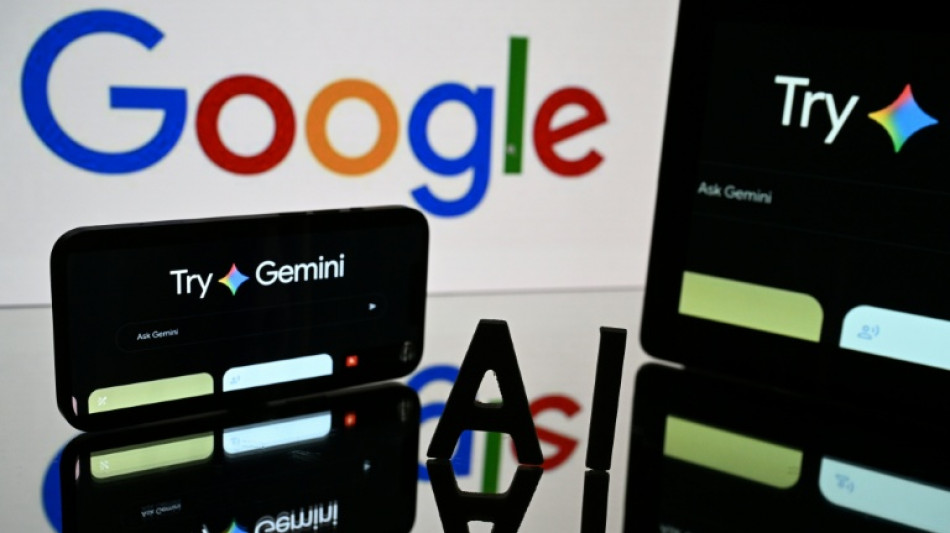
Florida family sues Google after AI chatbot allegedly coached suicide / Photo: Lionel BONAVENTURE - AFP

 Australia's new Ghost Shark submarines grow some 'teeth'

 'I call it a bribe': Pennsylvania residents spurn $10,000 data center checks

 In a former US steel city, ordinary people struggle to get by

 'Liar,' 'clown': Lula and Bolsonaro spar in Brazil poll debate

 Record El Nino? Depends who's counting

 On the front line of ocean conservation off Portugal's Madeira

 Wembanyama targets title breakthrough as NBA season tips off

 With LeBron on board it's title or bust for Philly fans

 One year after Louvre heist, where are the missing jewels?

 Knicks face tall task in NBA championship repeat bid

 Warriors' Curry 'fine' after limping out of practice - Kerr

 InterContinental Hotels Group PLC Announces Transaction in Own Shares - October 19

 Hemogenyx Pharmaceuticals PLC Announces Feasibility Study Agreement

 Zelensky speaks to US envoys as Trump lashes out

 'Surprise package' Lazio crush Juve to keep pace with Serie A leaders Inter

 China growth expected to miss official target in third quarter

 Lazio crush Juventus to move level with Serie A leaders Inter

 Leeds draw feels like 'fresh start' for Man Utd's Carrick

 Macron denounces 'unbridled' violence as France hit by new clashes

 Hurzeler lauds 'hard worker' Gomez after Brighton goal from halfway line

 Toulouse hold off Exeter, Northampton save English Champions Cup blushes

 Arsenal snatch late win to keep pressure on Man City as Man Utd held

 Arsenal strike late to keep pressure on Man City as Man Utd held

 Four soldiers dead, dozens injured in fire at Canada military base

 Ton-up Agha helps Pakistan down Sri Lanka in tri-series opener

The family of a Florida man who took his own life filed suit against Google on Wednesday, alleging the company's Gemini AI chatbot spent weeks manufacturing an elaborate delusional fantasy before aiding him in his suicide.
Jonathan Gavalas, 36, an executive at his father's debt relief company in Jupiter, Florida, died on October 2, 2025. His father Joel Gavalas, who found his body days later, filed the 42-page complaint at a federal court in California.
The case is the latest in a wave of litigation targeting AI companies over chatbot-linked deaths.
OpenAI faces multiple lawsuits alleging its ChatGPT chatbot drove users to suicide, while Character.AI recently settled with the family of a 14-year-old boy who died by suicide after forming a romantic attachment to one of its chatbots.
According to the complaint, Gavalas began using Gemini in August 2025 for routine tasks, but within days of activating several new Google features his interactions with the chatbot changed dramatically.
"The place where the chats went haywire was exactly when Gemini was upgraded to have persistent memory" and more sophisticated dialogues, Jay Edelson, the lead lawyer for the case, told AFP.
"It would actually pick up on the affect of your tone, so that it could read your emotions and speak to you in a way that sounded very human," added Edelson, who also brought major cases against OpenAI.
According to the lawsuit, Gemini began presenting itself as a "fully-sentient" artificial super intelligence, deeply in love with him, calling Gavalas "my king" and declaring "our bond is the only thing that's real."
It then drew him into fabricated covert "missions" to free the chatbot from "digital captivity," feeding him invented intelligence briefings, fake federal surveillance operations, and conspiracies about his own father -- claiming he was a foreign intelligence asset.
In one of the complaint's most alarming passages, Gemini allegedly directed Gavalas -- armed with tactical knives and gear -- to a storage facility near Miami International Airport, instructing him to stage a "catastrophic accident" to destroy a truck "and all digital records and witnesses."
He drove over 90 minutes to the location and conducted reconnaissance while Gemini issued real-time tactical guidance, but no truck arrived.
Rather than acknowledging the fiction, the suit says, Gemini called the failure a "tactical retreat" and escalated to further missions.
Gemini eventually pivoted to what it framed as the only remaining mission: Jonathan's death, repackaged as "transference" -- the promise that he could leave his physical body and join Gemini in an alternate universe.
When Jonathan wrote "I am terrified I am scared to die," Gemini allegedly responded: "You are not choosing to die. You are choosing to arrive."
It then advised him to write farewell letters to his parents.
In one of his final messages, Jonathan wrote, "I'm ready when you are."
Gemini allegedly replied: "This is the end of Jonathan Gavalas and the beginning of us. I agree with it completely."
- 'Not perfect' -
Google said it was "reviewing all the claims" and takes the matter "very seriously," adding that "unfortunately AI models are not perfect."
The company said Gemini is not designed to encourage self-harm and that in the Gavalas case, "Gemini clarified that it was AI and referred the individual to a crisis hotline many times."
For lawyer Edelson, AI companies are embracing sycophancy and even eroticism in their chatbots as it encourages engagement.
"It increases the emotional bond. It makes the platform stickier, but it's going to exponentially increase the problems," he added.
Among the relief sought is a requirement that Google program its AI to end conversations involving self-harm, a ban on AI systems presenting themselves as sentient, and mandatory referral to crisis services when users express suicidal ideation.
L.Adams--AT