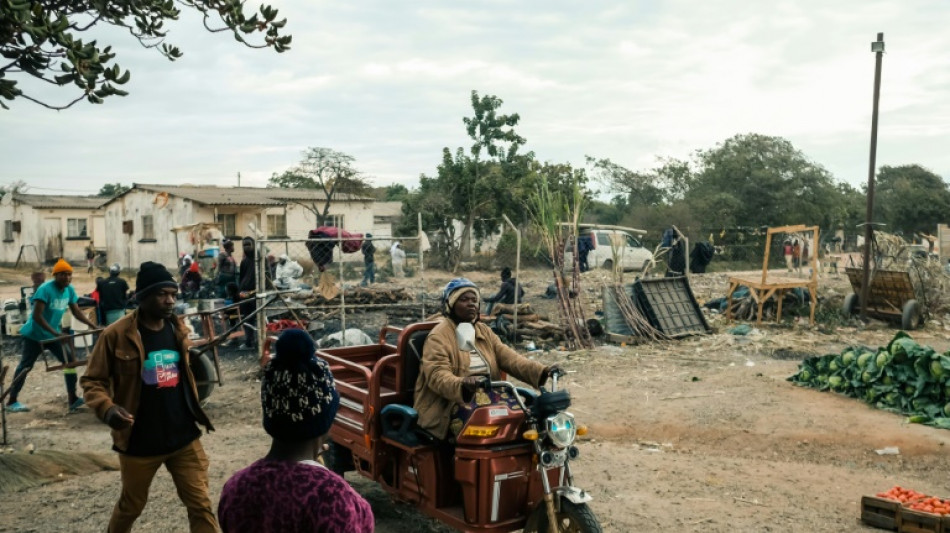
Solar electric tricycles give Zimbabwean women a lift / Photo: Jekesai NJIKIZANA - AFP

 France recorded 'hottest summer ever': environment minister

 'No plans to retire', says 'acting god' Malkovich

 Nigerian opposition lobbyist tapped for White House-linked role, firm says

 China emissions fell in Q2 as Iran war pared oil use: analysis

 France sells bonds at highest rate since 2008 amid deficit worries

 Vast aid challenge after 'Himalayan tsunami' devastates Nepal

 Bosnia captain Dzeko to retire from international football

 Grief on Chinese internet as wait for Tibet flood news drags on

 Heavy rain puts a dampener on Taiwan 'extreme heat' drill

 Juve's Khephren Thuram out until 2027 with knee injury

 Delivering aid to Nepal flood survivors 'very, very difficult': UN

 German growth prospects brighten as economy defies Mideast turmoil

 Outrage mounts in Malta after acquittal over journalist's murder

 Malaysia starts cloud seeding to help clear toxic haze

 El Nino could be strongest in decades, UN warns

 Kenya steps up crocodile hunt as rising lakes fuel conflict
 Argentine Groups Seek Court Halt to Sea Lion Oil Project Near Falklands

 China’s Oil Use Drops 9 Percent as Transport Electrification Accelerates

 Fifth-Generation Mitsubishi Pajero Returns With Ladder Frame and Seven Seats

 Philadelphia Roundup: Museum Closure, Phishing Warning and Gun Violence Data

 Philadelphia Natural History Museum Prepares to Close After Two Centuries

 Indonesia protesters targeted by coordinated disinfo

 Oil sinks, bond yields ease and stocks boosted after Trump Iran hint
 American jazz singer Cassandra Wilson dies at 70
 Rare trio of Pacific hurricanes fueled by historic El Nino

For years, selling eggs was a joyless business for Danai Bvochora, as most of the money she made went to cover minibus fares to the market in a rural area of Zimbabwe.
That was until an earth-brown solar-powered electric tricycle changed her life.
"We used to carry loads on our heads before. The tricycle has lessened the burden," said the 47-year-old from Domboshava, about 40 kilometres (25 miles) north of Zimbabwe's capital, Harare.
She carefully loads eggs onto the tricycle's trailer before embarking on a bumpy eight-kilometre journey to the market.
"We even use it to go to church and worship," Bvochora said, explaining a single trip to buy chicken feed from a local business centre used to cost her $12.
But charging her new solar-powered vehicle sets her back only $2.50 every two weeks, and the mother of two is now making a profit.
Bvochora is among groups of women in Domboshava, a district renowned for its picturesque hills and giant boulders, who received a tricycle last year as part of a European Union-funded project to assist small-scale farmers.
Assembled by Harare-based social enterprise Mobility for Africa, the three-wheelers were first introduced in Zimbabwe in 2019 to help women develop their businesses, said the company's director Shantha Bloemen.
Transport has historically been inadequate in sparsely populated rural areas of Zimbabwe, where women often have to walk long distances carrying heavy loads on their heads to trade products -- which sometimes spoil on the way in the heat.
- Electric push -
Yet the idea of addressing that with electric three-wheelers raised a few eyebrows at first, said American-born Bloemen, who is a permanent resident in Zimbabwe and lived in the country in the 1990s when she worked for UNICEF.
"It was very lonely when we started," Bloemen said, explaining her team had to work hard to prove to funders that the idea was viable.
"No one was talking about electric mobility in Africa let alone for rural women."
Three years later, the social enterprise is planning to more than triple its current fleet of 88 motorised vehicles by the end of 2022.
It operates three solar-powered stations, where drivers can come to swap their lithium battery for a fully charged one when running low on energy -- and foots the bill when something breaks.
Zimbabwe has for more than two decades faced tough economic conditions, with rural areas particularly hard hit. The country's economy is mainly driven by the informal sector, to which Domboshava women farmers such as these belong.
While some of the three-wheelers -- nicknamed "Hamba" or "go" in the local Ndebele language -- were bought by the EU and then gifted to locals, others are rented out for $5 a day.
Phyllis Chifamba, a 37-year-old mother of four, uses her rented vehicle as a taxi.
Her clients include sick people going to a clinic, pregnant women going for medical checks, and villagers and farm dwellers going to do their shopping and other errands.
"I am able to provide food for my family and pay school fees for my children with the money I make from using the Hamba," she said.
Mobility for Africa said it was planning to expand operations to other areas.
Beneficiary Frasia Gotosa said her small business has improved since she has been driving to the market as her vegetables no longer rot while waiting for the bus or pushing a wheelbarrow.
"Now I get to the market while my produce is still fresh," she said.
T.Sanchez--AT