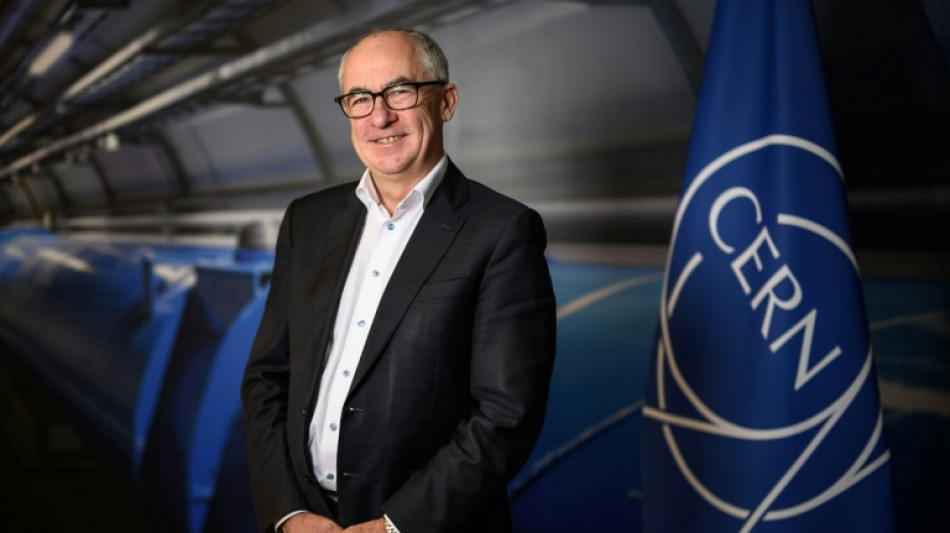
CERN chief upbeat on funding for new particle collider / Photo: Fabrice COFFRINI - AFP

 Top NBA Draft pick Dybantsa to miss opener with ankle sprain

 Italy sends troops, toughens security laws after Milan clashes

 Alberta separatists vow to fight on, risking turmoil for Canada

 Two men re-arrested for suspected spying for Iran in airbase scare: UK police

 Guatemalan man gets 30 years for truck smuggling deaths of 53 migrants

 'Clayface' gets under the skin of the superhero genre

 Zelensky, US envoys hold Oslo talks as Ukraine claims US missile holdup

 All-rounder Minhas stars as Pakistan crush England in tri-series

 Bavuma hits 179, Rabada strikes as South Africa dominate

 Allrounder Minhas stars as Pakistan crush England in tri-series

 Albania PM blames 'hybrid war' for week of unrest

 Bavuma hits 179 to lead South African fightback

 Solid GM results overshadowed by latest jump in commodity costs

 Houthi attacks undermine Saudi Arabia's economic ambitions

 French PM vows 'massive' police deployment for new demonstrations

 Power outage hits Google Cloud services, disrupting UK banks

 AI challenges maths by solving the unsolvable

 Turkey troops to stay in Syria, Iraq 'until border security ensured', defence minister tells AFP

 Kulusevski a 'different man' after emotional Spurs return

 Nawaz and Minhas lift Pakistan to 302-9 in England ODI

 Mourinho warns no 'untouchable' stars at Real Madrid

 Indonesian anger builds over wildfires, toxic haze

 Tamil Nadu and Puducherry Face Return of Very Heavy Rain

 James Maddison Leads Tottenham to First League Victory of Season

 Tamil Nadu Adds 25 State-Funded Workdays for Eligible Rural Households

Mark Thomson, the new head of Europe's physics laboratory CERN, voiced confidence Tuesday about raising the billions of dollars needed to build by far the world's biggest particle accelerator.
CERN, the European Organization for Nuclear Research, seeks to unravel what the universe is made of and how it works.
The planned Future Circular Collider (FCC) would be a proton-smashing ring with a circumference of 91 kilometres and an average depth of 200 metres.
Scientists believe that ordinary matter -- such as stars, gases, dust, planets and everything on them -- accounts for just five percent of the universe.
The FCC will try to reveal what makes up the other 95 percent, the so-called dark matter and dark energy that scientists have yet to observe directly.
"That project would start operation in the second half of the 2040s," Thomson told reporters.
The British particle physicist took over as CERN's director-general on January 1.
He said the gigantic collider would cost around $19.5 billion.
"About half of that comes out of the existing ongoing budget, and we have to find the resources for the other half," he said.
"I'm very optimistic personally, but it's not going to be straightforward."
In December, in a first for the laboratory, private donors pledged $1 billion towards the construction of the FCC.
"They're not expecting anything in return. This is really for the good of science," said Thomson.
- 'Giant leap forward' -
Based on the outskirts of Geneva, CERN has 25 member states and its council is set to take a decision in 2028 on whether to go ahead with the FCC.
For now, CERN's Large Hadron Collider (LHC) is currently the world's biggest particle accelerator, whizzing particles into each other at phenomenal speeds.
The 27-kilometre proton-smashing ring, running about 100 metres below France and Switzerland, has, among other things, been used to prove the existence of the Higgs boson.
Dubbed "the God particle", its discovery in 2012 broadened science's understanding of how particles acquire mass and earned physicists Peter Higgs and Francois Englert the 2013 Nobel Prize for Physics.
The LHC is expected to have fully run its course by around 2040.
It is set to resume operations in February after a winter break, before shutting down again in June.
It will then undergo upgrades, including more powerful focusing magnets and new optics, becoming the High Luminosity LHC (HL-LHC), aimed at conducting more detailed studies thanks to an increased number of collisions.
"This is technology we just didn't have when we designed the LHC," said Thomson.
"We're going to have a brighter machine, so we get much, much more data, and every bit of data we get, we have a clearer image of what's going on.
"This is really an opportunity for discovery. And I'm not sure what we will discover.
"Sometimes you make small steps in science. This is not a small step. This is a giant, giant leap forward."
M.White--AT