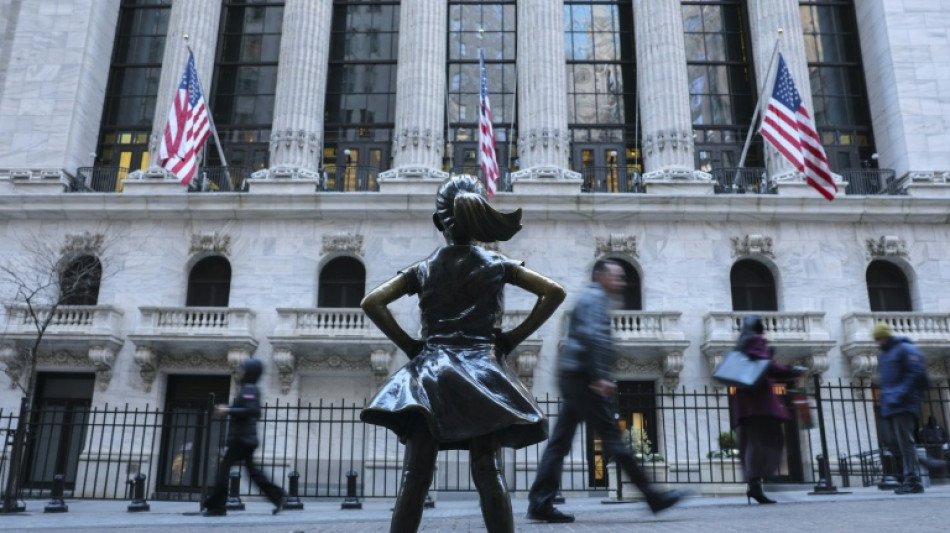
Wall Street intends to stay open around the clock / Photo: ANGELA WEISS - AFP/File

 Zelensky, US hail 'productive' talks to end Trump feud

 'Unbelievable' Foden back in the groove with treble in Man City rout

 Pistons rally to beat Celtics in NBA 2026-27 season opener

 PSG late show downs Barca in Champions League, Liverpool fight back

 Liverpool strike back to beat Villarreal in seven-goal thriller

 Dow boosted as markets rotate from tech shares

 Zelensky hails resumption of US advance warning of strikes on Ukraine

 Carrick says only wins can ease doubts over Man Utd future

 Top NBA Draft pick Dybantsa to miss opener with ankle sprain

 Italy sends troops, toughens security laws after Milan clashes

 Alberta separatists vow to fight on, risking turmoil for Canada

 Two men re-arrested for suspected spying for Iran in airbase scare: UK police

 Guatemalan man gets 30 years for truck smuggling deaths of 53 migrants

 'Clayface' gets under the skin of the superhero genre

 Zelensky, US envoys hold Oslo talks as Ukraine claims US missile holdup

 All-rounder Minhas stars as Pakistan crush England in tri-series

 Bavuma hits 179, Rabada strikes as South Africa dominate

 Allrounder Minhas stars as Pakistan crush England in tri-series

 Albania PM blames 'hybrid war' for week of unrest

 Bavuma hits 179 to lead South African fightback

 Solid GM results overshadowed by latest jump in commodity costs

 Houthi attacks undermine Saudi Arabia's economic ambitions

 French PM vows 'massive' police deployment for new demonstrations

 Power outage hits Google Cloud services, disrupting UK banks

 AI challenges maths by solving the unsolvable

The closing and opening bells of the New York Stock Exchange (NYSE) may become a ringing ritual of yesteryear, as the market moves toward nonstop trading.
This week, the Intercontinental Exchange announced it is developing a platform for 24/7 operations that offers "instant settlement."
The around-the-clock operations would rely on digital tokens mirroring the shares of listed companies, the NYSE's parent company said in a statement.
NASDAQ, another New York-based trading exchange, could follow suit as early as this year.
The move is pending approval by federal regulators at the US Securities and Exchange Commission (SEC), and would amount to a minor revolution for the way money moves in US stock markets.
- 'Waste of time' -
In the early days of the exchange, investors had to be physically present in markets on Wall Street to "stand and yell at each other and wave pieces of paper, and then they would have to write down what everybody bought and sold," Sam Burns, chief strategist at Mill Street Research, told AFP.
That meant "having trading go on all day every day would sort of be impossible to keep up with," Burns said.
Digitized transactions can change all that.
Off-hours trading has already been on the rise since 2019, exploding since 2024 when the daily average topped $61 billion, according to a NYSE report in early 2025.
But the appeal remains limited, according to Steve Hanke, a professor of applied economics at Johns Hopkins University.
"Historically, there is little evidence that supports the idea that the benefits of 24-hour trading outweigh the costs," he said, adding that there "are few market-moving events that occur outside of normal business hours in New York City."
"Night trading proved to be a waste of time," he said.
Hanke said the real advantage in the NYSE's announcement lies in the time needed to finalize a trade -- a process that usually occurs the next day in most stock markets.
"Narrowing the settlement window may prove to be a significant competitive advantage," Hanke said.
- Attracting the young and foreigners -
As host to immense market caps, the US market remains the largest in the world, but competition is growing.
Last year, many European indexes generated returns that outpaced their US counterparts.
With extended hours, Wall Street may be able to attract smaller investors and those outside the Americas.
Nearly 18 percent of US shares belonged to non-US holders in 2024, according to the US Treasury's most recent available figures.
And fans of cryptocurrency trading may jump into stocks, said Burns, the Mill Street Research strategist.
"A lot of retail investors nowadays, particularly younger ones, seem to like the idea of being able to trade stocks all the time the way they do cryptocurrencies and other digital assets, whether it's nights or weekends," Burns said.
It is unlikely that the change would move traditional investors from banker's hours because the impacts of any change are likely to be limited," Burns added.
"Most institutional investors that trade the real money aren't really interested in working or trading on the weekends, and the fact (is) that banks are mostly still closed on the weekends," Burns said.
S.Jackson--AT