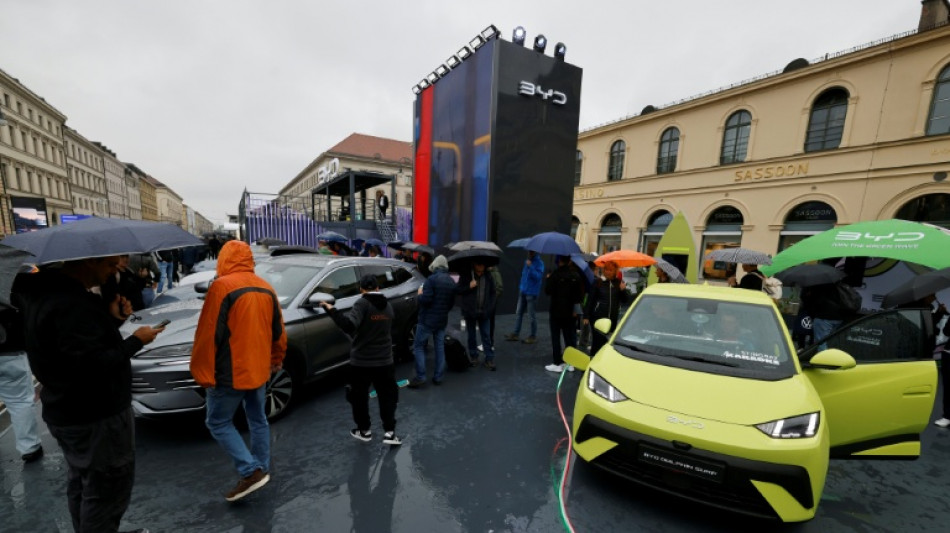
EV sales rebound in Germany as Chinese brands make inroads / Photo: Alexandra BEIER - AFP

 Judge orders Meta to pay $25 bn to New Mexico in Cambridge Analytica case
 Champagne puts cork in project to expand production area

 Canadian publisher says novelist Orelien used AI to write novel

 Trump faces fresh questions over ties to 'humanitarian' Putin

 Hansen back in Ireland squad for Nations Championship

 Kremlin sees little 'substance' in Ukraine peace ideas
 Top Arab-Israeli election candidate tells AFP Netanyahu win would be 'catastrophe'

 South African rugby player's death due to 'aortic dissection'

 France's Macron lands in Riyadh on surprise 'solidarity' visit

 Around the world, far right blames immigrants for French protests
 South Africa eases fuel pain as growth slows

 Woody Allen shoots new movie in Madrid

 Nvidia's Huang urges Europe to go all in on AI

 Five things to know as French bond yield tops 5%

 'Complete threat' Ngumoha excites Liverpool captain Van Dijk

 'The fishing's terrible': Deforestation devastates C.Africa river

 France's tourism sector worried about impact of riots

 Macron takes aim at Trump for using France riots for election gain
 North Korea says 'new firepower units' in place, loudspeakers to return
 Indonesia leader hits out at market downgrade warning

 Macron slams 'stupid' comments based on AI videos by leaders on France riots

 'Public health crisis': Indonesians seek fire relief from state

 British Museum sells second set of Bayeux exhibition tickets

 Australian lawmaker loses both legs after 'targeted' attack

 UK approves drilling in controversial Jackdaw gas field

Electric vehicle sales rebounded strongly in Germany in 2025, official data showed Tuesday, with Chinese manufacturers making inroads from a low base in the EU's largest economy despite tariffs.
EV sales rose 43.2 percent last year to 545,142 in total, the KBA federal transport authority said, representing 19.1 percent of all new cars sold.
Chinese EV giant BYD -- which last year overtook Elon Musk's Tesla to become the world's largest electric carmaker -- saw its German sales rise over 700 percent to more than 23,000 cars, giving it 0.8 percent of the overall auto market.
"International vehicle manufacturers with affordable battery electric vehicles and plug-in hybrids have contributed disproportionately to growth in these segments," said Imelda Labbe, head of the VDIK foreign carmakers' lobby in Germany.
The European Union in 2024 introduced higher tariffs on Chinese-made electric cars, alleging that they benefitted from unfair subsidies.
That has not stopped sales of Chinese cars rising across the bloc, with the country's carmakers keen to crack foreign markets amid cut-throat competition at home.
- Electric troubles -
Rising EV sales are also some rare good news for Germany's beleaguered carmakers, which have invested heavily in the technology in recent years, and are seeking to comply with European Union environmental rules.
Though the European Commission in December proposed scrapping a planned 2035 ban on new combustion-engine vehicles, carmakers would still have to cut emissions by 90 percent from 2021 levels under its latest plan, and need to see dramatic sales growth.
The rise in EV sales last year comes after a fall of almost 30 percent in 2024 following the withdrawal of government subsidies, and Germany's electric car market is still smaller than optimists had hoped for.
"We haven't seen a real boom yet," EY analyst Constantin Gall said.
"The hoped-for surge in e-mobility in Germany is proving to be much more protracted and difficult than expected."
After the decline in the market in 2024, the government said in December it would introduce subsidies again.
Some motorists will be able to benefit from 5,000 euros ($5,855) for the purchase of new EVs or hybrids so long as their components are largely made in Germany.
But industry figures say that better charging infrastructure and cheaper power would be needed to really boost EVs and warned that the planned subsidy would have limited impact.
"The state subsidies will only be available to households on low and middle incomes," Gall said. "But it is high-earners who tend to buy new electric cars."
- Tricky times -
Weak sales at home have compounded the challenges facing Germany's car industry.
It was already contending with the costs of investing in EVs and cratering sales in key market China even before US President Donald Trump last year slapped tariffs on cars and auto parts.
Volkswagen, Europe's largest carmaker, is in the process of cutting 35,000 jobs in Germany by 2030 under a deal reached with unions in a bid to slash costs.
Overall car sales in Germany rose just 1.4 percent last year to about 2.9 million vehicles, the KBA said -- roughly 750,000 fewer than were sold in 2019 before the Covid pandemic and Germany's economy sank into stagnation.
"The weak economy, increasing job insecurity and the multitude of political, social and economic crises are taking their toll," Gall said.
N.Mitchell--AT