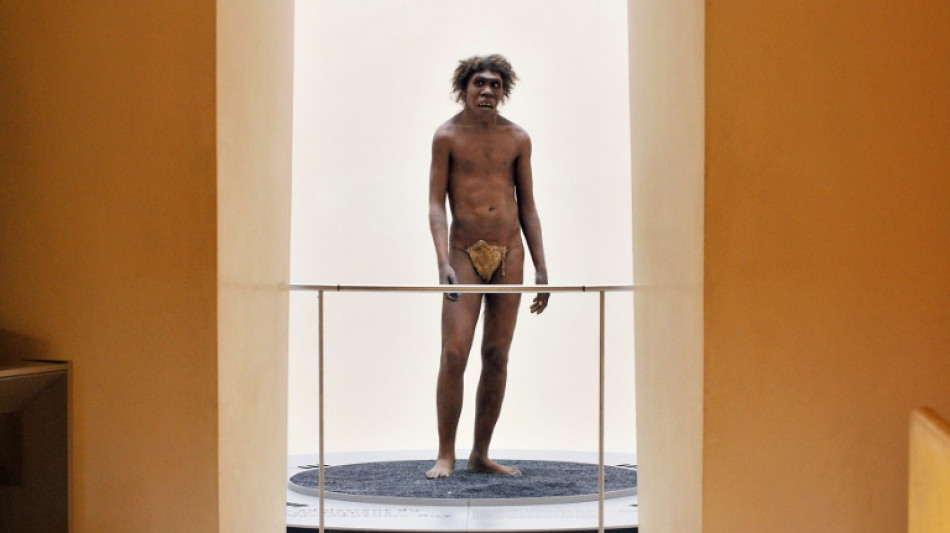
Fossils discovered in Morocco shed light on our African roots / Photo: PIERRE ANDRIEU - AFP/File

 Germans vote in elections threatening fresh blow to Merz

 US fears rapid escalation in Mideast after Houthis attack Riyadh

 Japan triathlete Hojo wins first gold of Asian Games

 IOC president impressed by 'beautiful' Asian Games wooden huts

 First Asian Games gold goes to Japan as China's 13-year-old Yu lights up pool

 Data centre command hub keeps AI up and running

 Pope Leo in France: the issues on the table

 Packing for a pope: behind the scenes on foreign trips

 Republicans find transgender issues a powerful political weapon in midterm campaigning

 German state elections threaten new shock waves for Merz

 Chile's Bachelet quits race to be next UN chief

 Raphinha treble fires perfect Barca to win at Sevilla

 Thiam makes winning heptathlon return at Decastar meet

 Czechs beat USA to qualify for Davis Cup finals

 Dortmund sink Stuttgart to climb to Bundesliga summit

 Trump says will not tolerate attempts to slow AI growth

 'It has to stop': runners protest women's murders in S.Africa district

 Fire erupts near Riyadh airport as Houthis claim strikes

 Cuba works to restore power after another blackout

 England thrash Sri Lanka again to return to top of T20 rankings

 Arsenal thrashed by Brighton, sorry Spurs lose again

 South Korea, Austria qualify for Davis Cup finals

 Seare shocks Ingebrigtsen to win world 5km gold

 Brigitte Bardot widower slams sale of star's belongings

 Aston Villa compound Tottenham's misery despite late rally

Where did our species first emerge? Fossils discovered in Morocco dating back more than 773,000 years bolster the theory that Homo sapiens originally appeared in Africa, scientists said in a study Wednesday.
The oldest Homo sapien fossils, dating from over 300,000 years ago, were found at the Jebel Irhoud northwest of Marrakesh.
Our cousins the Neanderthals mostly lived in Europe, while more recent additions to the family, the Denisovans, roamed Asia.
This has prompted an enduring mystery: who was the last common ancestor of Homo sapiens and our cousins, before the family tree split off into different branches?
This divergence is thought to have occurred between 550,000 and 750,000 years ago.
Until now, the main hominin fossils from around that time period were found in Atapuerca, Spain.
They belonged to a species dubbed "Homo antecessor", dated back around 800,000 years ago, and had features that were a mix of the older Homo erectus and those more similar to Homo sapiens and our cousins.
This sparked a contentious debate about whether our species originally emerged outside of Africa, before returning there.
There was "a gap in the fossil record of Africa", French paleoanthropologist and lead study author Jean-Jacques Hublin told AFP.
The research published in the journal Nature fills that gap by finally establishing a firm date for fossils discovered in 1969 inside a cave in the Moroccan city of Casablanca.
Over three decades, a French-Moroccan team unearthed hominin vertebrae, teeth and fragments of jaws that have puzzled researchers.
A slender lower jawbone discovered in 2008 proved particularly perplexing.
"Hominins who lived half a million or a million years generally didn't have small jawbones," Hublin said.
"We could clearly see that it was something unusual -- and we wondered how old it could be."
However numerous efforts to determine its age fell short.
- When Earth's magnetic field flipped -
Then the researchers tried a different approach.
Every once in a while, Earth's magnetic field flips. Until the last reversal -- 773,000 years ago -- our planet's magnetic north pole was near the geographic south pole.
Evidence of this change is still preserved in rocks around the world.
The Casablanca fossils were discovered in layers corresponding to the time of this reversal, allowing scientists to establish a "very, very precise" date, Hublin said.
This discovery eliminates the "absence of plausible ancestors" for Homo sapiens in Africa, he added.
Antonio Rosas, a researcher at Spain's National Museum of Natural Sciences, said it adds "weight to the increasingly prevalent idea" that the origins of both our species and the last common ancestor of Homo sapiens and Neanderthals/Denisovans lie in Africa.
"This work also suggests that the evolutionary divergence of the H. sapiens lineage might have started earlier than is conventionally assumed," Rosas, who was not involved in the research, commented in Nature.
Like Homo antecessor, the Casablanca fossils have a mix of characteristics from Homo erectus, ourselves and our cousins.
But while clearly closely related, the Moroccan and Spanish fossils are not the same, which Hublin said is a sign of "populations that are in the process of separating and differentiating".
The Middle East is considered to have been the main migration route for hominins out of Africa, however sinking sea levels at certain times could have allowed crossings between Tunisia and Sicily -- or across the Strait of Gibraltar.
So the Casablanca fossils are "another piece of evidence to support the hypothesis of possible exchanges" between North Africa and southwestern Europe, Hublin said.
A.O.Scott--AT